
Reworking the underground ‘Dikengyuan’ house
This Underground House of the Future stands in Zhangbian Township on the Loess Plateau of Henan Province, China, where a team from the University of Hong Kong has reexamined a centuries-old housing form through both traditional and modern construction methods — including large-scale 3D printing — along with community collaboration.
Designed by professors John Lin, Olivier Ottevaere, and Lidia Ratoi, the project was built with student volunteers alongside local masons. Their work adapts the regional ‘dikengyuan’ dwelling, an underground courtyard house excavated directly into the loess soil. The project explores how this long-standing architectural system can respond to shifting climate patterns while supporting social life in a rural village.
images courtesy Olivier Ottevaere
Living Below the Agricultural Landscape
Across the Loess Plateau, families have long shaped dwellings by digging rectangular courtyards roughly six meters into the ground. Rooms carved laterally from the earthen walls form a ring of vaulted chambers around an open void. The arrangement preserves the cultural importance of courtyard living while leaving the surrounding ground surface available for agriculture.
The Underground House of the Future builds upon this relationship between land and habitation. Even as concrete houses and factories appear above ground across the region, underground homes remain in seasonal use. The thermal mass of the earth maintains stable interior conditions through summer heat and winter cold.
the Underground House of the Future transforms a traditional dikengyuan courtyard dwelling
Climate Pressure and the Need for Adaptation
That equilibrium has been challenged in recent years. Extreme rainfall in 2021 brought flooding across the region, overwhelming drainage systems that had served the underground villages for generations. Walls collapsed and many houses were abandoned after the storms.
The Underground House of the Future emerged through a collaboration between the Hong Kong team, the Mingde Project Foundation, and local authorities in Zhangbian Township. Early surveys found that a large share of underground houses remained inhabited. The flooding transformed the question from preservation into adaptation.
The project became an opportunity to test how this typology could evolve under new climatic conditions.
A central participant in this process was Miss Zhu, the owner of the dwelling selected for intervention. Through social media she documents daily life in underground homes, drawing attention to a community that receives little economic benefit from nearby tourism developments. Together with the design team, she proposed shifting the house from a private residence to a shared venue for community gatherings.
a translucent tensile canopy filters sunlight across the courtyard gathering space
Courtyard as Amphitheater
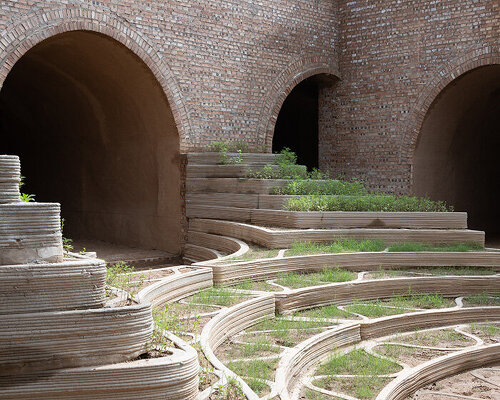
At the heart of the Underground House of the Future is its courtyard. The design reshapes this central void into a stepped amphitheater that accommodates weddings, funerals, and village ceremonies. Seating terraces double as circulation paths while guiding rainwater toward a newly designed drainage system.
The stepped surface was produced through robotic 3D printing in earth-based material, a technique tested alongside students during construction workshops. A perimeter drainage channel directs runoff into underground storage tanks for later reuse. Terraced planting areas absorb rainfall and support small-scale cultivation.
Above the courtyard, a lightweight tensile canopy stretches between the surrounding walls. Designed by Ottevaere, the fabric structure filters sunlight while keeping the space open to the sky. The translucent surface casts shifting patterns across the stepped seating during the day. An opening in the canopy accommodates a newly planted tree, lowered into the courtyard by crane, restoring vegetation lost during earlier flooding and honoring local feng shui traditions that associate underground houses with living trees.
the courtyard becomes a stepped amphitheater for weddings, funerals, and village gatherings
Vaults, light, and breezes
The rooms surrounding the courtyard maintain the logic of traditional cave dwellings while incorporating new structural techniques. Existing earthen chambers were reinforced with brick vaults constructed by local craftspeople. Builders shaped these vaults using a simple guide: a curved bamboo branch tied with string to establish the arch.
Daylight and ventilation reach deeper into the rooms through skylights and rear openings carved into the loess walls. These interventions transform conditions inside the house, where light enters as narrow beams and reflected surfaces brighten the earthen interiors. The experience of moving through the spaces shifts gradually from shadowed passageways to the open courtyard amphitheater.
Construction methods combined digital fabrication with vernacular building knowledge. Students conducted 3D scans and robotic printing experiments while local masons guided brick vault construction. The process created employment within the village and reinforced skills already present in the community.
robotic 3D-printing shapes terraced seating and integrated drainage in the central courtyard
brick vaulted rooms reinforce traditional earth caves while maintaining thermal mass
new skylights and rear openings introduce daylight and cross ventilation underground
the project was realized by professors and students from the University of Hong Kong with local masons
project info:
name: Underground House
architect: Professors at the University of Hong Kong
location: Henan, China
design team:
rooms, traditional brick masonry: John Lin
roof, tensile netting: Olivier Ottevaere
courtyard, robotic 3-D printing: Lidia Ratoi
project lead: Jenny Hsiao
project team: Anila Ma (HKU Horizons Mingde), Wilson Wu, Hayden Ng, Jiun-Yu Chang, Yiran Liu, and student volunteers from the HKU Department of Architecture, Department of Civil Engineering, and Master of Science in Advanced Architectural Design
construction: Anhai Liu with local masons and carpenters
robotic printing: Weiguo Xu, Tsinghua University
funding: Project Mingde Foundation
The post this ‘underground house of the future’ revisits ancient chinese cave dwellings appeared first on designboom | architecture & design magazine.