
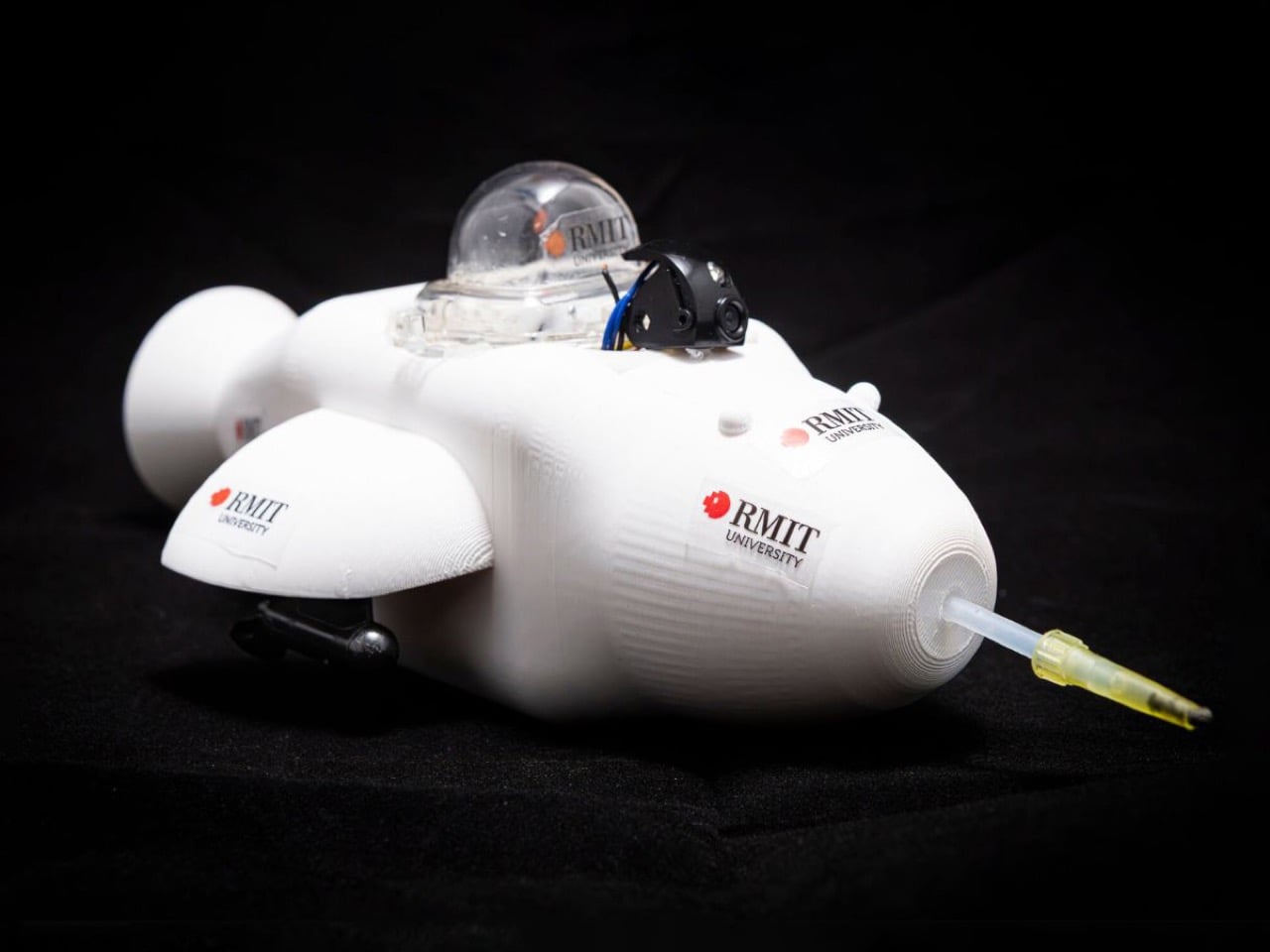
A sneaker-sized robot developed at RMIT University in Australia is making a compelling case for rethinking how humanity responds to one of the ocean’s most persistent threats. The “Electronic Dolphin” is a Wi-Fi-controlled minibot built to skim oil slicks from contaminated marine surfaces without deploying any chemical dispersants, and without putting human responders anywhere near the hazard. Detailed in the journal Small, the device is compact, remote-operated, and draws on one of nature’s more underrated structural templates to do its job. It is not the first machine built to address marine oil contamination, but it may be the first to approach the problem with this particular combination of biomimicry, material science, and autonomous ambition.
The secret is in the filter. Rather than relying on PFAS-based absorbents, which are toxic, persistent in the environment, and increasingly regulated worldwide, the RMIT team engineered a composite coating from specialized carbon layers and modified barium carbonate. The resulting material mimics the microscopic spine geometry found on sea urchins, forming tiny protrusions that trap air pockets in a precise architectural arrangement. That structure makes the surface simultaneously superhydrophobic and oleophilic, a combination that causes water to roll straight off while oil latches on and gets drawn in. The chemistry here is elegant in the way good materials science often is: solving a messy physical problem through surface geometry rather than reactive chemistry.
Designers: RMIT University
The filter sits at the robot’s nose, paired with a small onboard pump that actively draws the oil slick inward. In controlled laboratory tests, the prototype processed oil at roughly two milliliters per minute, achieving over 95% purity in the recovered material. The coating also demonstrated strong corrosion resistance when exposed to saltwater, and held up across multiple reuse cycles without meaningful degradation. Those numbers matter because reusability is one of the practical bottlenecks that has historically limited oil spill response hardware. A filter that survives repeated deployment in a corrosive marine environment is a filter worth scaling.
The current battery life runs to about 15 minutes, which is honest enough for a research prototype operating at this scale. The RMIT team is candid about the limitations, and equally clear about the trajectory. Future iterations are envisioned at dolphin scale, fully autonomous, and capable of operating in a continuous loop: skim the surface, return to a base station, drain the collected oil, recharge, and head back out. That remediation model borrows from how robotic vacuum cleaners normalized autonomous domestic cleaning, and it translates surprisingly well to open-water spill response, where the geography is hostile, the timeline is open-ended, and human supervision is expensive.
Marine oil spills remain one of the more intractable environmental disasters, not because the problem is poorly understood but because the cleanup tools available have lagged behind the scale of the damage. Dispersants break oil into smaller particles that sink rather than surface, which looks like cleanup but often relocates the harm. Booms and skimmers are manual, slow, and weather-dependent. The Electronic Dolphin does not solve all of that at once, but it represents a shift in the design logic: autonomous, chemical-free, biomimetically informed, and built from the start with continuous deployment in mind. That is the kind of thinking the problem has always deserved.
The post Meet the Electronic Dolphin, the Mini Robot That Cleans Oil Spills With Urchin-inspired Filters first appeared on Yanko Design.