
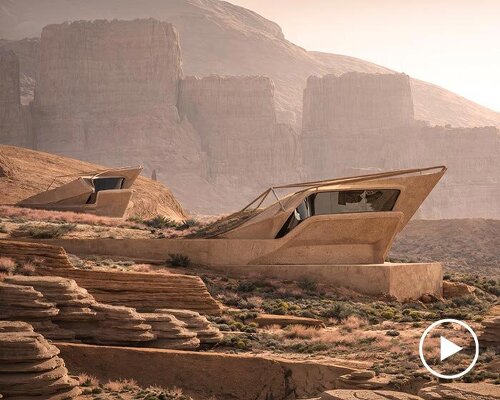
a residential observatory by VRANTSI in the canyonlands of Utah
The Desert Observatory House by Vrantsi is a conceptual residential observatory proposed for the canyonlands of the American Southwest. Located within the expansive desert landscape of Utah, the project explores how architecture can emerge from geological conditions rather than stand apart from them. The design interprets the surrounding mesas, cliffs, and stratified terrain through a series of elongated, low volumes that appear to rise from the ground like rocky outcrops. The architectural composition consists of several prism-shaped forms positioned across the site. Their inclined surfaces and sharp geometries reference the fractured rock formations found throughout the region. Instead of presenting a single dominant structure, the design distributes the building mass across the landscape, allowing the volumes to align with the natural slopes of the terrain.
Material selection plays a central role in the integration of the building with its environment. The project proposes the use of rammed earth, sourced from the local ground, as the primary construction material. This approach allows the surfaces to retain a textured appearance similar to eroded rock while reinforcing the visual continuity between architecture and landscape. Several portions of the structure are partially embedded within the desert terrain. This subterranean strategy reduces the visual presence of the building while also using the thermal mass of the earth to moderate interior temperatures. By combining exposed and buried volumes, the design creates thermally protected interior spaces suited to the extreme climate of the region.
all images courtesy of Vrantsi
desert observatory aligns with the natural slopes of the terrain
The project is conceived by Vrantsi design studio as both a residence and an observatory. The elongated volumes are strategically fractured with openings that frame views of the surrounding horizon. These apertures transform the building into a device for observing the desert landscape, directing views toward distant cliffs, open skies, and the expansive terrain. The residential program occupies approximately 150 sqm and is organized vertically through the terrain. Bedrooms are located within the semi-subterranean portion of the structure, where the ground provides insulation and protection. Communal living areas and observation spaces are positioned above, extending outward through projecting volumes that overlook the landscape. Circulation between levels is defined by an inclined interior slab, which connects the lower and upper areas while reinforcing the tectonic language of the design. This sloped surface establishes a continuous spatial transition from the protected underground spaces to the elevated observation zones.
The volumes are articulated through inclined planes, cantilevered edges, and fractured geometries. Rather than forming closed architectural objects, these elements emphasize the interaction between structure and terrain. Some parts of the building appear embedded in the ground, while others project outward or hover slightly above the surface. Through this approach, the project focuses on the relationship between architecture, geological form, and landscape perception. The composition interprets the desert terrain through architectural massing and material expression, establishing a spatial framework in which habitation and observation become closely connected.
the Desert Observatory House by Vrantsi is conceived as a residential observatory within the canyonlands of Utah
elongated volumes emerge from the terrain, referencing the rocky outcrops of the desert landscape
the design translates mesas and cliffs into a series of low, prism-shaped architectural forms
portions of the structure are partially embedded within the desert terrain
rammed earth is proposed as the primary construction material, sourced from the local ground
the textured surfaces recall the appearance of naturally eroded rock
inclined surfaces and sharp geometries echo the fractured formations of the surrounding canyonlands
cantilevered edges and fractured planes define the tectonic language of the project
project info:
name: Habitable Outcrop _ A Tectonic Interpretation of the Desert Landscape
architect: Vrantsi | @vrantsiandpartners
location: Utah, US
designboom has received this project from our DIY submissions feature, where we welcome our readers to submit their own work for publication. see more project submissions from our readers here.
edited by: christina vergopoulou | designboom
The post rammed-earth prisms emerge from the american desert to shape observatory house appeared first on designboom | architecture & design magazine.