
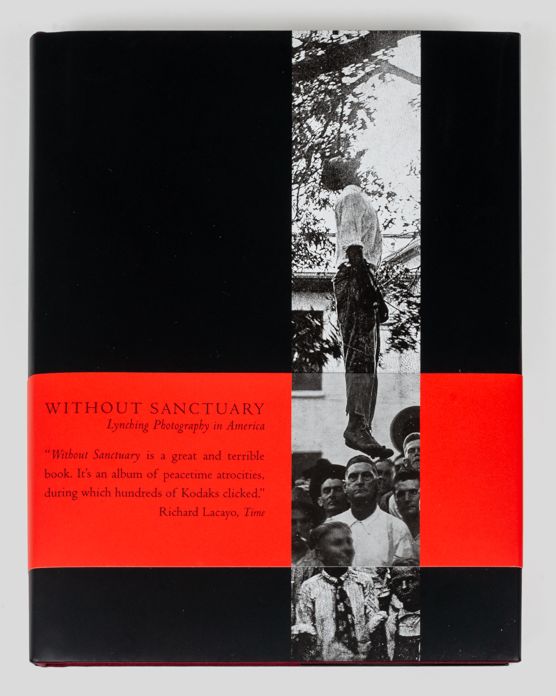
Editors’ Note: Images are never neutral—they carry cultural, political, and historical power that can shape how people understand reality. The following discussion of “Without Sanctuary: Lynching Photography in America” and the accompanying imagery reveals how photography has been used both to document truth and to reinforce harmful beliefs, reminding designers that visual work can influence public memory, identity, and social narratives. In an era of digital manipulation and AI-generated imagery, the responsibility of designers to create, present, and question visuals ethically is more critical than ever.
Many people today, despite the evidence, will not believe—don’t want to believe—that such atrocities happened in America not so very long ago. These photographs bear witness to … an American holocaust.”
John Lewis, US Congressman
The press person at Twin Palms warned me in advance that the images in Without Sanctuary were “harrowing” before she slid my review copy in the mail. She was not wrong. Harrowing doesn’t even begin to describe these photos of Black bodies, often burned and mutilated beyond recognition, dangling from broken necks. Undeniably gruesome, their value lies both in documenting a shameful past and in resurfacing a difficult but necessary American conversation. The Tuskegee Institute records the lynching of 4,743 people between 1882 and 1968, including 3,446 Black Americans, events that were often documented by photographers. But lynchings are not just an awful chapter from America’s past: as recently as 2020, three white men were convicted of violating Ahmaud Arbery’s civil rights when they chased him down with a pickup truck on a residential street outside Brunswick, Ga. His “crime?” Jogging while Black. The 25-year-old was out for a Sunday run through a mostly white neighborhood when he was murdered.
Without Sanctuary has been controversial since the image collection was first presented to the public in 2000 at the Roth Horowitz Gallery in New York, when Atlanta antique collector James Allen exhibited his trove of lynching postcards. A common observation during the show’s run was its tendency to stir up guilt about an inhuman practice that many white Southerners wanted to forget, leaving them to wonder if their ancestors participated in a lynching. (Black viewers of the photos may have wondered the same thing, from a different perspective.) Others questioned whether looking at such images was just voyeurism, a cheap dark thrill from a safe distance, and a further disservice to the victims—not unlike the crowds gathering to watch a lynching.
In Regarding the Pain of Others, Susan Sontag warns that photographs of suffering and particularly lynchings sometimes present a twisted vision of normalcy. The photographs in Without Sanctuary were not, at the time, created in outrage or protest; they were shot as ugly proof of white mob “justice” and shared in celebration, or as Leon F. Litwak said in his intro text, “the triumph of a belief system that defined one people as less human than another.” We see the images now as evidence of terrorism and brutality but this does not override the intent of their original creation. While it would be easier to sanitize these memories and just brush them aside as an anomaly, that would be a cowardly choice. As upsetting as it is to look, we must not look away.
Without Sanctuary’s photos, both of the victims and of the crowds who turned out to gawk at their grisly end, have a numbing sameness to them: the murdered Black men and women feel interchangeable, stripped of their individuality, one body barely distinguishable from another. The crowds of white faces are horrible in their bland ordinariness; they could be attending a carnival, a state fair, a church supper. They would be unremarkable, entirely forgettable, except for the fact that they came out to witness execution as public theater, as entertainment. It’s hard to find one person who looks upset in those crowds of spectators. They are a flattened mass of humanity, just a bunch of white Southerners hoping for some excitement on a lazy afternoon.
Columnist Philip Martin, writing in The Arkansas Democrat Gazette, observed:
One of the book’s most unsettling features is the lack of distance between viewer and crowd. The spectators in these images do not dissolve into the abstraction of “mob.” They stand plainly before the camera, settled, assured, often accompanied by children. Sunday clothes appear. Hats and belts sit comfortably. The body language suggests not chaos but order. The photographs refuse the relief of imagining an aberration. They show a social system operating as intended.
Philip Martin
The phrase “pictures or it didn’t happen” is quickly becoming meaningless because we don’t trust that the story images tell is true. What does this mean for documentary evidence showing an undeniable truth that might be dismissed by some viewers as just another visual falsehood?
Make no mistake: the photos in this book are real images of real events, supported by eyewitness and newspaper accounts. Grim physical souvenirs dispersed to participants and the crowd also support the truth of the atrocities: plate number 32 shows a 1930 postcard photo of the lynching of Thomas Shipp and Abram Smith, with a bit of one victim’s hair attached for good measure. Yet there are viewers who will not believe the veracity of these photos.
Part of the issue is: we all know that photos lie, and have lied, ever since the birth of the medium. The Spiritualist movement of the mid-19th century used double exposures to create false “spirit photos” claiming to show the presence of ghosts. In later years, photography both documented and distorted reality through physical retouching, digital manipulation, and now AI.
As generative AI matures, the visible clues of its deceptions are becoming harder to spot, leaving us with a digital record that mimics the truth while actively erasing it. When federal immigration agents shot and killed Renee Good and Alex Pretti in Minneapolis, the US government distributed an altered image relaying a provably false narrative. Genuine videos of the event were derided as fake, as though Americans can no longer distinguish between reality and fantasy and may not even care to draw the distinction.
Particularly disturbing is how much of the slop we currently see continues to harm and dehumanize Black people. Consider the altered image of Nekima Levy Armstrong, arrested in St. Paul for protesting at a church service. The civil rights attorney, activist, mother of four, and tenured law professor at the University of St. Thomas School of Law maintained a cool equilibrium and regal bearing as she was led to jail in shackles. That was the reality of the moment.
@Sec_Noem via X/@WhiteHouse via X
However, the White House manipulated her photo before posting it to its official social media account. Gone was her resolute calm. In this alternate reality, she is crying, her mouth open in a wail of anguish, hair disheveled, and her skin darkened. When Ms. Levy Armstrong first saw the photo the next day, she said she was “disgusted” because the alterations brought to mind lynching photos and racist propaganda from the Jim Crow era showing Black people as grotesque caricatures.
In another example seen earlier this year, the sitting president of the United States posted a jawdropping video clip to social media depicting former President Barack Obama and former first lady Michelle Obama as apes, just the latest in a government arsenal of offensive imagery and slurs aimed towards Black Americans. Quentin James, a co-founder of the Collective PAC, whose goal is to elect Black officials in America, compared the video to a digital minstrel show. He said, “This is the through-line from minstrelsy to Truth Social, and the intent is identical: to strip Black people of their humanity for political entertainment.”
Writer and critic Hilton Als addresses this consequence of racism head-on in his searing essay intro to the book:
Every black person is still a nigger, therefore vulnerable to lynching, in the eyes of the world, even when invited by white editors to write for this book. I’m assuming this aggressive tone to establish a little distance from these images of the despised and dead, the better to determine the usefulness of this project, which escapes me, but doesn’t preclude my writing about it. Too often we refuse information, refuse to look or even think about something, simply because it’s unpleasant, or poses a problem, or raises “issues”–emotional and intellectual friction that rubs our heavily therapeuticized selves the wrong way.
Without Sanctuary grimly reminds us that the past is always present. Lynchings carried out in the name of racial supremacy, in years past and today, force us to acknowledge the ever-present racism in American society, the threat of deadly harm always lurking in the background for Black Americans. Now more than ever, we need to be able to distinguish between fake images created to spread lies, and images that document a sickening reality. It’s hard to look, but we must look hard.
Without Sanctuary: Lynching Photography in America, Twin Palms Publishers, US $75.00. Now available in its 18th printing. Edited with text by John Lewis, Leon F. Litwack, and Hilton Als
REFERENCES
NYTimes: Chaos in Minneapolis Exposes an Internet at War With Truth
The Controversy of the Without Sanctuary Museum Exhibit – AAIHS
Trump Deletes Racist Video Portraying the Obamas as Apes – The New York Times
NYTimes: ‘They Couldn’t Break Me’: A Protester, the White House and a Doctored Photo.
OPINION | PHILIP MARTIN: The familiarity of violence | The Arkansas Democrat-Gazette
History of Lynching in America | NAACP
Lynching is now a federal hate crime after a century of blocked efforts : NPR
Racist Hatred in America’s Past Stirs Emotions at Exhibition – The New York Times
The post Hard Images, Hard Truths: A Lesson in Visual Responsibility appeared first on PRINT Magazine.