
OAD restores Soviet military bunkers as a seaside home in Latvia
SAR is a seaside residential project designed by Open Architecture Design (OAD) on the Saraiki coastline in Latvia. The house is built on the remains of Soviet-era military bunkers originally constructed to protect the fragile Baltic coastal dune habitats. The project adapts these existing structures into a residential complex composed of a main house and two guest houses for a multi-generational family.
The site contained four abandoned bunkers partially covered by vegetation. Rather than removing them, the design incorporates these foundations into the new residential program. The intervention reuses the structures as the base for the main dwelling and two smaller guest houses, establishing a relationship between the existing military infrastructure and the new domestic environment.
The main residence is defined by a large dual-sloped roof that follows local architectural regulations while introducing a contemporary material expression. Fiber cement panels clad the roof surface, referencing the material language associated with Soviet-era construction. To support the roof above a glass facade, OAD developed a custom metal frame that functions both as a structural solution and as a visible architectural element. The main living spaces are located on the second floor, while the entrance is positioned beneath the elevated volume. The house spans two bunker foundations, effectively bridging between them. This configuration increases the interior floor area while limiting direct impact on the surrounding landscape.
a wooden path leads toward the Latvian white sand beach | all images by Alvis Rozenbergs
SAR residence reinterprets the form of the original bunkers
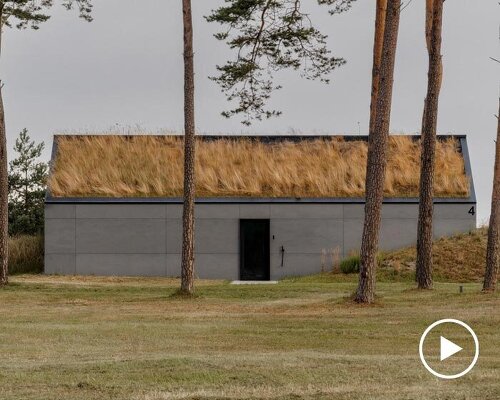
The two guest houses draw directly from the form of the original bunkers. Their low volumes are covered with grass roofs, allowing them to merge visually with the coastal terrain while extending habitat conditions for local fauna. The contrast between the elevated main house and the grounded guest structures defines the spatial organization of the site. One element appears suspended above the landscape, while the others remain embedded within it.
Inside the main house, the interior design by studio Open Architecture Design – OAD emphasizes restrained material choices and simple detailing. Wooden finishes, exposed concrete floors, and tactile surfaces define the interior environment. The layout responds to natural daylight conditions. The main living area is oriented to receive morning light, while the master bedroom includes openings directed toward sunset views over the Baltic Sea. A continuous glass facade strengthens the visual connection between interior spaces and the surrounding coastal landscape.
Through the reuse of existing bunker foundations and the careful placement of new structures, SAR project explores how domestic architecture can be integrated within a historically layered coastal environment while limiting its physical footprint on the site.
the dual-sloped roof complies with regional architectural regulations
roofs covered with wild grasses expand the habitats of local fauna
the residence is built on the foundations of former Soviet military bunkers
a custom metal frame supports the roof above the glass facade
with the entrance tucked below, main living areas are located on the second floor
the main house is positioned above the horizon of the Baltic Sea
SAR by Open Architecture Design – OAD sits on the Saraiki coastline in Latvia
deep-set windows inspired by the original Soviet-era military bunkers
glass facade dissolves the boundary between the man-made space and natural environment
the living room features a vaulted wood-clad ceiling
the master bedroom captures sunset views of the Baltic Sea
interior is restrained, embracing natural and tactile materials
the main living areas are filled with morning light
a key intention of this coastal home is to minimize its impact on the surrounding landscape
project info:
name: SAR
architect: Open Architecture Design – OAD | @oad.archi
design team: Zane Tetere-Sulce, Dace Bula, Alvis Petrovskis, Eva Heidingere-Jukama
location: Saraiki, Latvia
photographer: Alvis Rozenbergs | @alvis.rosenberg.photo
designboom has received this project from our DIY submissions feature, where we welcome our readers to submit their own work for publication. see more project submissions from our readers here.
edited by: christina vergopoulou | designboom
The post grass-covered seaside family home repurposes abandoned soviet military bunkers in latvia appeared first on designboom | architecture & design magazine.