
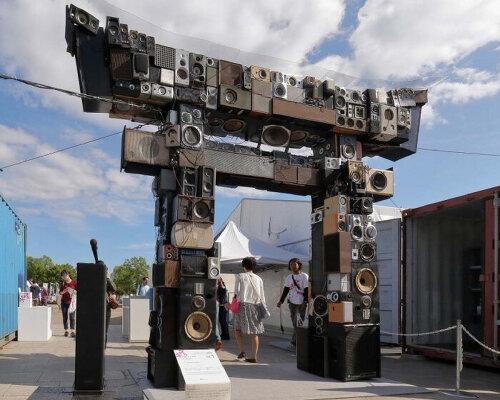
Benoît Maubrey crafts public sculptures from recycled speakers
Benoît Maubrey turns discarded speakers into functional recycled public art sculptures shaped as shrines, ships, obelisks, igloos, and temples, to name a few. In an interview with designboom, the artist says that he’s always wanted to activate public spaces, gathering people as participants of his functional recycled speakers instead of them just being standing viewers. It’s a reason why he shifted his artistic practice from painting to making in the early 1980s. For him, painting on canvas couldn’t do what he needed to do: to make the air move, aka the sounds.
The artist lives in his own farmhouse in Brandenburg, Germany. In the barn, on one side, there are 3,000 speakers in storage, including the ones he kept after his public sculptures ended their exhibition times. Some also arrived from recycling companies, thrift markets, friends, and the street. He doesn’t select them by brand or acoustic quality but by availability. He describes the process as democratic, or what he calls a democracy of ohms (the ohm is the unit of electrical resistance in a loudspeaker). When connecting hundreds of speakers together, each one carrying a resistance value, the system requires a specific approach to wiring and amplification. Benoît Maubrey knows this because, as he shares with designboom, nobody else in the world connects 3,000 or more recycled speakers together and turn them into interactive public sculptures across cities worldwide.
all images courtesy of Benoît Maubrey
Viewers can speak, sing, or connect their bluetooth devices
Benoît Maubrey is the founder and director of Die Audio Gruppe, a Berlin-based art group the artist has run since 1982, including the team who helps him craft his public artworks. Over four decades, he has built sculptures from recycled speakers in public spaces across Europe, the Middle East, and Japan, and the list of structures includes obelisks, walls, gates, arenas, lighthouses, temples, and a cube. Through his works, he imagines the relationship between a public space and the people inside it as interactive, an exchange.
A person can walk up to a microphone connected to the recycled speakers and speak or sing, or even connect their smartphones via Bluetooth to play music into one of the speakers or the entire sculpture, their voice traveling through the system and coming out of every device in the artwork at once. In the Speakers Wall, a 2011 installation that included an actual piece of the Berlin Wall embedded in the center, surrounded by 1,000 speakers, amplifiers, and tuners, people could also call a phone number and speak into an answering machine. The recording then played through all the speakers. The sculpture functioned as a speakers’ corner: a space where any person, with no credentials or permission, could broadcast their voice in public.
Streamers at Vienna, Austria, on view between January 29th and May 1st, 2022
‘I don’t believe in utopia, but in fantasy and fun and imagination’
In many ways and forms, the familiar shapes of Benoît Maubrey’s public sculptures embedded with functional recycled speakers hint at a reimagination of a different setup of reality, one where people could amplify their voices (and quite literally, at times). Our conversation with the artist transitions, as we ask him if permanent speaking sculptures in public spaces represent his version of utopia. Benoît Maubrey takes a pause and says, ‘I burned all my utopias already. They’re all past me. I don’t think I believe in utopia, but I believe in fantasy and fun and imagination.’ Through forty years of installing sculptures that let strangers speak in public squares, he says he has collected evidence. Take the SD cards from his answering machine sculptures that hold up to eight hours of recordings per installation, and roughly three percent of calls contain content that could be considered offensive.
The remaining ninety-seven percent are people joking, greeting, performing, writing poems, singing. ‘People are basically good,’ he tells designboom. ‘Human beings are basically curious, interested, fantasy folk, as they like to enjoy themselves, they like to create things.’ He pauses again, then adds: ‘Utopia is basically that the human being is good. That’s the utopia. That actually we’re good, and actually we’re friendly, and we really love each other.’ This is not a political statement in the way Benoît Maubrey understands politics because he draws a line between political art, which he defines as art about systems, and what he does, which he calls opening spaces to people. He doesn’t want to talk about systems but wants to put a microphone in a public square and see what happens.
Obelisk at Potsdam, Germany, as part of the Intersonanzen Festival from May 30th to June 5th, 2019
What has happened, across festivals in Germany, Japan, Egypt, France, Canada, and Austria, is that people use the functional recycled speakers made by Benoît Maubrey. Strangers talk. Some of them make art. None of the structures have required censorship beyond the three-minute limit on the answering machine. ‘Contrary to what you read in newspapers or blogs, human beings are nice people,’ the artist continues to tell designboom on the topic of utopia. The sculptures Maubrey builds carry that position into their materials. A loudspeaker that has been in someone’s living room for twenty years carries what he calls a patina, a surface quality that comes from age, use, and time. People who encounter that speaker in a public sculpture may recognize it and have a memory of it.
In return, that recognition pulls them toward the structure, inviting them to come closer, pick up the microphone, or connect their Bluetooth-ready devices to play music in one of those speakers. His public sculptures then become a design tool that gathers people and uses familiarity as an invitation. The speaker that a household threw away returns to public life in a form that still functions. It has been given a second context, one that is larger, louder, and more open than the room it came from, and it moves air, which Benoît Maubrey has always wanted to make.
Obelisk at Cairo, Egypt, 2018
Closing our interview with the artist, Benoît Maubrey says he is 73 years old and still building, still crafting these functional recycled speakers into public art sculptures. The current inventory in his barn includes an arena structure built in four sections so it can be loaded onto a truck and moved between cities. There’s also the Torii sculpture from Japan, which doubles as a public karaoke machine, stored and waiting for its next location. Before the call, the artist sent us a picture of a rocket made up of hundreds of recycled speakers.
During the call, he explains that it’s because ‘Burning Man (festival) asked me for a project, so I developed a rocket. I had no personal desire to go out to the hottest place on earth to spend three weeks in the heat. I have health problems too. But other organizations saw the project, and they kept on asking, saying we wanted it here, we wanted it in those places,’ he tells designboom. While it’s still unsure if it’ll come to life, the artist reminds us that this is his definition of his public sculptures: building a structure from recycled speakers, giving it a functional system and a microphone, stepping back, and allowing the viewers to say what they want to say, freely.
Karaoke Torii in Japan, functioning as a public karaoke machine
Shrine for for the Kobe Biennale in Japan
Shipwreck for FUSION Festival near Berlin
Arena for the CAFKA festival in Kitchener, Canada, 2017
viewer using the microphone at the Obelisk installation in Potsdam, Germany
detailed view of the devices, from the Obelisk installation in Cairo
Temple for the Sound Art exhibition at the ZKM / Karlsruhe
project info:
artist: Benoît Maubrey | @beno.it1809
group: Die Audio Gruppe
The post benoît maubrey builds a world of speaking sculptures from recycled sound appeared first on designboom | architecture & design magazine.