
Human homes on moon, mars, space and underwater
The most frequent medicine taken on the International Space Station is sleeping pills because astronauts in orbit live in a light cycle that doesn’t match their biology. Their bodies don’t know when to sleep or when to wake, and the disruption lasts for weeks or months, affecting their performance, mood, and physical health.
For SAGA Space Architects, the Copenhagen-based architecture and space studio founded by Sebastian Aristotelis and Karl-Johan Sørensen, this is not a spacecraft problem. It’s the home design’s fault, and for those who want to go to the Moon, Mars, and the ocean floor and live there, the structure has to adapt to their needs first.
all images courtesy of SAGA Space Architects
Saga space architects focuses on designs for well-being
The Moon is the next nearest surface to Earth, and NASA’s Artemis program is building toward a permanent human presence there within this decade. Mars represents the longer horizon, a planet with a 24.6-hour day, evidence of past water, and enough distance from Earth that any mission there requires a home capable of sustaining life for years without resupply. The ocean floor is closer and already accessible, but less than 0.01 percent of it has been directly explored. Each of these three environments holds resources, research potential, and, in the case of Mars, the question of whether human civilization can exist beyond a single planet. For SAGA, all three also hold the same design problem: a person needs to live there, and nothing in any of them was built for that purpose.
As a means to solve the problem of the growing trend, the studio has built a Moon habitat tested in the Arctic, a Mars shelter concept that runs on dust storms, an underwater structure at the bottom of Copenhagen Harbor, and a training facility for the European Space Agency. When they started designing these, they began with the human body. SAGA Space Architects designs for human needs when their location and environment change, in the sense that a person who spends months in a confined habitat still needs surfaces that feel like something. They need to know what time of day it is or have a place that is quiet when they sleep and lit correctly when they work. These, among others, are some basic conditions under which they continue to live at all.
view inside FLEXHab
Natural materials and technologies bring the life in
This is why the natural materials appear in structures that SAGA Space Architects have designed for the Moon, Mars, space, and the ocean floor: cork on the floors and storage surfaces, natural wool felt on the walls, recycled textile panels hand-dyed in the studio, poly-fiber textiles lining sleeping pods, and Alcantara vegan suede on bench surfaces. These are domestic materials, the kind found in well-considered apartments and not laboratories, added inside the future homes that must also withstand pressure, hurricane-scale winds, and temperatures of -30°C.
In every project, they occupy the same room. The circadian lighting system, for example, that runs through LUNARK, the Rosenberg habitat, and FLEXHab is a clear expression of this: a technology that can give the astronaut living inside it a sunrise, a midday, and an evening, regardless of what is happening outside. Here, constraint and form in terms of design and the environment face each other, allowing the team to treat each as a design input.
multipurpose room inside the FLEXHab
Take the Dandelion Shelter on Mars that harvests static electricity from dust particles with acrylic-coated carbon fiber spikes on its exterior. The dust storm becomes the power source, and the shelter electrolyzes air into water, farms algae, and produces oxygen before any human arrives, a preview of how the future home can integrate with the Martian climate rather than fight it.
The same logic appears in the underwater habitat Uhab, where the pressure and isolation of the ocean floor are treated as analogs for the pressure and isolation of space, making the water a training environment rather than a barrier. In each case, the condition that makes the place hostile is also the condition that the design is built around.
view of Rosenberg Space Habitat
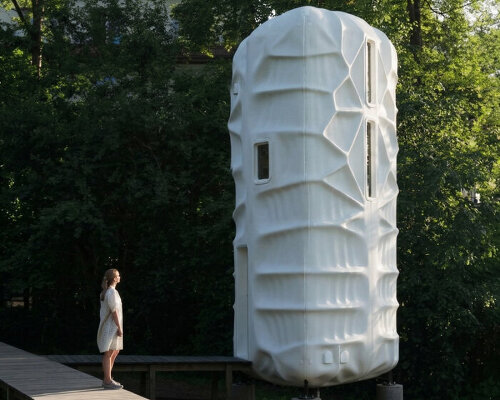
Structure follows the same logic, as the Rosenberg habitat’s shell shape, positioned mathematically between a triangle and a circle, was chosen so that six of those shapes fit inside a SpaceX Starship cargo bay. The LUNARK habitat folds from its transport configuration to its full interior volume, too. The Dandelion Shelter stacks twenty units into a single Falcon Heavy payload. In every case, the form is the solution to a transport problem, and the transport problem is the first design brief.
SAGA Space Architects isn’t positioning its works as a vision of a better future because each project is built, tested, and inhabited already. Aristotelis and Sørensen lived in LUNARK for 60 days in the Arctic; Aristotelis spent 48 hours at the bottom of Copenhagen Harbor in Uhab; the Mars Lab was deployed in the Negev desert and inhabited as part of a live experiment; and FLEXHab sits at the European Astronaut Centre, where crews are already training in it. What SAGA Space Architects is building isn’t a series of renderings. These are now actual spaces that could let us into the future of homes out of Earth.
the hexagonal structure can be transported out of Earth
view inside of Rosenberg Space Habitat
view of Uhab, dubbed the smallest functional underwater habitat
the structure has been tested successfully at 7 meter depth in the Copenhagen Harbor for 48-hours
view of Mars Lab
Mars Lab is the studio’s first habitat with expanding structures
the habitat forms part of an experiment to study the experience of living in a confined space
project info:
studio: SAGA Space Architects | @saga_space_architects
The post where future homes could be for SAGA space architects: on moon, mars and underwater appeared first on designboom | architecture & design magazine.