
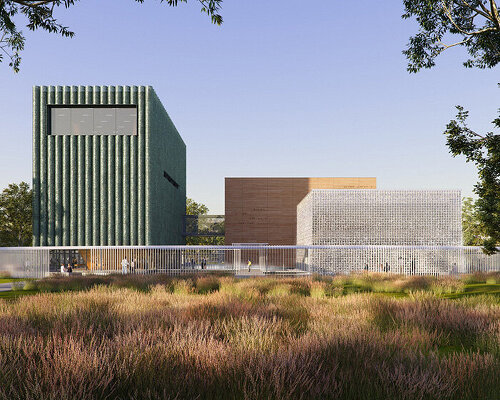
in a chinese garden, shede culture museum tops out
Rising from a circular garden pond, OPEN Architecture‘s Shede Culture Museum has topped out in Shehong, China. The project is expected to complete in 2027, and will stand as a new threshold for a distillery along the Fu River.
The project occupies a peripheral site that has long remained unused despite its proximity to the main entrance. OPEN identifies this edge condition as an opportunity. The museum draws visitors into a landscape that bridges production and public life, and uses land and water to create a tranquil arrival experience.
visualizations © OPEN Architecture
A built landscape of pond and islands
At the center of the Shede Culture Museum is a ninety-meter circular pond, which the team at OPEN Architecture inserts into the existing garden. Its geometry establishes a continuous field without corners, where a covered walkway traces the perimeter as a semi-transparent ring.
Within this water surface, three volumes appear as separate figures. Their placement follows the classical principle of One Pond, Three Mountains, translating a historic garden composition into a contemporary architectural system. Mist and gentle water movement animate the surface, introducing shifts in atmosphere throughout the day.
the Shede Culture Museum is set within the East Garden of a distillery in Shehong China
three buildings, three material expressions
Each of the Shede Culture Museum’s three buildings engages the pond in a different way. OPEN Architecture designs one to volume hover above the surface, while one sits within it and one extends below, peering slightly above the waterline.
These volumes are defined by material. The Glass Box is wrapped in a thin veil of flowing water that runs continuously down its facades and recirculates below. The Earth Box is formed from local yellow soil using rammed-earth construction, directly referencing the fermentation pits used in spirit production. The Bronze Box is clad in perforated panels whose patterns encode verses about spirits in Morse code, introducing a layer of text embedded within the facade.
three volumes engage the water differently by hovering, resting, or extending below the surface
Movement between water and enclosure
Visitors move across bridges and through the volumes, alternating between enclosed galleries and open views across the pond. The sequence of spaces shifts between darker interiors and brighter passages, guided by changes in light and reflection.
Below the waterline, the buildings connect into a continuous interior. This lower level houses a theater, rehearsal space, and supporting functions, allowing the above-ground volumes to remain visually distinct. The separation between what is seen above and what is connected below shapes a reading of the museum as both fragmented and unified.
a ninety-meter circular pond defines the project and organizes movement through water and land
Material time and environmental systems
The selection of earth, glass, and bronze ties the architecture to the processes of making Shede spirits. Each material carries a different temporal quality. Rammed earth records the compression of soil and the passage of weather. Bronze surfaces develop patina over time. Water flowing across glass introduces constant change.
Environmental strategies are integrated into the design. A ground heat pump system works with water thermal storage to regulate temperature. Solar panels on the Bronze Box contribute energy, while air-source heat pumps support hot water supply. Rainwater is collected and reused, and water drawn from the Fu River, already part of the distillery’s operations, feeds the pond system.
below the pond, the volumes connect into shared spaces including a theater and support areas
a thin veil of flowing water runs continuously down the facades of the Glass Box
rammed-earth construction referencing the fermentation pits used in spirit production
the Bronze Box is clad in perforated panels rendering Morse Code
project info:
name: Shede Culture Museum
architect: OPEN Architecture | @open.architecture
location: Shehong, China
client: Shede Spirits
completion: expected 2027
visualizations: © OPEN Architecture
interior, landscape design: OPEN Architecture
architectural, structural, MEP, landscape construction documents: China Southwest Architectural Design and
Research Institute
interior construction documents: Beijing Tsingshang Architectural Design and Research Institute
structural consultant: AND Office
MEP, sustainability consultant: LINK Engineering Consultant
curtain wall consultant: RFR
rammed-earth consultant: On Earth Studio
waterscape consultant: Shanghai Sushui Art Design Co., Ltd
acoustic, theater consultant: JH Theatre Architecture Design Consulting Company
lighting consultant: Gradient Lighting Design
scenographer: Shanghai MANA Culture & Technology Co., Ltd
signage design: Tothree Design Co., Ltd
The post OPEN’s ‘shede culture museum’ is shaped from rammed-earth, glass and bronze appeared first on designboom | architecture & design magazine.