
The street food vendors of Mumbai did not negotiate the terms of the Iran conflict. Neither did the factory managers in Vietnam, the government officials in Colombo, or the home cooks across a dozen nations who depend on liquefied petroleum gas. Yet the military standoff in the Strait of Hormuz, the chokepoint for 30% of the world’s traded LPG, is landing in their kitchens and economies with uncomfortable speed. In India, the government is rationing supply. In Sri Lanka, officials declared national holidays on Wednesdays specifically to curb fuel consumption. In Japan and South Korea, two of the world’s largest LPG importers, the primary energy artery is tightening, while European markets are bracing for wholesale gas prices to triple. A single geopolitical flashpoint is now determining whether millions can cook dinner.
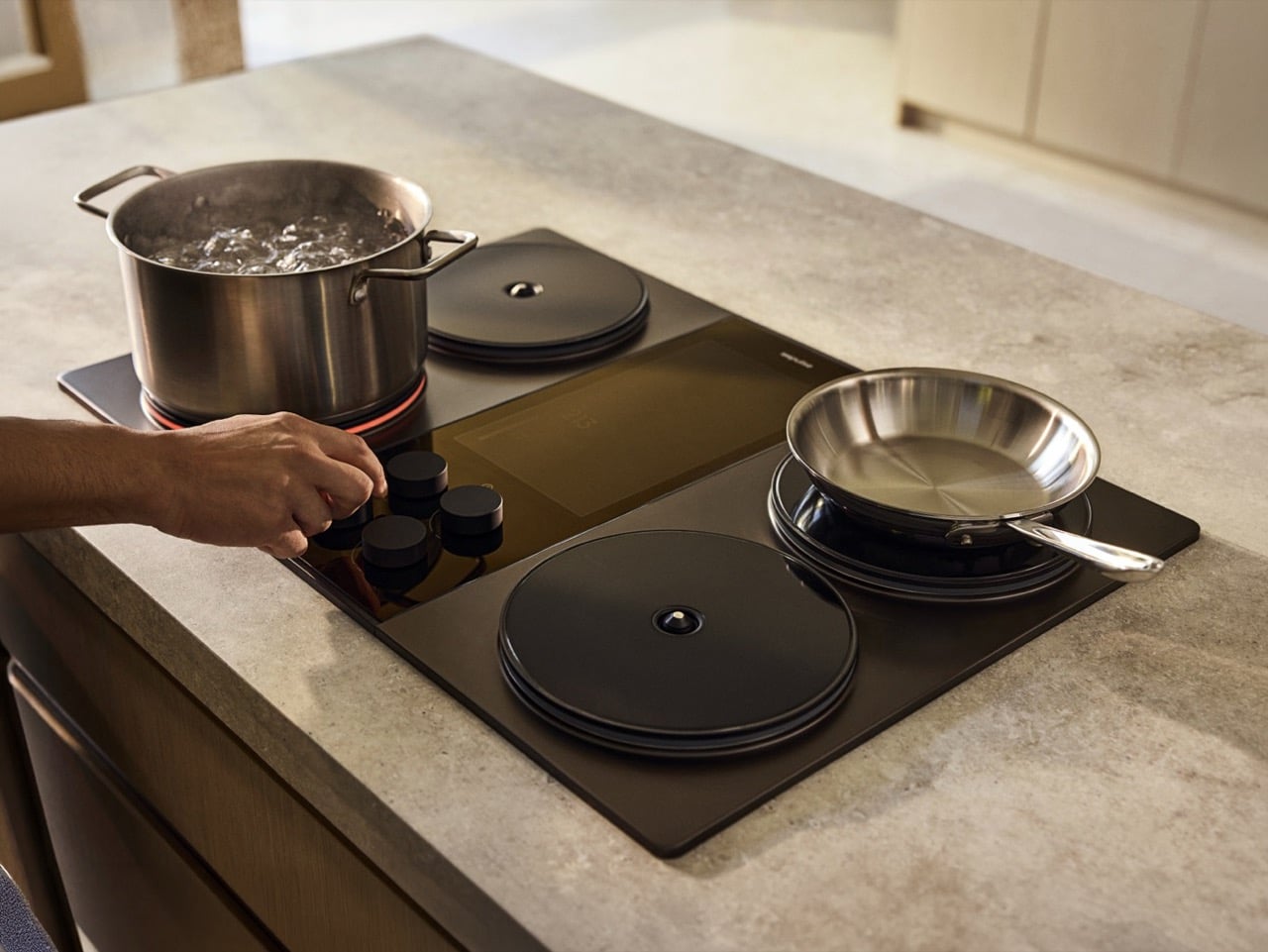
Against that dystopian backdrop, the Impulse cooktop occupies a category with very little company. The appliance, which earned the Red Dot’s Best of the Best and won Fast Company’s 2024 Innovation by Design Award, builds a battery directly into the cooktop body. It draws from stored charge and the grid simultaneously to deliver a staggering 10,000 watts per burner. BLOND, the industrial design firm behind it, gave the object the physical language of a considered luxury kitchen piece. The engineers gave it freedom from every fuel supply chain that currently has Asia and Europe in a headlock. Both things matter here; right now, one of them lands with a global urgency that the designers probably never anticipated.
Designer: BLOND
BLOND stripped the Impulse cooktop down to a precise, slab-like form with a magnetic control knob that carries the rotational weight of something deliberately engineered, and a ceramic cooking surface that reads more like high-end DJ equipment than kitchen accessories. The battery pack lives entirely inside the appliance body, with no external modules and no separate storage unit. That battery and the grid work in simultaneous tandem, together pushing up to 10,000 watts per induction zone, which is three times the output ceiling of the most powerful competing induction cooktop on the market. A standard gas burner tops out between 1,500 and 2,000 watts. A premium gas hob might hit 4,000. Impulse doubles that, through induction, from a domestic plug.
Impulse became the first battery-integrated appliance to earn UL 858 certification, the U.S. standard applied to household electric ranges, which matters because it signals a tested, production-ready product rather than a clever concept that survived the prototype stage. Most residential kitchens cannot realistically pull 10,000 watts through standard wiring without a costly electrical panel upgrade, which is the single biggest friction point in induction adoption globally. The onboard battery eliminates that bottleneck by buffering the peak load and recharging from a normal household outlet during lower-intensity cooking. The result is extreme performance on ordinary electrical infrastructure. Getting 10,000 watts into a domestic kitchen without rewiring the house turns out to be a harder problem than building a burner that can hit those numbers, and Impulse solves both in the same enclosure.
Amazon India reported induction cooktop sales jumping more than 30 times their normal volume last week as the LPG shortage deepened. That number tells you how fast behavior shifts when a supply chain snaps. The problem is that most of those units being panic-bought are budget induction plates capped around 2,000 watts, which work fine for boiling water but flounder with the kind of cooking that defines South and Southeast Asian cuisine. High-heat wok cooking, crispy dosas on cast iron, intense stir-fry; all of these demand fast, concentrated thermal output that conventional induction simply cannot generate. Impulse at 10,000 watts per zone changes that equation entirely, and it does so without a gas line anywhere in the picture.
At KBIS 2026, THOR Kitchen debuted a full induction range built on Impulse’s battery-integrated platform, and it got recognized at the show. That partnership reveals the bigger picture: Impulse Labs is positioning its engineering as a licensable platform for the appliance industry broadly, treating the consumer cooktop as proof of concept rather than end product. If that model scales, the 10,000-watt battery system becomes the architecture that a generation of kitchen appliances gets built on, with real implications for manufacturers trying to electrify product lines without sacrificing performance. Whether the business reaches that scale fast enough to meet this particular moment depends on manufacturing capacity and pricing the company has not widely publicized. But the Strait of Hormuz did not ask for a roadmap before closing, and the people queuing for gas cylinders at 3am in New Delhi are not waiting on a product launch schedule either.
The post LPG Shortage Has Millions Unable to Cook. This Battery Induction Cooktop Never Needed Gas Anyway. first appeared on Yanko Design.