
Sheep Grazing Shapes a Regenerative Urban Heath System
Heath Hiking is a landscape proposal that investigates the reintroduction of heathland ecology within an urban context in London. Located between Hampstead Heath and Brent Cross, the project examines how fragmented city edges can be reconfigured into a continuous ecological corridor that supports both human activity and non-human systems.
The proposal is grounded in the historical and environmental significance of Hampstead Heath, extending its landscape logic toward Clitterhouse Playing Fields. It focuses on heathland as a semi-natural, low-nutrient ecosystem that has largely disappeared from contemporary urban environments. The design explores how this landscape type can be re-established through low-intervention strategies and long-term ecological management.
Sheep grazing is introduced as a primary maintenance method, drawing from traditional land management practices. This approach supports the regeneration of heathland vegetation while reducing reliance on mechanical upkeep. The presence of grazing animals also informs the spatial character of the site, establishing shared territories between human and non-human users.
Heathland Status: once abundant in the UK, lowland heathlands have declined due to farming, planting, and enclosure. Heath Hiking reclaims their value as shared social and ecological landscapes
Reactivating Land, Water, and Agriculture at the Urban Edge
The project, conceived by designer Yiling Deng, responds to existing conditions at Brent Cross, where current development strategies prioritize commercial and recreational uses. In contrast, the proposal reconsiders underutilized elements such as allotments, historic agricultural patterns, and water systems. A restored heathland landscape is combined with new allotment spaces, the reintroduction of an open river corridor through de-culverting, and a network of pedestrian paths that reconnect isolated areas.
Material strategies prioritize ecological performance and minimal intervention. Meadow seed mixes support biodiversity, while locally sourced timber is used for small-scale structures and site furniture. Permeable surfaces are implemented to maintain natural water cycles and improve ground conditions. Rather than relying on extensive construction, the design emphasizes subtle landform adjustments and landscape processes. Seasonal change, vegetation growth, and grazing patterns contribute to the evolving spatial character of the site.
Heath Hiking presents a model for integrating ecological restoration, public access, and landscape management within urban environments. By combining historical references with contemporary environmental strategies, the project proposes a framework for reintroducing heathland as a functional and accessible landscape system.
Vegetation & Loss: 80% of lowland heathlands have vanished since 1800. this project celebrates their unique flora and seasonal rhythms, seeking revival through design and community engagement
Hampstead Heath Historical Analysis: reviving London’s lost heathlands: tracing Hampstead Heath’s evolution to inspire urban rewilding and shared social-ecological landscapes
Site Context: Hampstead to Brent Cross: a green corridor from Hampstead Heath to Brent Cross linking parks and regeneration zones through ecology, public access, and urban critique
Heath Hiking Route: 13 Parks Walk: a 16.3km green trail from Hampstead Heath through 13 public parks exploring everyday life, ecological links, and the potential to revive urban heathland across North
Heath Hiking: everyday encounters: Heath Hiking maps everyday public life revealing interactions between people, animals, and transport that form the social texture of green urban routes
diagram mapping the integration of non-human habitats and human programs through water restoration, grazing systems, and connected landscape infrastructure
Clitterhouse Farm Project History: reimagining Clitterhouse Farm as a resilient hub, restoring farming heritage, civic identity, and community-led landscape transformation
Field Survey of Site Issues: Clitterhouse Playing Fields suffer from enclosure, isolation, and disuse. Heath Hiking proposes reintegration through inclusive, open, green connections
Hydrography + Historic Land Use: mapping past and present rivers reveals lost flows and erosion risks, supporting the case for river restoration and hydrological healing
Design Strategies + Zoning Vision: a multifunctional framework zoning for grazing, woodland, wetlands, and walkable paths to regenerate ecological and social life in the city
Final Masterplan: reclaiming the urban void: Heath Hiking proposes a layered, inclusive masterplan with farms, allotments, wetlands, and amphitheatres rooted in ecological tradition
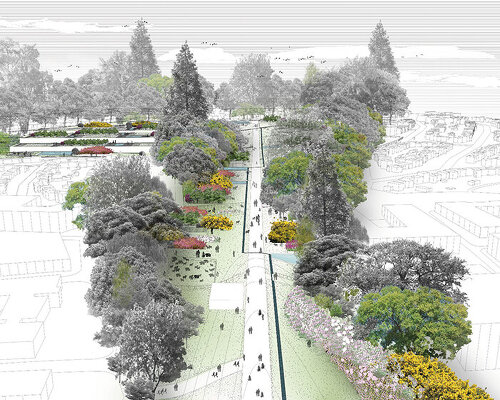
Perspective Visualisation: a walkable green spine unfolds, with immersive planting, soft paths, and shared encounters creating a living heathland trail in the heart of the city
timeline showing the daily movement of sheep across heathland, allotments, and shared spaces, structuring ecological maintenance and human interaction
project info:
name: Heath Hiking
designer: Yiling Deng
designboom has received this project from our DIY submissions feature, where we welcome our readers to submit their own work for publication. see more project submissions from our readers here.
edited by: christina vergopoulou | designboom
The post urban rewilding in practice: restoring london’s heathland for humans, sheep, and ecology appeared first on designboom | architecture & design magazine.