
New Babylon: a city after the end of work
In the aftermath of World War II, Europe rebuilds its cities with urgency, but not its certainties. The physical reconstruction of streets and housing takes place alongside the collapse of social structures, habits, and belief systems that once organized everyday life. Within this unstable terrain, Constant Nieuwenhuys begins to imagine something far more radical than reconstruction. Not a better city, but a different civilization altogether.
Conceived between 1956 and 1974, New Babylon emerges as a speculative project through which Constant does not design buildings in the conventional sense. Instead, he constructs a framework for a world inhabited by homo ludens, a figure liberated from labor and driven by play. His proposal describes a planetary network of elevated megastructures, an endless interior where space is continuously reshaped according to desire. The city becomes mutable, atmospheric, and fundamentally unfinished, proposing a society no longer organized around production, but around the constant reinvention of experience.
New Babylon-Paris, 1963 | image via @constant.101
alba as origin point
In 1956, Constant travels to Alba in northern Italy, invited by Danish painter and sculptor Asger Jorn for a congress of the International Movement for an Imaginist Bauhaus. There, he encounters a group of Roma families forced out of the town’s central spaces and relocated to a muddy, improvised site along the river, made available by Pinot Gallizio.
What he observes follows a different spatial logic from the one he was familiar with. The settlement is provisional, adaptive, and collectively shaped. Walls shift, materials are reused, and space is continuously redefined through use rather than fixed planning. Constant recognizes in this environment a model of living that embraces transformation.
This moment becomes foundational. What begins as a proposal for a permanent encampment evolves into a vast, interconnected system. The informal settlement of Alba is translated into steel frameworks and plexiglass models, marking Constant’s departure from painting and his commitment to what he calls the problem of construction.
image via Kunstmuseum Den Haag
from cobra to spatial thinking
Constant’s trajectory toward New Babylon is gradual. As a founding member of the avant-garde CoBrA group, he initially embraces spontaneity, instinct, and collective expression in painting. Yet by the early 1950s, he grows dissatisfied with the limits of the canvas. The scale of postwar transformation demands something more immersive.
Collaborating with architect Aldo van Eyck, he begins to explore the synthesis of the arts. Color is no longer applied to surfaces but becomes spatial, structuring perception and movement. Projects such as een ruimte in kleur at the Stedelijk Museum reveal a shift toward environments rather than objects. This transition reframes architecture as a field of relations rather than a collection of forms. Space is understood as something lived, negotiated, and continuously redefined. These ideas lay the conceptual groundwork for New Babylon, where architecture does not prescribe behavior but enables its constant reinvention.
Constant’s involvement with the Situationist International, alongside Guy Debord, sharpens the political dimension of his work. Together, they develop the concept of unitary urbanism, a critique of modernist planning and its rigid functional divisions. The city, in their view, has become a mechanism of control, producing what they describe as deserts of the mind.
During a series of dérives through Amsterdam in 1958, they draft the Amsterdam Declaration, proposing an urbanism based on ambience, participation, and play. The city is reimagined as a continuous field of experience, shaped by movement and emotion rather than zoning and efficiency. Debord grows suspicious of Constant’s models and visual representations, seeing them as aesthetic objects that risk neutralizing political urgency. Constant, by contrast, insists on the necessity of construction, of giving form to possibility. By 1960, he had left the movement, continuing New Babylon independently.
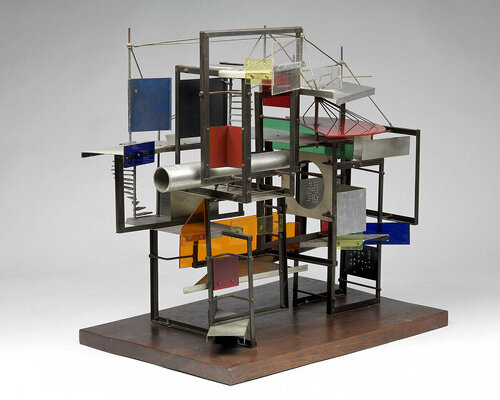
Ladderlabyrint, 1967, 71,6 x 79,2 x 87,5 cm, brass, plexiglass, wood, collection Lehmbruck Museum, Germany | image via @constant.101
constant’s homo ludens and the automation horizon
At the center of New Babylon lies a radical hypothesis. Automation will eliminate the need for human labor. In its place emerges homo ludens, a subject defined by play. Drawing from Johan Huizinga, Constant reframes play as the primary driver of culture. In this post-labor society, all productive tasks are delegated to automated systems. The inhabitants of New Babylon are free to construct situations, to experiment with space, and to continuously transform their environment. Ownership dissolves into collective access. Borders become irrelevant. The city expands as a network without fixed limits.
Play, in this context, becomes a mode of existence, structuring time, space, and social relations. The city becomes a laboratory for desire, where every individual participates in shaping the conditions of experience.
Architecturally, New Babylon is composed of interconnected sectors, vast horizontal frameworks elevated above the ground on pilotis, that extend across landscapes, forming a continuous network that overlays the earth. The ground level is freed for infrastructure, agriculture, and remnants of the old industrial world. Above, the sectors function as open systems, devoid of fixed programs. Their interiors are labyrinthine, defined by movable walls, ramps, and platforms that can be reconfigured at will.
There is no clear distinction between inside and outside, day and night. Artificial lighting and climate systems produce a controlled environment, detached from natural cycles. Navigation becomes experiential rather than directional. Disorientation is not a flaw but a principle, encouraging exploration and discovery.
The sector is not a building. It is a framework for endless transformation.
Constant New Babylon exhibition, 2015-2016, installation view at Museo Reina Sofia | image courtesy of Museo Reina Sofia
the atmospheric city
Perhaps the most forward-looking aspect of New Babylon lies in its conception of atmosphere as architecture. Constant imagines a city where light, sound, temperature, and texture are continuously adjustable. Each space becomes an immersive environment, shaped by those who inhabit it. A corridor can shift from bright and resonant to dark and absorbent. A room can expand, contract, or dissolve entirely. The city operates as a sensory machine, producing variations rather than stability.
This approach anticipates contemporary discussions around responsive environments and digital space. Yet Constant’s vision remains distinct in its emphasis on collective authorship. Atmosphere is not optimized for comfort or efficiency, but for experimentation, as it invites unpredictability, even discomfort, as a catalyst for new forms of experience.
Constant’s project is neither purely optimistic nor purely critical. It is grounded in a belief in human creativity yet aware of its potential instability. The artist concentrates on the subjective experience of space, the psychological journey through an ever-changing environment.
detail of Yellow Sector, 1958 | image by Bram Wisman via @constant.101
collapse and doubt
By the early 1970s, the tone of New Babylon begins to shift. The political upheavals of 1968 reveal the difficulty of achieving the social transformation the project requires. Constant acknowledges a growing gap between the world he imagines and the one that exists.
His later drawings become darker, populated by scenes of conflict and excess. The freedom he once celebrated appears increasingly unstable. Without structures of necessity, desire risks turning inward, producing tension rather than liberation.
In 1974, Constant ends the project. The models are archived, the vision suspended. Yet the questions it raises remain unresolved.
New Babylon Constant (Constant Nieuwenhuys), 1963 | image courtesy of Museo Reina Sofia
echoes in the present
Today, New Babylon resonates in unexpected ways. The figure of the nomad reappears in digital culture, where mobility is enabled through networks rather than physical movement. Virtual environments echo the project’s immersive interiors, offering spaces detached from geography.
At the same time, the project exposes the limits of these parallels. Contemporary systems often prioritize efficiency, control, and data extraction, rather than the open-ended creativity Constant envisioned. The playful city risks becoming a managed platform, its freedoms carefully calibrated.
New Babylon asks whether a society organized around play is possible, and what forms of space such a society would require. It operates as a conceptual tool, a way of thinking about architecture beyond utility, beyond permanence and positions the city as a dynamic process, shaped by collective imagination rather than predetermined order.
Constant Nieuwenhuys, Gele sector, 1958, 21 x 87.3 x 77.5 cm, blotting paper, copper, ink, iron, lead, metal, oil paint, plexiglass and wood, Collection Kunstmuseum Den Haag | image via @constant.101
New Babylon-Barcelona, 1963, original dimensions | image via @constant.101
Constant, Portfolio New Babylon, nr. 5, 1963, 37 x 36 cm, lithograph, multiple collections incl. Collection Kunstmuseen Krefeld, Germany and collection Boijmans van Beuningen, NL | image via @constant.101
New New Babylon installation view | image via Kunstmuseum Den Haag
Constant, Chantier, 1972, ink and watercolor on paper, 55 x 76 cm, Collection Meeuwissen, NL | image by @tom_haartsen via @constant.101
Constant Nieuwenhuys, New Babylon, 1961, litho. Collection Het Nieuwe Instituut, archive Academie van Bouwkunst Amsterdam (ABAM). Copyright Pictoright via Nieuwe Instituut
The post in new babylon, constant imagines a world built for people who never stop playing appeared first on designboom | architecture & design magazine.