
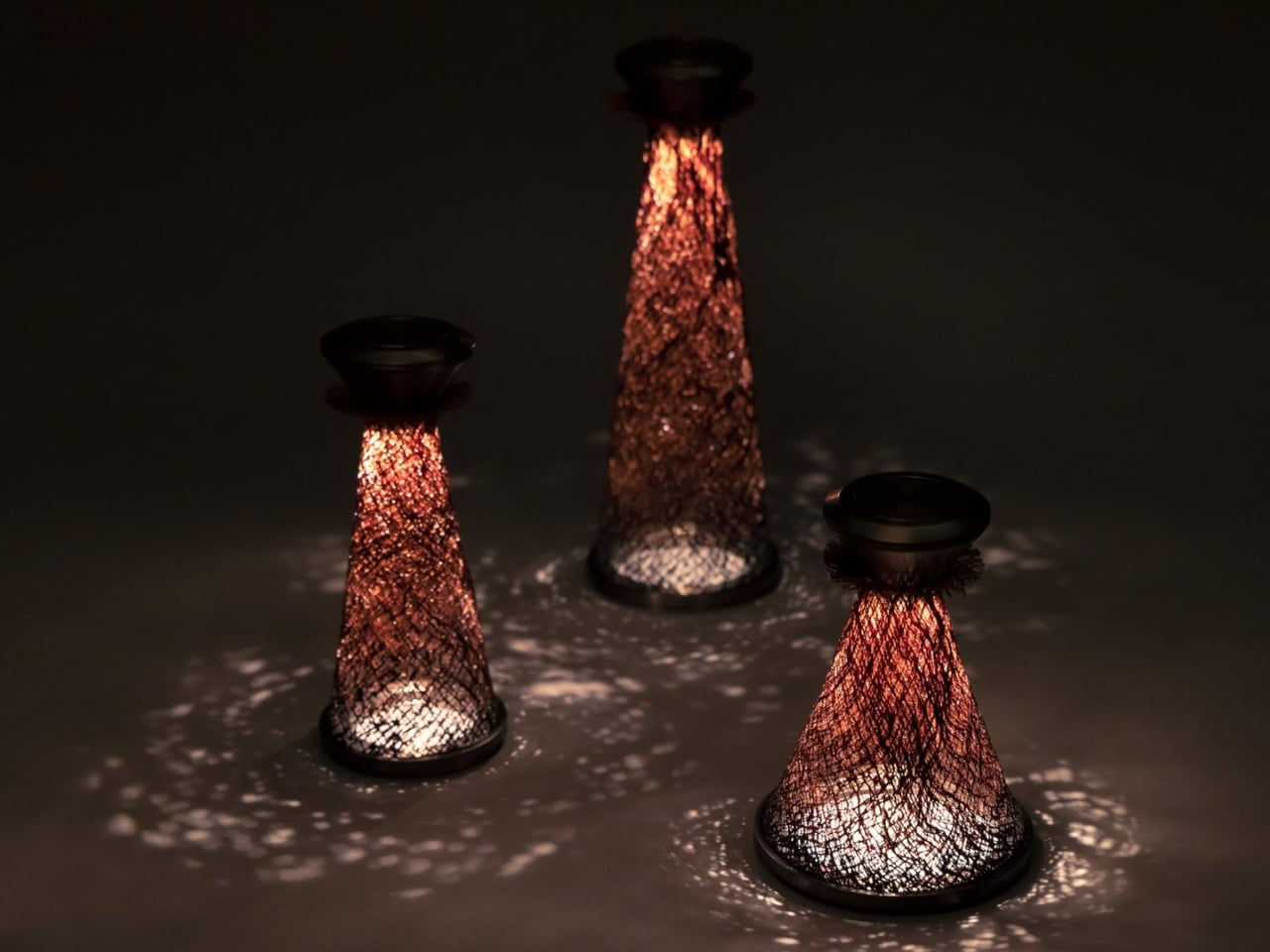
The HOUYOU lamp doesn’t announce itself. It sits on a table, conical and quiet, wrapped in fibrous brown bark that looks almost raw, almost unfinished. Nothing about it is trying to impress you at first glance, and that restraint is exactly what makes it so hard to stop looking at. Every time I come back to it, I feel a kind of quiet I didn’t know I was looking for.
HOUYOU is part of the JUHI Series by Kazuki Nagasawa, a 29-year-old Tokyo-based designer who founded his studio, SUPER RAT, in 2024. The studio name alone is worth a story. It comes from the rat termination companies of Shibuya and Shinjuku, where the so-called “super rats” are those that have grown immune to poison. Nagasawa borrowed that idea for his design philosophy: to create work that resists passing trends, that stays relevant because it’s rooted in something deeper than the moment. It’s a darkly funny origin story for a studio making some of the most quietly beautiful objects I’ve encountered in recent memory.
Designer: Kazuki Nagasawa
The lamp is made from juhi, the fibrous bark of the shuro palm tree (Trachycarpus fortunei). For centuries, Japanese artisans have cut, woven and shaped this bark into brooms, brushes, ropes and fishing nets. It’s been a workhorse material in everyday Japanese life for generations. Nagasawa takes that same bark and does something that feels almost counterintuitive: he turns it into light. When the lamp is illuminated from within, the bark doesn’t just glow. It transforms. The texture shifts. Fragments and subtle presences embedded in the material rise to the surface, visible only because the light is now moving through them. You’re not just seeing a lamp. You’re seeing the tree. You’re seeing time.
The name HOUYOU translates to “embrace,” which is exactly the right word. The shade of bark wraps around the light source the way natural bark wraps around the trunk of the shuro palm, protecting the heart of the tree. When the lamp casts its shadow, the shape that forms on the wall mirrors the gesture of a human embrace. That’s not an accident. Nagasawa is drawing a very intentional line between the behavior of the material in nature and the behavior of the object in your home, and that kind of poetic precision in design is rarer than it should be.
I’ll be direct: we are drowning in lamps right now. Every design week, every pop-up, every Instagram grid delivers another sculptural, bouclé-shaded, artisanal lighting object trying to signal “thoughtful modern living.” Some of them are genuinely beautiful. Many of them are interchangeable. HOUYOU stands apart not because it’s trying harder, but because it’s trying differently. The design doesn’t chase aesthetics. It follows material logic, and the beauty is simply what happens as a result.
Nagasawa’s work first caught major international attention when he won first place at the prestigious SaloneSatellite Award during Milan Design Week in 2025. SaloneSatellite is the launchpad for early-career designers, and its alumni include names like Oki Sato, founder of nendo. Winning there, with a studio barely a year old at the time, was a serious statement. The JUHI Series, including both the HOUYOU lamp and the Utsuwa vase collection, has continued to build momentum since, with the series also shown at the Lake Como Design Festival.
The quiet argument the HOUYOU lamp makes about material culture is one I keep coming back to. We don’t need to keep inventing entirely new substances. We don’t always need polymers, composites, or the next engineered alternative. Sometimes the most radical thing a designer can do is look at something ancient and ask: what has this material always been capable of that nobody thought to reveal? The HOUYOU lamp doesn’t answer that question with a manifesto. It answers it by sitting on a table, glowing softly, and letting you feel a palm forest you’ve never visited.
The post Ancient Japanese Palm Bark Turned Into a Lamp Worth Staring At first appeared on Yanko Design.