
Leshi sofa explores mass, enclosure, and slavic cultural memory
Leshi is a sofa that positions itself between furniture and architectural object. Instead of relying on decorative references, the design focuses on primary spatial elements such as mass, arch, and enclosure. It emphasizes presence over styling, exploring how an object can convey stability, protection, and a direct relationship to the human body.
The name Leshi refers to a figure from Slavic mythology, but the project interprets it as an atmosphere rather than a character. In early Slavic domestic culture, sofas did not exist as a distinct type. Interiors relied on benches, chests, and sleeping platforms, objects closely integrated with the architecture of the home. Rather than referencing historical forms directly, the design engages with this cultural memory, where boundaries between architecture, body, and environment remained fluid.
Leshi is a sofa that positions itself between furniture and architectural object | all images courtesy of Design Lab KOD.objects
low profile and landscape-like presence define furniture form
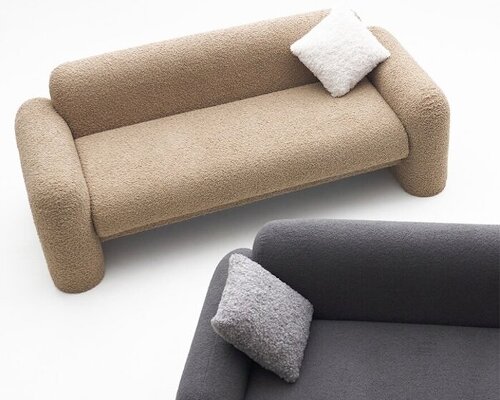
The sofa takes the form of a single continuous volume. Wide cylindrical armrests and a rounded backrest create a stable, monolithic composition. The object appears almost as if it were discovered rather than designed, suggesting a form shaped gradually over time. This approach recalls early architectural structures from the 9th to 11th centuries, where arches and walls retained traces of manual construction and avoided strict symmetry.
Scale plays a central role. Leshi sits low and grounded, avoiding visual lightness or exposed structure. It does not stand apart from the interior but occupies space as part of it, closer to a landscape element than a conventional piece of furniture. The absence of detailing reinforces this effect, directing attention toward proportion, volume, and physical interaction.
Leshi sits low and grounded, avoiding visual lightness or exposed structure
tactility and sensory contrast shape user experience
The upholstery introduces a contrasting layer. Its texture evokes animal qualities such as dense wool, warmth, and softness, shifting the reading of the object from purely architectural to sensory. This tension between a solid, monolithic form and a soft, tactile surface defines the project’s character and strengthens the connection between object, body, and environment.
Leshi does not function as a neutral background piece. It asserts a clear presence and encourages a slower, more physical mode of interaction with space. In doing so, it contributes to a broader discussion on local identity in design, expressing cultural memory through form, scale, and material rather than through ornament or direct historical reference.
wide cylindrical armrests and a rounded backrest create a stable, monolithic composition
tension between a solid, monolithic form and a soft, tactile surface defines the project’s character
instead of relying on decorative references, the design focuses on primary spatial elements
project info:
name: Leshi Sofa
designer: Olga Petrova-Podolskaya/ Design Lab KOD.objects
designboom has received this project from our DIY submissions feature, where we welcome our readers to submit their own work for publication. see more project submissions from our readers here.
edited by: claire brodka | designboom
The post inspired by early slavic living, leshi sofa rethinks furniture as spatial object appeared first on designboom | architecture & design magazine.