
Devices that allow physical touch with WINT design lab
WINT Design Lab envisions, prototypes, and designs regenerative futures through devices and biotextiles that allow humans to connect with their bodies more and free themselves from fossil materials that harm them and the environment. The studio works on (concept) objects that pull people back to their own bodies and away from screens, synthetic feedback, materials that have no biological relationship with the users wearing, touching, and surrounding them. The story begins as the industry produces materials that run almost entirely on fossil fuels, and the timeline for changing that is shorter, and becoming shorter, than most people realize.
Within this setting is where WINT Design Lab steps in. Their response goes: return to the body, return to biology. Their projects use touch instead of screens, biological materials instead of petroleum-based ones, and technology that adapts to the person rather than demanding the person adapt to it. In an imagined future, where people are healthier, more present, and not dependent on systems that poison the ground they live on, the studio’s designs live as infrastructures that can connect us more to our physical and sensorial sides, with the help of biosensors, physiotherapy devices, inflatable structures, bio-based textiles, and even robotic paper folding.
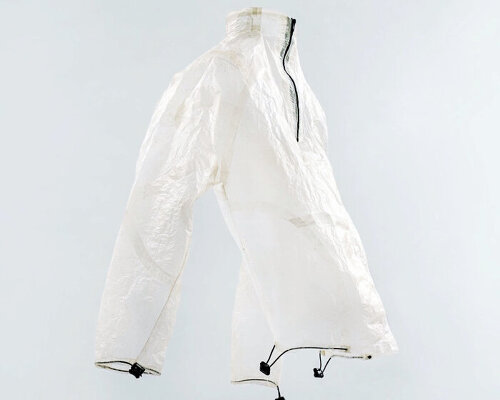
regenerative clothing GOLD | all images courtesy of WINT Design Lab
Materials that work with human bodies, not against them
The thread that connects studio WINT Design Lab’s creations so far is a belief that the materials and objects closest to the human body should work with it, not against it. One of the most direct expressions of this is AVA, a wearable physiotherapy device developed with CPI Electronics and funded by the European Commission’s Horizon 2020 initiative. For people recovering from muscle, ligament, or bone injuries, who are often sent home with exercises to do, and without supervision, they do them wrong, recovery can slow down, so the treatment extends.
AVA chimes in as a compact device that attaches to any body part and uses embedded machine learning to recognize whether a movement is being performed correctly, then gives the user a vibrotactile signal, or a physical pulse, to confirm or correct. There is no screen or app involved to use it, as the therapist trains the device through movement, all the while the patient uses their body and the device communicates through touch. In a community where healthcare is distributed and accessible rather than centralized and expensive, this is what primary rehabilitation can look like: quiet, portable, and entirely focused on the person doing the recovering.
GOLD is a collagen-based textile without any use of plastic
Tactile experience away from digital world and screens
The body and the material world are the two spaces that WINT Design Lab keeps returning to in their regenerative designs. On the body side, what they craft can connect a user to their own physical experience rather than pull them away from it. Take Soft Interfaces, a lamp that responds to a stretched piece of fabric and requires no tap, no swipe, but just a hand pressed on a textile surface that reads the pressure and changes the light accordingly. The liquid metal pathways embedded in that fabric have a melting point below room temperature, which means they flex and stretch with the material without breaking the circuit.
The system reads the change in the pathway’s cross-section and translates it into an adjustment in light temperature or intensity. Both AVA and Soft Interfaces point toward the idea that the objects around people speak the language of the body, be it touch, pressure, movement, instead of requiring people to rely on a screen and what it projects to them. There’s a bodily and physical interaction, which innovative technologies seem to shy away from over time, as they gear more toward swiftness of a processor or a click on a glass surface.
the studio built a demonstrator jacket from cow gut tissue using robotic yarn laying and lamination
WINT Design Lab also shifts from how objects feel to what they are made of and where they go after use. GOLD, the collagen-based textile project developed with Mimotype, built a demonstrator jacket from cow gut tissue using robotic yarn laying and lamination, which is a biodegradable material separable from fiber composites without chemical toxins and acts as a waterproof outer layer for Arctic conditions. The Fiber Futures exhibition at the London Design Festival in 2024 allowed the studio to bring that same material urgency to the forefront, as it showcased five years of research into bio-based alternatives to petroleum-derived synthetic fibers, which make up 91 percent of all human-made textiles and are projected to account for 26 percent of total CO2 emissions by 2050.
Then, there’s ARA, a project that explores air as a structural material, using parametric tessellation patterns drawn from biological systems to create inflatable structures that adapt and protect without rigid frames or wasted material. These projects help imagine and curate a community where the objects people touch respond to their bodies, where the clothes they wear return to the ground when worn out, where structures adapt to conditions instead of fighting them, and where production happens close to the person who needs the object rather than across a global supply chain. In this case, this community isn’t a concept, but the accumulation of what WINT Design Lab has, so far, already started building, one prototype at a time.
view of Soft Intefaces’ liquid metal technology
Soft Interfaces is a lamp that responds to a stretched piece of fabric
users press the surface fabric to interact with the device
MESMER01 is a nano bio-sensor
the sensor opens and closes, initiating the analytical process
detailed view of MESMER01
ARA is a project that explores air as a structural material
it uses parametric tessellation patterns drawn from biological systems to create inflatable structures
detailed view of ARA
view of MESMER01
project info:
studio: WINT Design Lab | @wintdesignlab
The post explore WINT design lab’s regenerative futures where humans connect with their bodies appeared first on designboom | architecture & design magazine.