
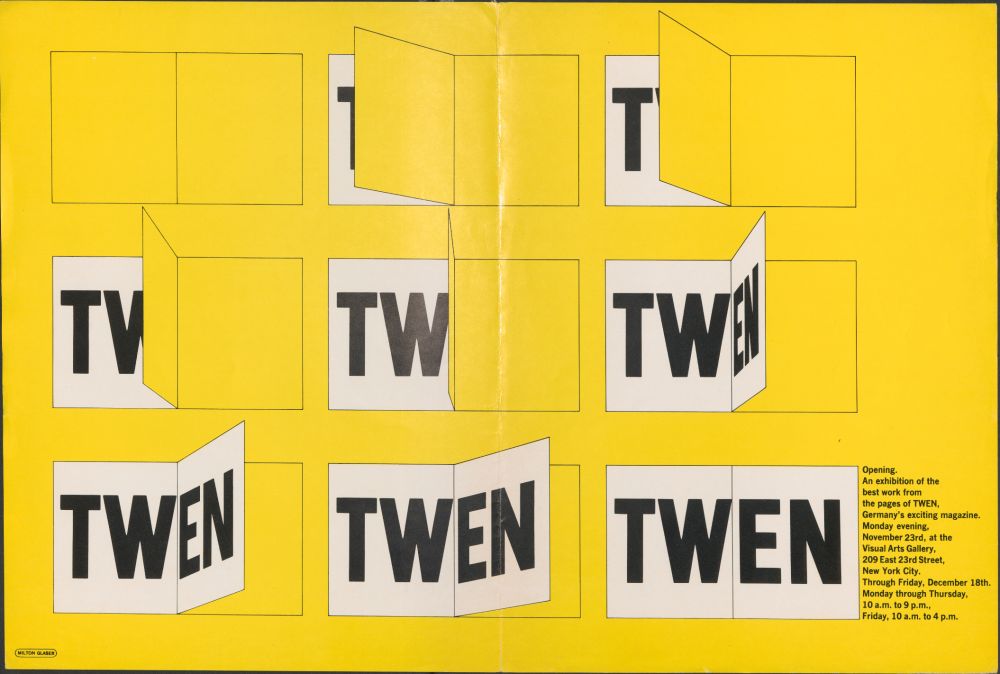
Willy Fleckhaus (1925–1983) was the art director’s art director. As a designer, the magazine twen (short for twenty) in postwar Germany was his R&D and proving ground. Published from April 1959 to May 1971, twen never sold millions of copies like leading German news periodicals Stern (Hamburg), Der Spiegel (Berlin) and Quick (Munich)—but it did have genuine international reach. It attracted a readership not only in Europe but also in America, in part through a mind-expanding exhibition curated by Milton Glaser at the School of Visual Arts. He raised Fleckhaus’ visibility among the American and British art directors who followed his post-Midcentury-strict-yet-explosive typographic virtuosity.
Since 1993, Carsten Wolff has been researching, publishing and collecting Fleckhaus’ entire work. He published the first comprehensive monograph in 1997, followed by an extensive catalog for two museum shows during 2016 in Koln and Munich, from which the examples here are excerpted.
They include some early work, such as the Stib and Sunday supplement, Frankfurter Allgemeine Zeitung magazine.
“Over the decades, I have compiled a diverse, comprehensive, unique and—if I may say so—truly the only existing collection on Fleckhaus,” Wolff says proudly. It includes countless books, magazines and posters designed by him, many personal documents, photographs, letters, manuscripts, drawings, sketches, drafts and all the awards he ever received, including the most significant ones: The Gold Medals from the Art Directors Club of New York. “Fleckhaus was the first non-American to receive this prestigious distinction, and it was a source of particular pride for him,” he notes.
2025 would have been Fleckhaus’ 100th birthday. “For the past three years, I have been trying to initiate an exhibition on his life and work to mark this anniversary—without success,” he laments. “For just as long, I have been looking for an institution in Germany or Switzerland interested in acquiring this collection—also without success.” During his visit to Frankfurt in 1981, even Andy Warhol said he wanted to ensure that the rainbow-colored edition suhrkamp series (below) was included in the MoMA collection. “Unfortunately, that never happened.”
The inability to find viable venues for archival graphic design has been a sad development for many aging designers and the researchers who are keeping snuffed flames alive. Wolff sent me an example of an unpublished manuscript that would be invaluable to anyone seeking insight into Fleckhaus’ thinking. “It is a typescript of Fleckhaus’ inaugural lecture at the University of Wuppertal, which I am currently evaluating for my upcoming dissertation. In this text, Fleckhaus explicitly details his connection to New York, the School of Visual Arts, Milton Glaser, and a guest appearance at Alexey Brodovitch’s lessons in Richard Avedon’s studio.”
“An example from New York: Next to the giant Camel posters: the giant posters denouncing the city’s pollution with the words: ‘When this poster was hung up, it was still white.’ No other image. Just the slogan. Just the surface: a gray one now! They could have learned that from Beuys, if the designers in New York weren’t already as smart as they are. The metropolis, the competition has shaped them. And a school. Most of them were graduates of the ‘School of Visual Arts’ on 48th Street. Only those with a thriving art practice can become teachers there. Milton Glaser, founder of the famous Push Pin Studios, himself a teacher there, staged my first American exhibition at the School of Visual Arts. So, understandably, my sympathies go to America, where I also found the man who must be called the father of modern magazine design: Alexey Brodovitch, a Belarusian, stranded in New York. Art Director of Harper’s Bazaar. Discoverer, stimulator of almost all the great photographers there. Towards the end, sick and frail, he taught in Richard Avedon’s studio. His listeners sat on cabinets and windowsills. He set concrete tasks. From week to week: ‘Make 3 double-page spreads about the Brooklyn Bridge.’ And then he hardly corrected. Works he didn’t like, he threw on the floor. And that was almost all of them. ‘Shit, shit, shit!’ he yelled. He had invited me for a guest lecture and I asked him: ‘Aren’t you doing them an injustice? After all, they are paying for this hour with you.’ ‘No,’ he said, ‘I am doing them right by trying to chase them away. They should be grateful to me. Without talent, they will later perish in the jungle of New York.’ He said ‘talent’ and believed in it so much; just as our schools even suppress the word. Yes, he loved the talents. He praised them effusively, became tender, as only a Russian can be tender, and said: ‘I can only animate the talent, it develops by itself. I can only watch it grow.’”
While Fleckhaus’ work is available in a rare monograph and catalog, there is nothing that takes the place of the real documents. Carsten is currently trying to place his entire archive in a welcoming and accessible institution. Below are pages from his co-authored book, Fleckhaus: Design, Revolt, Rainbow.
The post The Daily Heller: Willy Fleckhaus, a God of Art Direction, Seeks Safe Haven appeared first on PRINT Magazine.