
Freddy Mamani on his fusion of architecture and heritage
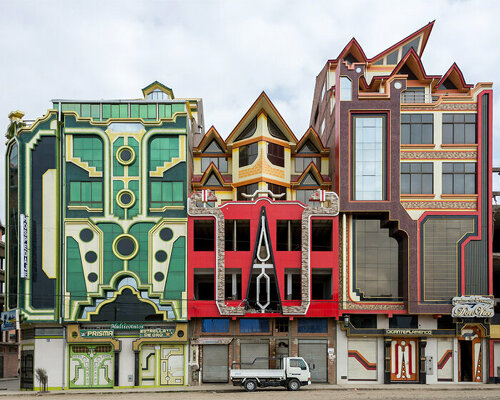
Bolivian architect Freddy Mamani emerges not simply as a stylistic outlier, but as a practitioner of a living utopia; one grounded in cultural continuity rather than speculative abstraction. Known for his vibrant Neo-Andean architecture, Mamani has reshaped the monochromatic cityscape of El Alto in his native country, transforming its once monochromatic skyline into a bold expression of identity. His work resists the homogenizing tendencies of global modernism, instead proposing an alternative vision of progress rooted in indigenous knowledge and collective memory.
Mamani’s architecture operates less as a projection of an ideal future and more as an active method, as a way of building that reconnects past and present to produce new spatial possibilities. By embedding Aymara symbolism, craft, and color into contemporary structures, his projects challenge the notion that modernity requires rupture from history. Instead, they suggest that utopia can be constructed incrementally, through cultural affirmation and everyday urban transformation. For deeper insights into the fusion of architecture and heritage, designboom had the opportunity to attend Mamani’s speech at the In Focus: Radical Repair event during the Triennale di Milano 2023 – read the conversation below.
Freddy Mamani’s vibrant architecture in El Alto | all images courtesy of Yuri Segalerba
interview with BOLIVIAN ARCHITECT Freddy Mamani
designboom (DB): What is the focus of your participation at the In Focus: Radical Repair event?
Freddy Mamani (FM): I want to show my identity through architecture. With my participation in In Focus: Radical Repair, I want to showcase that in South America exists a strong culture tied to its ancestral roots.
DB: In your work, you’ve imbued the city of El Alto and other places across Bolivia with culture, color, and personality. How does your approach contribute to the concept of radical repair?
FM: We have contributed to filling a radical void within the urban landscape by creating buildings that help the current society identify with the culture of our ancestors by incorporating ‘Tihuanacota’ elements and traditional colors.
Mamani expresses his identity through his extravagant architectural works
DB: Bolivia, like many places around the world, grapples with climate change and inequality. How do your architectural projects address the interconnectedness of these issues and propose solutions for a more sustainable and equitable future?
FM: Climate change and inequality have been extremely worrying factors in the past few decades. In my projects, I try to incorporate materials that are friendly to the environment and don’t leave polluting debris behind. In order for architecture to be sustainable, we need to utilize local materials, less energy, and reuse the water we put into construction. In order for architecture to be equitable, we need laws that are more aligned and coherent with society, so that the majority can be prioritized.
flamboyant shapes and colors characterize Mamani’s style
DB: What kind of elements of indigenous architecture and crafts do you incorporate in your work? Can you elaborate on how this approach not only preserves culture but also aids in repairing social and ecological fabrics within your community?
FM: The goal is for these buildings to serve as an element for society to interact with their roots and integrate rurality and urbanity.
DB: Can you discuss the role of community involvement and engagement in your architectural projects?
FM: People are the strongest agents of change in this city. My community gives me the opportunity to freely work on my buildings and with them, change the ochre color of the city to a colorful one.
‘the goal is for these buildings to serve as an element for society to interact with their roots and integrate rurality and urbanity,’ the architect shares
DB: In the face of ‘global boiling,’ what are the most pressing challenges for architects and designers, and how can they balance the protection of vulnerable communities with environmental conservation?
FM: The challenge is urgent in the face of extreme global warming. We architects have to promote and make our customers aware of the need to adopt sustainable practices. The most vulnerable communities are usually respectful and caring towards the environment.
DB: From your experience, what lessons can architects and designers worldwide learn when it comes to infusing cultural identity and history into their work while addressing urgent contemporary issues?
FM: To my architecture peers, I want to say that each culture and society in the world is different and, in order to deal with climate change and other globalized issues, we have to always respect our history in the face of modernity. We need a more conscious society in order to deal with modern world problems.
Mamani is noted for his transformation of the monochromatic cityscape of El Alto in Bolivia
the Bolivian architect’s style is called Nuevo Andino (New Andean)
the presence of multiple bright colors is evident in both exteriors and interiors
Mamani’s designs draw inspiration from indigenous traditions and craftsmanship
project info:
name: New Andean architecture in El Alto
architect: Freddy Mamani | @freddy_mamani_silvestre
location: El Alto, Bolivia
event name: In Focus: Radical Repair
event location: Triennale di Milano, Milan, Italy
event date: 28 September 2023
The post ‘we have to respect history’: freddy mamani on constructing utopia through radical repair appeared first on designboom | architecture & design magazine.