Voting should be easy, right? Registering to vote should be clear and simple, right? Participating in democracy should be encouraged, right? Alas, just because something should be the case, doesn’t make it so, and certain groups have done their best to make voting in the US complicated and inaccessible for certain groups as a means of maintaining their power. But thankfully there are organizations like VoteRiders who have stepped up to fight against these voting obstacles.
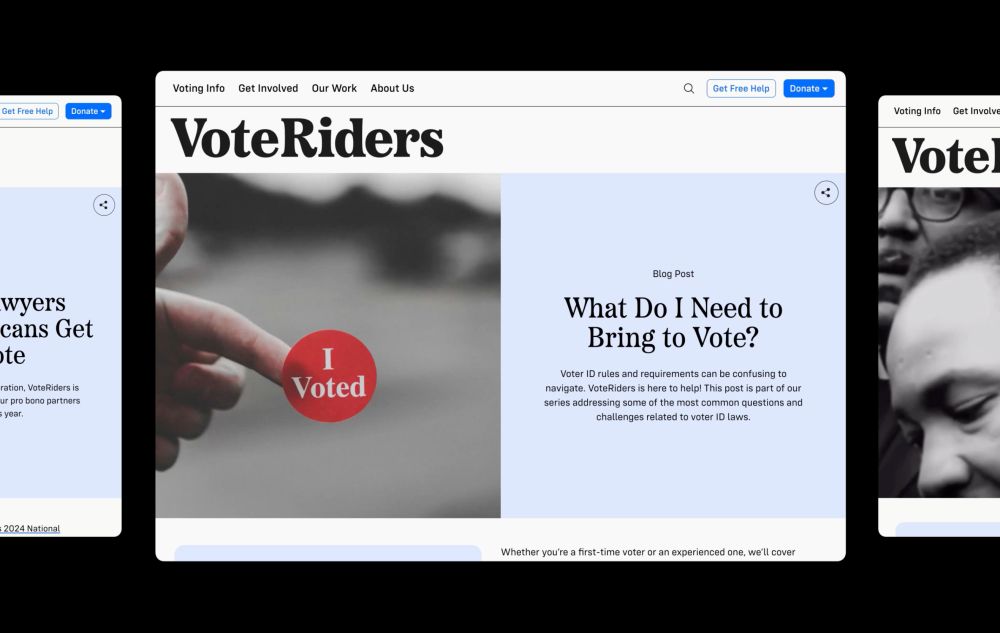
VoteRiders is the US’s leading nonpartisan nonprofit focused exclusively on eliminating voter ID barriers. And just ahead of the fall voting season, they’ve launched a new platform in an effort to transform dreadfully confusing voter ID laws into a clear, accessible, and action-driven digital experience.
“One of the biggest voter suppression tactics is confusion,” said Kiayna O’Neal, Digital & Communications Director at VoteRiders. “When laws are messy and intentionally complicated, people disengage. They choose to stay home rather than wade through the confusion to cast a ballot. The new site cuts through the noise and supports our efforts to combat the confusion and misinformation that eligible voters encounter. It’s clear, it’s accessible, and it makes it easier for people to get free direct support. Creativity goes beyond aesthetics here, it’s a tool for civic action and engagement.”
VoteRiders teamed up with the New York design consultancy Synoptic Office, a 2025 PRINT Award honoree, to bring the platform to life, and tapped Morgan Searcy for the brand identity. Searcy developed a look and feel inspired by the bold visual language of 1960s and 70s public service announcements, and used high-contrast color, confident typography, and clear structural hierarchy to bring clarity to a disjointed space. “When design is organized, optimistic and actionable, it reduces friction, and reducing friction increases participation,” said Caspar Lam, Partner and Co-Founder at Synoptic Office.
When asked about the 1960s and 70s service announcement style, Lam and his fellow Synoptic Office Partner and Co-Founder, YuJune Park, elaborated on that historic context. “America in the 1960s witnessed a period of polarization and growing distrust in institutions, including the government. However, the country also saw a growth of extraordinary grassroots movements that sought to empower citizens and push toward a more equal and representative society,” they said. “People-powered graphics—flyers, posters, handbills, and more—helped shape the visual and communication landscape. We hoped to capture some of that optimism and its sense of empowerment and opportunity in the design.”
With ID laws for voters continuing to change across the country, voters need clear, trusted information laid out in a navigable and organized way that’s simple to grasp. “The site is built to meet people where they are: those navigating busy lives and constantly shifting voting rules, or those lacking the resources and information to participate in our democracy,” said O’Neal. “Every element is designed to inspire action, from securing an ID to vote, to mobilizing communities around the harms of ID laws, to giving people and partners the tools to help protect the freedom to vote.”
When designing for an organization that’s driven by an action-based mission, aesthetics are far from the main consideration. “It goes without saying that we always want to place citizens and their needs first,” O’Neal and Park explained. “This means imagining all of the edge cases and scenarios that might affect their use of the design and making sure they feel confident about making decisions and performing actions. From here, design decisions like audience-specific areas, frequent use of lists, and generous sign-posting help create the conditions for citizens to move through the experience more easily.”
But creating visually appealing design is baked into inciting action. “We’re not dismissive of aesthetics because these things matter to human beings, and help bring a measure of joy and delight to an otherwise stressful situation,” added O’Neal and Park.
The platform has been designed to serve three separate audiences: Disenfranchised individuals facing barriers to obtaining voter IDs, supporters and partner organizations looking for a dynamic hub of resources, and policy experts, researchers, and journalists wanting a trusted source to understand the evolving landscape of voter ID laws. Across the platform, every piece of information connects to a clear call-to-action. Stories that were once purely informational now lead directly to tangible next steps, from getting free assistance to supporting advocacy efforts.
“This project was about designing an ecosystem of action,” said Park. “Every page pairs clarity with a pathway, so information never stands alone. It always connects to what someone can do next.”
O’Neal, Park, and the Synoptic Office team don’t take working with important organizations like VoteRiders lightly. “We are always humbled that our partners have placed their trust in us no matter how big or small the project is,” they said. “Our studio is mission-driven, and so we feel deeply responsible to all of the partners we work with (be it educational, cultural, or civic) because they are all invested in making the community and society we live in a better place.”
The post VoteRiders Gets Out the Vote with a New Platform that Demystifies Voter ID Laws Across the US appeared first on PRINT Magazine.