
assemble: a practice grounded in collaboration and continuity
Assemble has developed a practice that moves between architecture, design, and social engagement, working across scales to produce not only buildings but also the conditions that sustain them. Co-founder Anthony Engi Meacock, during his conversation with designboom editor-in-chief Sofia Lekka Angelopoulou (find designboom’s coverage here), describes an approach grounded in collaboration, making, and long-term thinking.
Founded in 2010 to undertake a single self-built project, the London-based collective emerged from a desire to act directly on the built environment. As Meacock explains, early work was driven by ‘trying to work together again in the way that we had done at university’ and by ‘exploring our agency as designers in public.’ What began as an informal collaboration has since evolved into a practice that maintains a non-hierarchical structure while engaging with increasingly complex projects.
Central to Assemble’s work is an expanded understanding of architecture itself. Rather than focusing solely on form, the collective operates through what Meacock describes as ‘a very holistic idea about the kind of activities that come under architecture,’ encompassing programming, fabrication, and long-term use. This approach allows projects to extend beyond their initial construction, embedding themselves within existing communities and systems, and supporting forms of continuity that resist the short-term logic of conventional development, where utopia is less imagined than it is lived. ‘It’s not just about the work we do now. It’s about creating a sustainable framework for the future,’ Meacock adds, pointing to a practice that prioritizes continuity, adaptability, and shared authorship over fixed outcomes.
The Cineroleum (2010)
from self-built experiments to collective infrastructures
Assemble began as a loose collective testing what architecture could do outside of commissions. In 2010, just after the financial crash, its members came together to realize The Cineroleum, a self-built cinema in a disused petrol station in London. With no formal structure and minimal resources, the project became an exercise in total authorship. ‘We kind of designed it, built it … we programmed it, we made the uniforms, we made the signs, we chose the films, we managed it,’ recalls co-founder Anthony Engi Meacock. This project shaped the collective’s way of working, one rooted in immediacy, collaboration, and a shared sense of agency.
That early, improvised model continues to underpin the collective’s practice today. Assemble approaches architecture as an evolving framework, an expanded understanding that becomes more explicit in projects like Blackhorse Workshop in Walthamstow, a community workshop developed in the wake of the 2011 riots. Conceived as ‘a library of tools,’ the space remains deliberately minimal, while the social infrastructure it enables continues to grow. Significantly, the project operates independently from the studio. ‘it’s a separate organization … something that we’ve created and then kind of let go,’ Meacock explains, highlighting a recurring ambition to build systems that can sustain themselves beyond the architect’s control.
This approach extends into more traditional commissions without losing its experimental edge. At the Goldsmiths Centre for Contemporary Art, Assemble works within an existing industrial structure, developing materials through on-site testing and fabrication. Working with tight budgets, the team produces custom elements in-house, from facade components to tiles and finishes, embedding craft directly into the building process. As Meacock notes, this allowed them ‘to create a very economic affordable kind of crafted element on a building,’ demonstrating how hands-on making can operate even within institutional constraints.
a self-built cinema in a disused petrol station in London
granby as a lived utopia
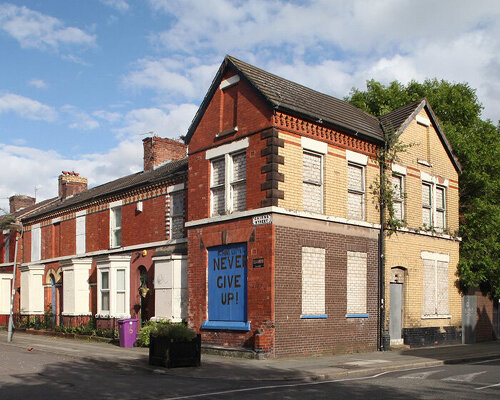
‘You’re not trying to start things from scratch,’ Meacock explains, describing an approach that prioritizes existing communities, materials, and networks. This principle finds its most compelling expression in Granby Four Streets in Liverpool, a long-term collaboration with residents in a neighborhood shaped by decades of decline and failed regeneration policies. Where previous interventions had erased local identity, replacing ‘real material culture … and real community’ with ‘very nondescript, very soulless’ developments, Assemble begins instead by listening.
By the time the collective becomes involved, residents have already initiated their own forms of resistance, painting empty houses, planting gardens, and organizing street markets. ‘They’d sort of taken matters into their own hands,’ Meacock recalls. Rather than imposing a masterplan, Assemble develops an incremental strategy that works with these existing efforts.
Within the restored houses, small gestures carry significant weight. After years of neglect, many interiors had been stripped back entirely. ‘All items of value been removed from the property,’ read the notices left behind. In response, Assemble allocates a small portion of the budget to what they call ‘enhancements,’ reintroducing moments of care and identity. Fireplaces, in particular, become symbolic anchors, described by Meacock as a ‘phoenix-like rebirth of the house.’ These elements persist even as new residents adapt the spaces to their own needs, suggesting a form of continuity that extends beyond the original intervention.
The project expands further through Granby Workshop, a social enterprise producing handcrafted objects inspired by the architectural details of the neighborhood. Initially developed as part of Assemble’s Turner Prize nomination, the workshop has since evolved into an employee-owned company, creating jobs and sustaining local production. Creating a kind of economic activity within the area, Meacock explains, points to a broader ambition: architecture not only as spatial intervention, but as a catalyst for long-term social and economic structures.
Granby Four Streets (2013)
thinking ecologically, not just sustainably
Alongside this socially engaged work, Assemble’s practice also engages deeply with material research. Questioning conventional notions of sustainability, Meacock suggests a more grounded approach: ‘We’re quite like primitivists as architects … we’re interested in the things being the things.’ Rather than relying on technological systems, the collective focuses on the inherent properties of materials and their relationship to place, approaching design through ecological thinking rather than optimization.
This thinking is developed further in their collaboration with Atelier LUMA in Arles, where the team works with local resources such as rice husks, sunflower stalks, and limestone dust to develop new construction systems. The process is iterative and experimental, with multiple materials tested on site. ‘There’s about 20 different materials … three or four actually turned into things that were usable,’ Meacock notes, emphasizing the role of trial and error and its impact in the design process.
a long-term collaboration with residents
one method across multiple scales
Across installations, buildings, and urban strategies, Assemble maintains a consistent focus on participation, craft, and adaptability. ‘Our diversity is a strength and sometimes a weakness,’ Meacock reflects, yet this breadth allows the studio to operate across disciplines while retaining a clear underlying approach. Regardless of scale, architecture is understood not as a fixed outcome, but as a process that unfolds through use. Through research into community land trusts and locally driven housing models, Assemble explores alternatives to conventional top-down systems. How you could look at like a different model development, Meacock suggests, points toward a shift from designing individual projects to shaping the frameworks that produce them.
This ethos is reflected internally within the practice itself. Operating with a flat hierarchy, Assemble allows long-term collaborators to become partners, ensuring continuity while maintaining its collective structure. ‘Anyone who joins … is eligible to join the partnership,’ Meacock explains, reinforcing a model based on shared authorship and gradual evolution.
Rather than proposing utopia as a distant or idealized vision, Assemble constructs it incrementally, through projects that are embedded, adaptive, and open-ended.
painting empty houses, planting gardens, and organizing street markets
Granby Winter Garden (2019)
an incremental strategy that works with existing efforts
the team maintains a consistent focus on participation, craft, and adaptability
Folly For a Flyover (2011)
Atelier LUMA (2023)
Assemble’s practice also engages deeply with material research
rather than proposing utopia as a distant or idealized vision, Assemble constructs it incrementally
regardless of scale, architecture is understood as a process that unfolds through use
This article is part of designboom’s Utopia: Then and Now chapter, examining utopia’s role in the past, present and future as a way of envisioning a better way of being. Explore more related stories here.
The post assemble builds a collective future by working with what already exists appeared first on designboom | architecture & design magazine.