
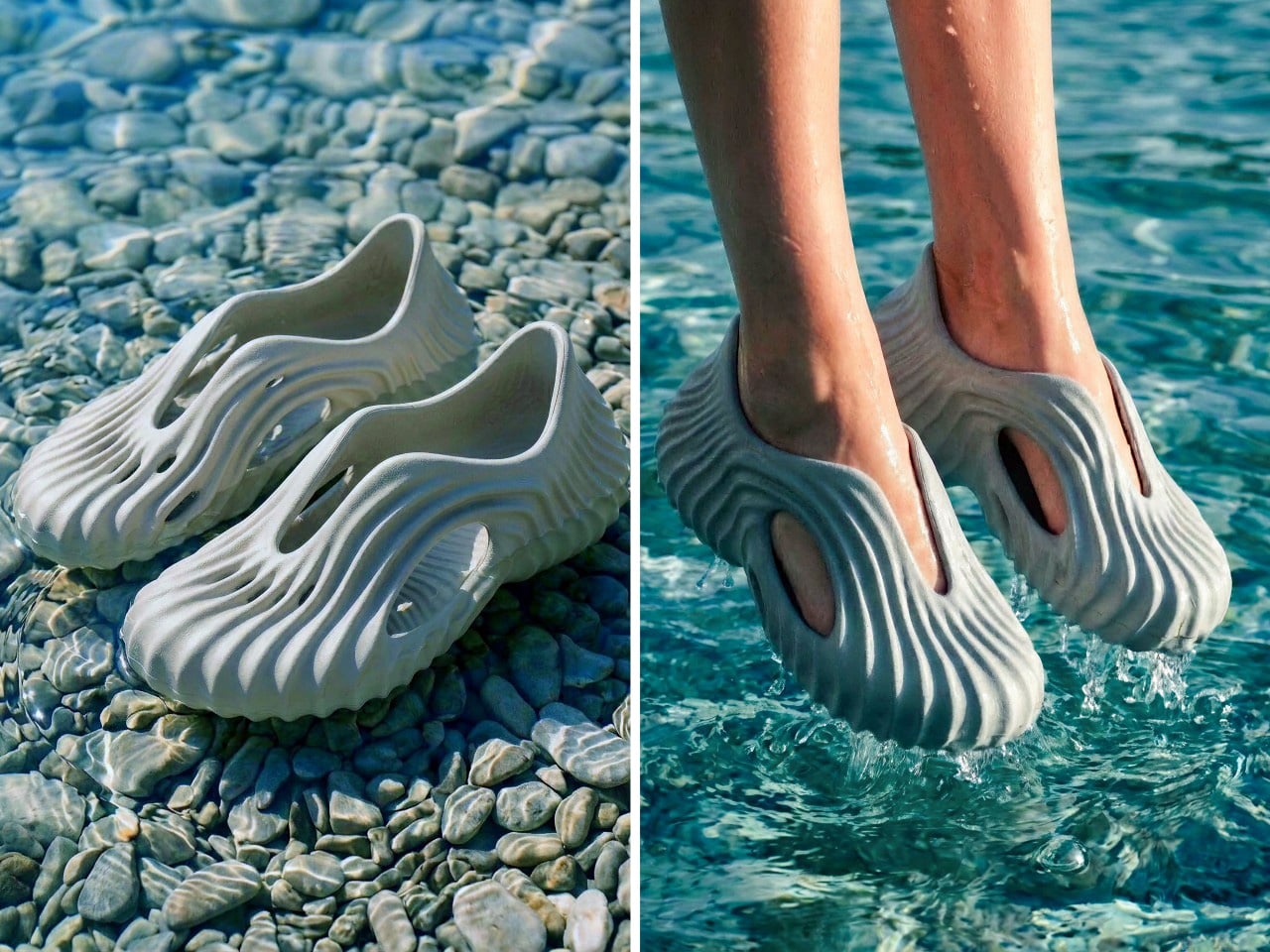
The Yeezy Foam Runner opened a strange and genuinely productive door in footwear design, proving that a monolithic, organically sculpted clog could capture serious cultural attention. Tati Ferrucio‘s Onda walks through that same door but ends up somewhere quite different. Where the Foam Runner borrows loosely from athletic heritage, the Onda goes fully geological, its dense flowing ridges reading more like layered sandstone strata than anything borrowed from a sportswear archive. The comparison is worth making once and then setting aside, because the Onda has its own logic and it holds together well on its own terms.
That logic starts with landscape. Ferrucio drew directly from waves, sand patterns, stone surfaces, and tree bark, treating nature as the original generative designer and asking what footwear would look like if it followed the same rules. The cutouts are sculpted voids, not punched holes, and the ribbing on the sole wraps continuously into the upper so there is no visual seam between base and body. It reads as a single carved object, the kind of thing you might find in a tide pool if tide pools produced wearable foam.
Designer: Tati Ferrucio
Ferrucio developed the Onda using Vizcom, an AI-assisted design platform that takes a designer’s sketch and generates a field of iterated possibilities rather than a single resolved outcome. The workflow is worth pausing on because it explains something about the result. The Onda does not look like a design that was decided in one session; it looks like a form that accumulated, the way sediment does, layer by layer under consistent pressure from the same directional force. Just FYI, Vizcom did not generate the design; Ferrucio directed it, feeding creative intention into each round of iteration and pulling the form toward her reference material until the surface stopped arguing with itself and settled into something coherent.
Positioned along the sides of the upper, the cutouts allow water and sand to escape when moving through wet or granular terrain, which is a functional requirement in a clog built for outdoor use. But structurally, they also reduce material mass without compromising the integrity of the upper, and visually, they create depth in the silhouette that a solid body would not have. The oval void near the heel is particularly well resolved; it sits inside the ribbed surface like a window cut into a canyon wall, framed by ridges on all sides, and gives the rear of the shoe a formal completeness that most clogs never bother to achieve.
Three colorways exist in the current lineup: a grey-blue that photographs like wet stone, a sand beige that almost disappears against the layered rock surfaces in the campaign imagery, and a sage green that reads somewhere between sea glass and weathered copper depending on the light. Each one is photographed in a context that suits it specifically, which is the kind of creative direction that signals a designer who thought carefully about what the object is actually communicating and to whom. The grey-blue sits on a rocky riverbed in shallow water. The beige is shot against sedimentary cliff faces in warm light. The green lands on dry sand with hard shadows. Every environment reinforces the geological reference without stating it out loud.
The Onda is a mere concept at this stage, developed in collaboration with Vizcom as a demonstration of what AI-assisted industrial design can produce when the designer maintains genuine creative authority over the process. Whether it goes into production depends on factors Ferrucio has not specified, but as a design object it makes a coherent and confident argument: that the clog format, for all its utilitarian plainness, has more formal ambition available to it than most brands have been willing to extract.
The post Tati Ferrucio’s Onda Clog Is the Most Geologically Correct Shoe Ever Made first appeared on Yanko Design.