
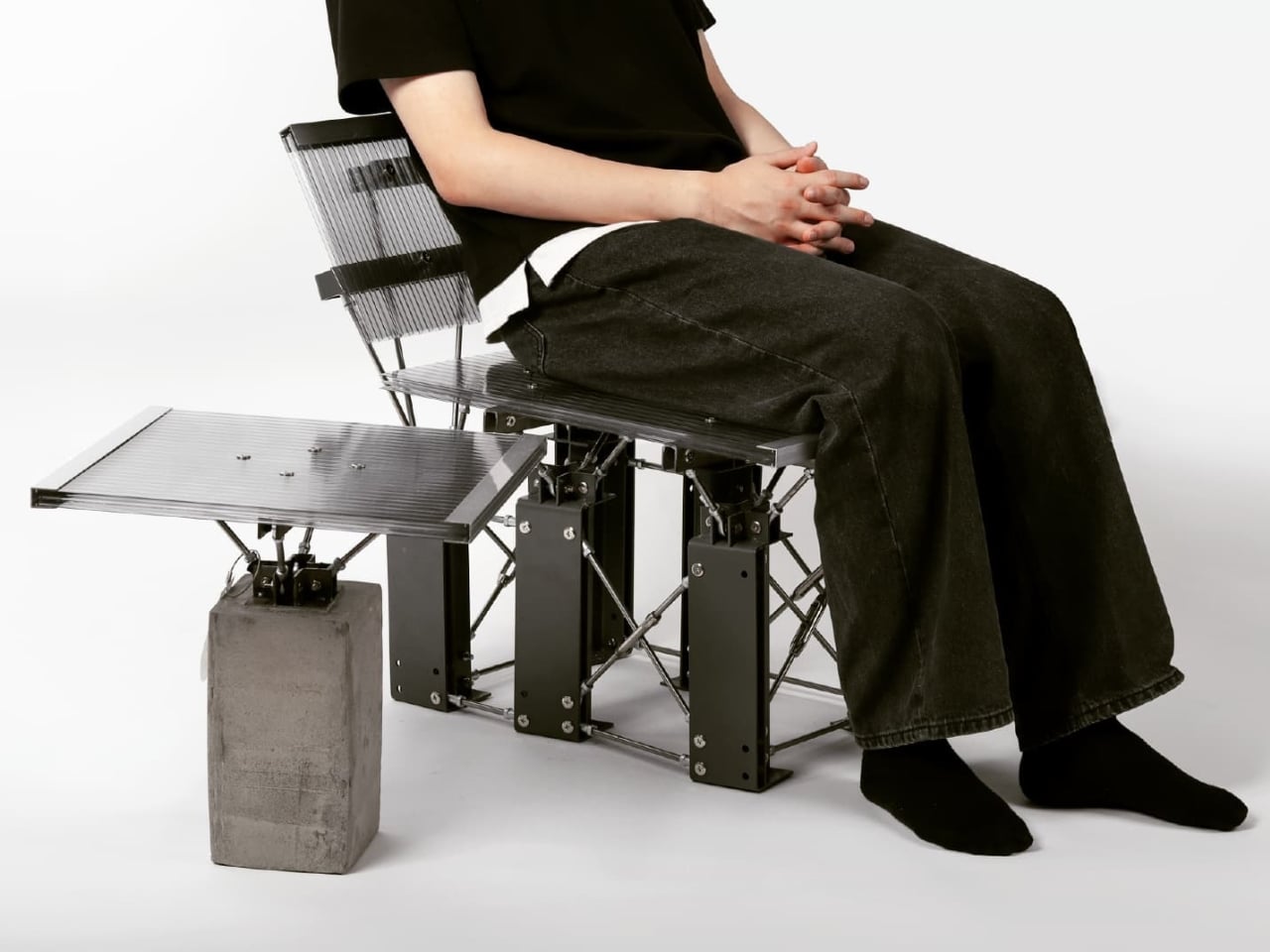
Most furniture design conversations orbit the same fixed points: material choices, color palettes, the eternal debate between form and function. SeongJin Hwang isn’t really interested in that conversation. With the YY Series, his studio TPGF takes a hard left turn and asks a more structural question: what if furniture borrowed its logic directly from architecture?
It sounds like a thought experiment, but the result is a collection of pieces that feel genuinely original. The series consists of two objects, the Y1 side table and the Y6 lounge chair, both built around what Hwang calls a “Y structure,” a truss-inspired configuration that mirrors the load-bearing frameworks found in bridges and buildings. The name isn’t arbitrary. Y1 uses the structure once; Y6 repeats it six times. Simple math, surprisingly compelling design.
Designer: SeongJin Hwang
What makes this interesting isn’t just the aesthetic, though the aesthetic is striking enough on its own. Look at the Y6 chair and you’ll see something that reads almost like a miniature industrial site: bolted steel joints, criss-crossing metal rods, ribbed panel surfaces. It doesn’t look like furniture trying to reference architecture. It looks like architecture that happens to be the right size to sit in. That’s a harder trick to pull off than it sounds.
The truss is one of the oldest structural tools in engineering. Builders have used triangulated frameworks to distribute weight and resist bending since well before modern steel construction, and architects have long made a visual language out of it. Steel bridges, industrial warehouses, airport terminals, concert stages; the truss pattern is everywhere once you start noticing it. Hwang’s premise is that this visual and structural logic belongs in the domestic sphere too, not as decoration, but as genuine engineering applied at a smaller, more intimate scale.
The Y1 side table is the more understated piece. On its own, a single Y structure can’t carry the load a table demands, so Hwang grounds it in a concrete block. The contrast is the point. Concrete is gravity and mass; the steel Y above it is precision and tension. Together they read like a tiny architectural section model that also holds your coffee. The rigor is real, but so is the playfulness.
The Y6 chair scales the idea up and out. Six repeating Y modules form the base and back support, creating a dense pattern of interconnected joints that distributes weight the same way a truss distributes structural stress. From the side profile, the chair looks almost impossibly mechanical, like a piece of stage rigging folded into a sitting position. From above, the bolted tabletop surface turns the ribbed panel into something straight out of an architectural rendering.
The most honest way to describe the YY Series is as furniture made by someone who wasn’t willing to forget what they learned in an architecture program the moment they sat down at a design desk. That’s not a criticism. The tendency to treat furniture and architecture as completely separate disciplines with only occasional, surface-level overlap has always felt a little artificial to me. Buildings and the objects inside them share an ongoing conversation about structure, material, and human use. The YY Series makes that conversation explicit rather than decorative.
Whether these pieces belong in a gallery or a living room is a fair question. The steel and concrete combination isn’t exactly warm, and the mechanical density of the Y6 chair isn’t for everyone’s taste. But that’s part of what makes it worth paying attention to. The YY Series isn’t trying to soften architecture into something livable. It’s inviting you to live inside the logic of architecture directly, bolts, trusses, load paths, and all.
The studio received recognition for the YY Series at the Architecture Madrid Award in October 2024. For a design rooted so firmly in structural thinking, that feels like exactly the right room to be noticed in. The work is worth tracking, and SeongJin Hwang is a designer worth knowing.
The post Furniture That Borrows Its Bones From Architecture first appeared on Yanko Design.