
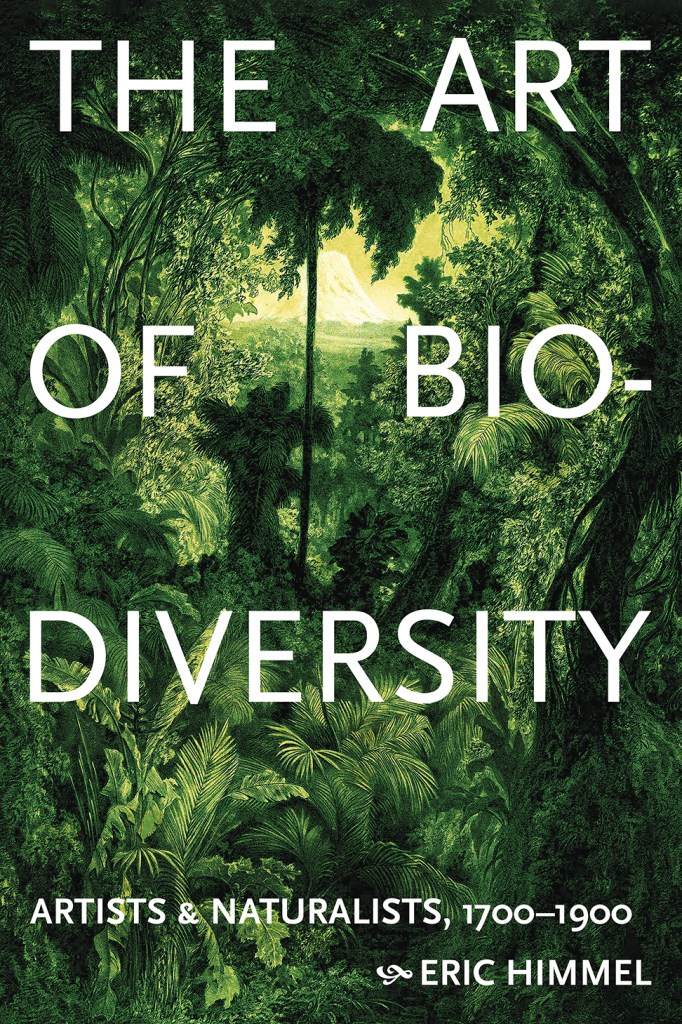
… Essential! And the art and design of natural science is brought to the forefront in Eric Himmel’s elegantly written, illustrated and designed The Art of Biodiversity. Available on April 13 from Abrams, this book is essential too!
The word “Diversity” has been erased from the Trump lexicon but is fact in the natural world. Himmel, editor-in-chief of Abrams (2002–2019), proves its truth beyond doubt. Through the lens of science for two centuries (1700-1900), artists and naturalists have chronicled the vast array of visible and microscopic organisms designed to inhabit our biodiverse third rock from the sun. While some of the images have been seen before as curiosities in some art books or textbooks, the vast number of plates herein are new to me (and will be to you). But image alone does not underscore the significance of or pleasure inherent in Himmel’s research. He has impressively deconstructed, narrated and annotated every image in the three main branches of natural science and brought attention to a species of little-known specialized artists.
This is not a science book per se, but an explorative appreciation of the art and artists who brought the natural worlds from the shadows to the sunlight with their extraordinary artistic and observational skills. For those who are not immediately seduced by this art, I guarantee your senses will be touched. And although realism prevails, many of the selected images exemplify natural abstraction in the service of existence.
The following dialog with Himmel will whet your appetite for more.
Why did you become interested in naturalism and this very specific approach to portraying and presenting it?
It was really just luck. Every editor has fantasy books, and mine was a vague concept that I called “Design in Nature.” I never figured that one out, but during the pandemic I was surfing around looking for images I could use to make my dream project. I stumbled on a massive online library of illustrated natural history books, mostly from the 18th and 19th century. I’d never been particularly interested in “natural history art,” but something about this collection moved me. The rules of this kind of art are simple: The artist is making an accurate drawing, or portrait, of a species, for science. Before photography, you needed artists for that. I named this “biodiversity art.” Why? Because this art played an important role in communicating the modern view of nature as millions of species evolving in deep time and filling every corner of Earth. I was convinced I’d discovered a lost child of the history of art.
You are an editor and artist; what made you believe that you could do the extensive research, write such evocative text, and design every inch of the book yourself?
Over 40 years of editing, shaping, occasionally designing, and even ghostwriting illustrated books at Abrams, I got a lot more than Malcolm Gladwell’s famous 10,000 hours of practice. I was like a grad student who never left school. What “made me believe” I could do it was this: Over those 40 years, all the different analog tools and techniques needed for the very separate tasks of research, writing and design were integrated into a single digital computer. Every day that I worked on the book on my Mac desktop, I felt like the captain on the bridge of the starship Enterprise, exploring the universe, compiling a record of other life forms.
Your collection of illustrations ranges from representational to veritably surreal. What criteria did you use in the process of selecting each one?
In the two centuries my book covers, hundreds of superb artists made a living from portraits of animal and plant species. All of them felt a professional and even a moral obligation to draw living beings accurately. I tried to gather an all-star team of the most skilled and imaginative, including famous artists like Audubon or Haeckel, along with unknowns. It’s our modern brains that see some of their pictures as naturalistic and others as surreal. I suspect that the further living things get from us on the evolutionary tree, the more surreal they appear to us. In reality, a bluejay is no less mysterious and otherworldly than carnival candy slime mold.
What were the motivations that pushed an artist like Ernst Haeckel (to whom you dedicate two chapters) to create such detailed documentary illustrations?
Many of the biodiversity artists felt suspended between art and science and suffered through vocational crises until they found a way to practice both. Haeckel was a scientist through and through, but he had the art itch real badly. In his twenties, he even briefly fantasized about becoming a landscape painter, freaking out his fiancée. The scientific frontier he chose to explore—the marine invertebrates—was particularly rich in strange, complex organisms that he could draw. To Haeckel, the essence of life was expressed in archetypal forms that he struggled to depict. I’m sure many scientists since Haeckel inhabit mental universes populated by ideal forms, but I don’t know of any that have tried with any seriousness to make pictures of them.
Haeckel’s 1862 book Die Radiolarien includes flawless, artful details of radiolarians—like his plates of Acantharea species—that could not even be seen through a microscope of his time. How did he achieve such gem-like results?
That’s a great question. Radiolarians are unicellular marine organisms that secrete fancy skeletons of glass or gemstone. We can’t know what Haeckel saw in his microscope. One of his contemporaries who examined Haeckel’s microscope slides couldn’t find the precise symmetries and architecturally rhythmic shapes that he drew. More recently, Stephen Jay Gould thought that Haeckel just made stuff up, delighting art lovers and irritating scientists ever since. This question goes straight to the heart of what makes hand-drawn pictures of species so different from photographs. Haeckel would strip away imperfections in his subjects to reveal an underlying pattern. In this sense, you might say that his drawings were somewhere between diagrams and portraits. Would a modern biologist be able to reliably identify the species of a radiolarian specimen from one of Haeckel’s drawings? I kind of doubt it.
Some of Haeckel’s images (above) refer to the Art Nouveau tropes of naturalistic curvilinear obsession. Is Haeckel the source for this?
Haeckel’s drawings of radiolarians and jellyfish did inspire a few Art Nouveau designers and architects to explore new design concepts. For example, René Binet based his magnificent monumental gateway to the Paris Exposition Universelle of 1900 on Haeckel’s radiolarian drawings. But the influence went both ways. By the 1890s, Haeckel and his lithographer were working in an Art Nouveauish mode—it was in their toolbox to want their pictures to look modern. That’s another way drawing is different from photography. It has much greater latitude for expressing style as well as content.
What sources did the artists of the undersea world use to create this virtually alien beauty?
The source for every illustration in my book is a specimen, full stop. In some cases, it was a living plant or animal. More often, it was a preserved specimen. Marine animals are often preserved in fluid—maybe you’ve seen squids in jars in a natural history museum. To draw a jellyfish, Haeckel might scoop it into a glass vessel and observe it carefully while it lived. Then he would transfer it to alcohol and dissect it, to capture its fine anatomical structures. The English naturalist Philip Gosse invented the modern aquarium, which made it possible for him to study living marine plants and animals in his studio and capture their vivid colors, which fade soon after they die. All the biodiversity artists were avid adapters of visualization tools.
The animal and plant kingdoms, species of all kinds, have been recorded in hand-colored engravings and lithos. What was the most difficult (or rarist) work to locate?
Let me give a shout out for one of the achievements made possible by the internet that we should feel proud of. I call it the universal library. While we were staring at our smartphones, just about every book ever published that’s in the public domain was scanned, ripe for reading or downloading. Twenty years ago, the biodiversity artists were buried in inaccessible library vaults. Today, they are a click away. That’s progress. For the record, I’d say the rarest book I illustrate is Bauer’s Strelitzia depicta, on bird-of-paradise flowers, with 10 copies known to exist. But the Natural History Museum in London scanned and uploaded its copy, and today Strelitzia depicta is free for anyone to enjoy.
I am fascinated by the microscopic surreality of creatures like Facelina uricula, which has an otherworldliness, and Philorthagoriscus serratus, which is somewhat monstrous. How were the artists able to find and render these presumably real creatures?
Steve, I love it that you call them “presumably real creatures”! They’re very real. What’s happening here is that the Italian naturalists who made these drawings, working at the end of the period covered by my book, didn’t have the training and skill of earlier generations. In some ways, their naïve style makes their work more pleasing to modern eyes. Maybe we could call them “outsider biodiversity artists.”
What did you learn from your expedition into shape-shifting nature?
For me personally, it was a real pleasure to spend five years looking at and thinking about hand-drawn pictures rather than photographs. To travel back to a time when possessing drawing skills could be as valuable as being able to write a sentence. Today, when we struggle to pay attention to anything, we think of attention as a valuable resource. To draw a butterfly carefully is an act of paying attention. One of the ironies of our time is that we worry more about the fate of nature than earlier generations, but I think we may actually pay it less of our attention.
What do you want the reader to take from this biodiverse artistic treasure?
Well, biodiversity art is the only artform that isn’t about us humans. It has nothing to say about our societies, our history, our sins, our virtues, our values, our perceptions, our beliefs, our temptations, our fantasies, our desire for transcendence. We like to speculate about extraterrestrial life, but I wonder if we’d just find it boring when we encounter it, because it’s not us. We have plenty of alien life forms on Earth that are uncontroversially believed to possess sentience, and, slightly more controversially, to have consciousness. I hope some readers will want to spend some time with these earthly aliens, and the colorful men and women who drew their portraits with such loving care.
The post The Daily Heller: Nature is to Design What Design is to Life appeared first on PRINT Magazine.