
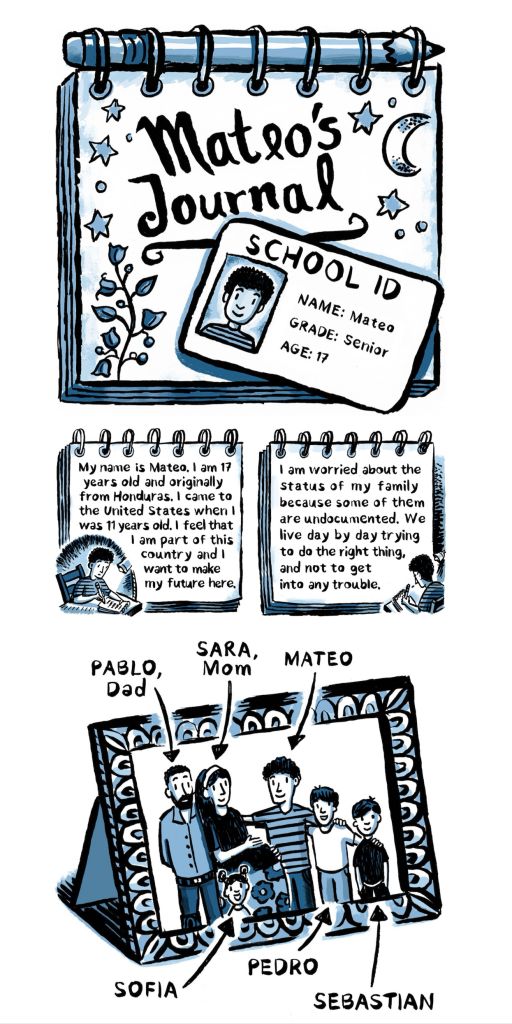
“Separation” is an episodic comic strip that runs in The New York Times. It chronicles a Honduran family as they struggle to survive during the current tidal wave of immigration abductions and deportations. Although names and some details have been changed to protect the vulnerable, this is not fiction; rather, actual reporting by journalist Jake Halpern in real time, conveyed as visual narrative by artist Michael Sloan. Together they created “Welcome to the New World” in 2018 as a New York Times Opinion series about a family of Syrian refugees seeking haven in the U.S. It went on to win the Pulitzer Prize.
“Separation” centers on Mateo, a 17-year-old boy who’s coming of age in the era of ICE. It’s based on Mateo’s real journal entries, firsthand reporting, and legal documents. (“Separation” episodes can be found here in their entirety, along with “Welcome to the New World.”)
It’s drawn by Sloan in a subdued style that enhances the quotidian disquiet and fear experienced by the family caught between untenable alternatives—continual gang violence that runs rampant in Honduras, and ICE’s cruel enforcement. In contrast to increasing photographic evidence of ICE’s fatal outcomes, “Separation” is a spotlight on the human toll such policies wreak on the hearts and minds of the victims.
The episodes each address the barbarity in a sympathetic way so that the reader is free to apply their own emotions and points of view. I asked Sloan, who has been an illustrator for the Times for over 20 years, to talk about his emotional and professional experience in working on this testament for our times.
What triggered “Separation” as an ongoing strip?
In an early 2025, Jake and I decided that we wanted to work together on another project. We were hoping to find a mixed status family with an adolescent child who could be the focus of our story. Through a legal aid agency in Manhattan, Jake was introduced to a family of Honduran refugees who live in the New York City area and are facing the risk of deportation and seeking asylum. The family was immediately willing to collaborate with us on our project. We subsequently pitched the story to The New York Times one morning in the spring, 2025, and they gave us the green light for the project later that same day. We were very fortunate because often these things can take days, weeks or months to unfold.
How involved did you become in the family’s life? And how did you decide what to include or not?
Jake meets with the family on an ongoing basis and does all the interviewing (I have not met the family yet, though I’m looking forward to doing this at some point soon). Jake is also in frequent contact with their lawyer. Based on these interviews, especially Mateo, who is the 18-year-old son and the protagonist of our story, he writes a panel-by-panel script for each episode, which goes through an editorial process at The New York Times before I receive it and start sketching. We have weekly online meetings with our New York Times team, a form of progress report to meticulously go over each episode panel by panel. Jake decides what to include or not to include in the storyline.
Jake and I are very aware of the fact that we are doing justice to the family, and want to portray them with the dignity, grace and honor that they deserve. It is our hope that the family will read this comic with a sense of pride for many generations to come. It is also our hope, as with “Welcome to the New World,” that this project will eventually become a full-length graphic novel, and that it would be translated into Spanish as well as other languages so that it can reach a broader audience.
Did Mateo readily agree to be involved? He must have dreaded what the consequences could be.
Yes, he readily agreed to be involved (as did the rest of the family), and he continues to do so. He does not dread the consequences of being in the comic. In fact, we have the sense that he is quite proud of the work that we are doing and his involvement in it. He is fearful of having to recall the horrors that he endured in Honduras and what that brings up for him as he seeks to apply for asylum. This is most evident in Part 5 of “Separation.”
What was your level of concern? Do you believe that this strip will help families within this terrible system?
I feel connected to the family and wish them well. Mateo is a visual artist and likes to play drums, so he and I have an artistic connection. I would like to think that somehow “Separation” will help this and other families dealing with immigration issues. For now, all I can hope is that we are giving voice to people that do not have one, so that they can be understood and provided with the help that they need.
Have you feared for their safety?
Yes, I fear for their safety. This is mostly as a result of something that I witnessed when I was visiting out of town a few months ago. A bicycle food delivery messenger had been pulled over by about a dozen ICE agents in a busy urban neighborhood, and was being asked for identification. My wife explained that he could be an American citizen and could be on a plane and shipped out of the country within 24 hours. I did not understand that this could happen. Witnessing this put a human face on deportation issues that I had not considered before.
How has working on “Separation” altered your own life as an artist and person?
When Jake and I worked on “Welcome to the New World,” it gave me an appreciation for the many challenges that refugees face as they settle in our country. It also made me appreciate the tireless work of an army of volunteers, many from diverse religious organizations, who help immigrants with nearly every aspect of their lives, from opening a bank account, helping the children go to school, to learning how to use a thermostat in their apartment. This was a very life-changing experience. “Separation” is a greater extension of this.
Pacing myself is a very important part of this project. I’m also a prolific and productive musician with over 300 music albums available on Spotify and other streaming platforms. I tend to work on two panels at a time, then I go upstairs and record two songs, shifting back-and-forth between visual art and music. “Separation“ is a life-changing experience, but so is every song that I record, so positive life-changing experiences are fortunately something that occur for me on a daily basis.
What has the response been? Given the Times‘ audience, I’d assume there is empathy. But are there any surprises?
In my experience, most of the people that I meet in my neighborhood or when I am giving speaking engagements at various universities and schools are sympathetic and understanding of the family and their situation.
At the bottom of the comic on The New York Times‘ website, there is a curated comments section. Some comments are sympathetic and understanding, others state that we have borders for a reason, and since several members of the family entered the country illegally they should be deported.
I recently gave a talk at a local elementary school where third through sixth graders publish a highly professional newspaper. They interviewed me and asked me questions such as “Am I afraid of ICE?” And “Do I get any hate from my involvement in this project?” The answer to both is no. Some of the students in this classroom were facing similar issues that the family in “Separation” is facing.
Is there any chance of a “Hollywood” resolution? Or is the family trapped by the system?
For me, personally, a Hollywood resolution would be that Mateo is accepted and goes to college, and receives the legal status that I think he deserves. Yes, the family is trapped by the system at a particularly challenging time in our nation’s history.
The post The Daily Heller: An Immigrant’s Fear Factor is More Than a Game of Survival appeared first on PRINT Magazine.