
judy chicago constructs utopia through feminist space-making
American artist Judy Chicago approaches utopia as a method embedded in space, collaboration, and education. Her work is currently on view in Judy Chicago: Revelations at the Joods Museum, a comprehensive survey marking her first major presentation in the Netherlands, while The Materiality of Judy Chicago, curated by Allison Raddock, will open in 2026 at Alberta Pane in parallel with the Venice Biennale. Together, these exhibitions bring renewed attention to a practice that, across more than five decades, has consistently constructed environments where historically excluded voices, particularly women, can be seen, studied, and collectively reimagined.
From Womanhouse (1972), where domestic space is collectively reworked from within, to The Dinner Party (1974–79), which reorganizes historical narratives through a shared structure, Chicago develops environments that actively reshape how histories are experienced and produced, asking ‘What If Women Ruled the World?’
Judy Chicago, Installation view of Wing Three, featuring Margaret Sanger and Natalie Barney place settings from The Dinner Party, 1979, Elizabeth A. Sackler Center for Feminist Art, Collection of the Brooklyn Museum. © Chicago Woodman LLC, Judy Chicago/Artists Rights Society (ARS), New York; Photo © Chicago Woodman LLC, Donald Woodman/ARS, NY
rewriting space through feminist environments
From the outset of her career, Judy Chicago understands space as something shaped by social and cultural forces. This becomes evident in Womanhouse (1972), developed with Canadian artist Miriam Schapiro and students from the Feminist Art Program at CalArts, where an abandoned domestic interior is transformed into an immersive installation and performance environment. The project grows out of consciousness-raising sessions, where participants reflect on personal experiences and begin translating them into physical form, turning the house itself into a medium for examining the realities of domestic life.
Rooms such as the Menstruation Bathroom or the collectively produced Dining Room push familiar settings to an uncomfortable clarity. Everyday spaces are exaggerated, reframed, and at times made surreal, revealing the emotional and social pressures embedded within them. Through this process, the house operates as an active field of experimentation, where personal narratives take spatial form and shared experiences begin to reshape how these environments are understood. The significance of Womanhouse lies in how it is made and inhabited, as much as in what it shows. The project opens up a space where dominant ideas around gender and domesticity can be questioned from within, suggesting that even the most familiar environments can be reworked through collective action and reinterpretation.
Womanhouse catalog cover featuring Judy Chicago and Miriam Schapiro, 1972. Designed by Sheila de Bretteville | image courtesy of Though the Flower Archives housed at Penn State University Archives
collective authorship and the politics of representation
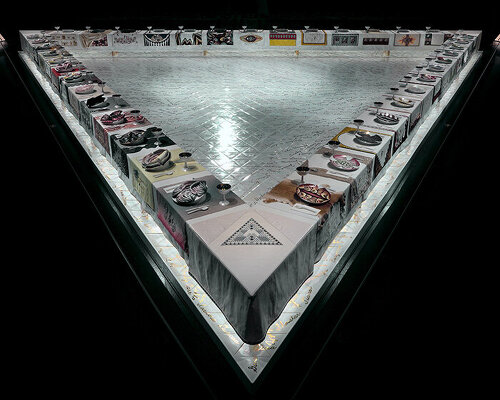
Chicago’s most widely known work, The Dinner Party (1974–79), expands this approach into a large-scale installation that brings history into the room as something shared and spatial. Arranged as a triangular table with thirty-nine place settings dedicated to historical and mythical women, the work stages a symbolic gathering where absence is actively addressed. Figures who had been overlooked or excluded are given presence through their placement within a structured, collective setting.
The project emerges from an extensive collaborative process, involving hundreds of contributors working across ceramics, embroidery, painting, and research. This mode of production shifts attention away from the idea of a single author, instead foregrounding a network of hands and voices whose contributions shape the work at every level. The system formed for this installation is built through shared labor, where meaning is produced collectively rather than imposed from above.
At the same time, The Dinner Party has prompted ongoing debate, particularly around its use of recurring visual motifs associated with femininity and the boundaries of the histories it brings forward. These critiques become part of how it is understood. They point to the complexity of attempting to construct a space of inclusion, where any effort to gather and represent inevitably raises questions about who is included, how, and on what terms.
This tension continues across the installation, where the 999 additional names inscribed on the floor extend the work beyond the table. Recognition moves outward, suggesting a broader field of presence that cannot be fully contained within a single structure.
Judy Chicago, The Dinner Party, 1979, Elizabeth A. Sackler Center for Feminist Art, Collection of the Brooklyn Museum. © Chicago Woodman LLC, Judy Chicago/Artists Rights Society (ARS), New York; Photo O Chicago Woodman LLC, Donald Woodman/ARS, NY
pedagogy as spatial and social infrastructure
For Judy Chicago, education is one of the core components of practice. The Feminist Art Program, developed in the early 1970s, set out to rethink how artistic knowledge is shared and produced. The program was built around dialogue, collaboration, and the recognition of personal experience as a valid starting point for making work, challenging, in this way, the hierarchy between teacher and student, opening up a more collective way of learning and creating.
Within this framework, the classroom becomes a space for discussion, reflection, and making Consciousness-raising sessions, group critiques, and collaborative projects allow participants to draw connections between their own experiences and broader social structures, gradually shaping new ways of understanding both themselves and their work. Learning is not treated as a preliminary step before making, but as something that happens through it, in real time and in relation to others.
This approach continues beyond the original program, extending into Chicago’s ongoing efforts to document and share feminist art practices. Through archives, teaching materials, and long-term educational initiatives, these methods are carried forward, allowing them to be revisited, adapted, and reactivated in different contexts.
Seen this way, pedagogy begins to function almost like a spatial system. It shapes how people come together, how they participate, and how ideas take form. Utopia, in this context, appears built through these interactions, through the conditions that make new forms of visibility, authorship, and collective work possible.
first issue of Networks magazine published by the California Institute of the Arts, edited and designed by students in the School of Design (1972)
material, labor, and the politics of making
Across her practice, Judy Chicago moves away from the idea of a finished or idealized work. Her projects remain open, shaped by process, collaboration, and ongoing revision, an approach also reflected in her choice of materials. By working with ceramics, textiles, and embroidery, she brings forms of making traditionally excluded from fine art into focus, not as secondary or decorative, but as central to how meaning is produced. These materials carry histories of labor often associated with women, and their presence shifts the terms through which artistic value is understood.
This way of working continues in projects such as the International Honor Quilt (1980), which brings together contributions from multiple participants into a work that grows over time, absorbing new additions and perspectives. Its structure remains open, suggesting that cultural production does not move toward completion but unfolds through accumulation and exchange.
Even in more spatially defined installations, attention to process remains visible. The layers of collaboration, research, and technical work that support each project are not hidden behind a finished surface, but remain part of how the work is read. What matters is not only what is presented, but how it comes into being, with the conditions of making forming an essential part of its meaning. This shift becomes more explicit in later projects, such as What If Women Ruled the World? (2020), where Chicago moves from constructing environments to structuring a shared question. Developed as a participatory work, the project invites audiences to contribute their own responses, transforming speculation into a collective process.
Judy Chicago, What if Women ruled the World?, 2020 | image © designboom
practice in the present
Judy Chicago’s practice shows how utopia can take form through concrete actions rather than abstract ideas. Projects such as Womanhouse rework domestic space from within, The Dinner Party reorganizes historical narratives through a collective structure, and the Feminist Art Program reshapes how knowledge is shared and produced. Each of these operates as a specific response to existing conditions, proposing alternatives that can be tested in real time.
Taken together, these works do not aim to define a perfect model but to demonstrate how change can occur through spatial, social, and educational frameworks. Utopia, in this sense, becomes a set of practices that make different ways of living, working, and remembering possible.
Judy Chicago, What if Women Ruled the World?, 2020, Embroidery and brocade on Velvet backed fabric, Executed by the Chanakya School of Craft, Mumbai, India, 204 × 144 × 0.5 in. (518.16 × 365.76 × 1.27 cm), Collection of Jordan Schnitzer Family Foundation. © Chicago Woodman LLC, Judy Chicago/Artists Rights Society (ARS), New York; Photo © Chicago Woodman LLC, Donald Woodman/ARS, NY
Judy Chicago, Arles Lilies,2024. metal, color | image © Adagp, Paris, 2024 © Victor & Simon – Renata Pires
immolation from women and smoke, 1972 fireworks performance | performed in the california desert © judy chicago/artists rights society (ARS), new york photo courtesy of through the flower archives courtesy of the artist; salon 94, new york; and jessica silverman gallery, san francisco
Judy Chicago, Herstory, 2024, Le Magasin Électrique, Parc des Ateliers, LUMA Arles, France | image © Adagp, Paris, 2024 © Victor&Simon – Joana Luz
Judy Chicago with Zig Zag and Trinity, c. 1965.
Judy Chicago, 2020 | photo © Donald Woodman/ARS
This article is part of designboom’s Utopia: Then and Now chapter, examining utopia’s role in the past, present and future as a way of envisioning a better way of being. Explore more related stories here.
The post from ‘the dinner party’ to feminist classrooms, judy chicago builds change through practice appeared first on designboom | architecture & design magazine.