
Oh, it’s so in
When I last posted here about the Outside Art Fair in New York City, it was a relatively sedate event, calm, spacious. Not so last weekend. The Metropolitan Pavilion on West 18th Street was jam-packed with eager visitors and with gallery owners happily talking art, taking orders, running credit cards, and wrapping up paintings, drawings, prints, collages, sculpture, jewelry. At the 2011 OAF, most of the artists were no longer alive, having made their art, for example, on the back of prescription pads they picked up at the mental hospitals where they’d spent much of their lives. Not so anymore. Most of the artists are very much alive, but still don’t fit into the traditional mold of those with university or art school MFAs.
Which got me wondering, as I took in all the art and all the people, why so many are interested in outsider art right now. Is it because outsider art is unconventional, emotional, raw, diverse, visually interesting, thought-provoking? But is it also a way to support people, the makers, often marginalized individuals with intellectual disabilities, some who’d been institutionalized or homeless? Or could it also be because the prices are so good? Some pieces were priced at around $300 and some at $10,000, but the average seemed to hover between $3000 and $5000. What’s most important now, I wondered, the art itself or its investment potential? Were some of the buyers hoping to discover the next Basquiat for $1000 that might someday bring them millions.
And yet, I for one, just kept hoping that my house could grow more wall space so I could pick up a few great pieces, especially those that incorporate typography, hand lettering, calligraphy, and collage elements from packaging and advertising. Here are some examples.
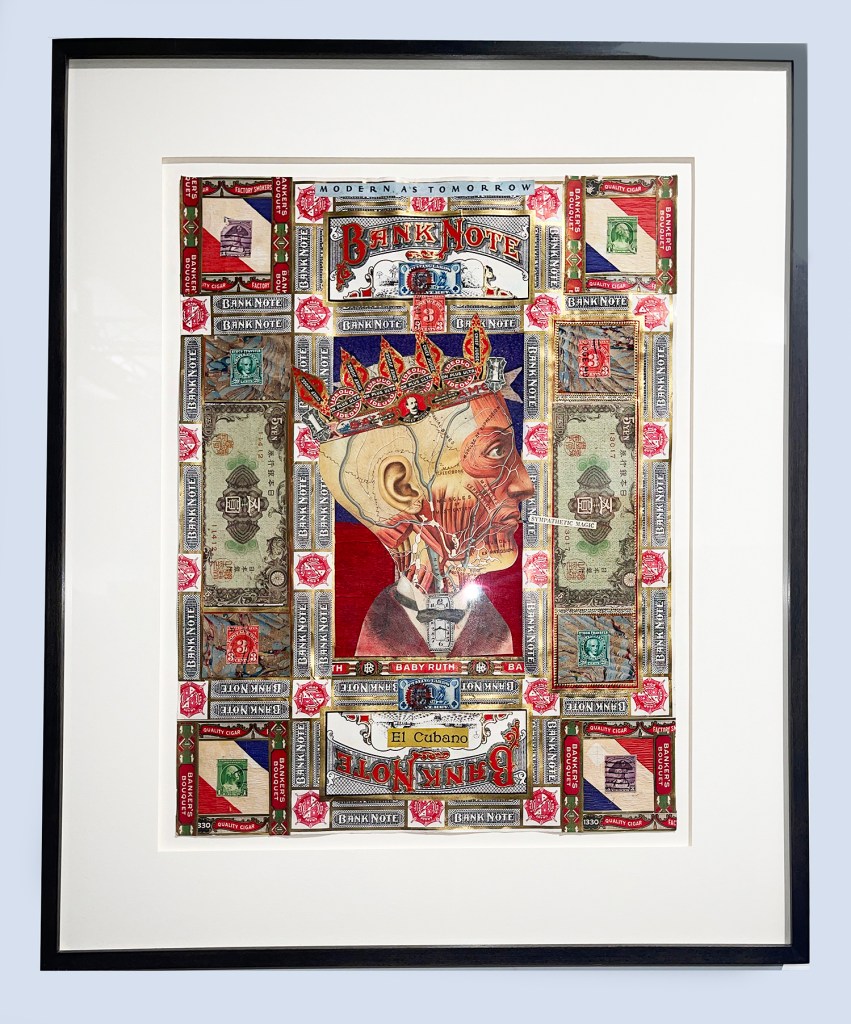
Felipe Jesus Consalvos (1891-1960)
While I stood in front of his collages, admiring how deftly he’d incorporated cigar bands into the composition, Hillary Halter, assistant director at Fleisher Ollman Gallery, Philadelphia, stepped up and explained, “He was a cigar roller from Havana.” Right, I’d seen his work before and read about how his 750 collages on paper and on surfaces including photographs, musical instruments, and furniture were discovered in 1980 at a Philadelphia garage sale. Somehow, now they spoke to me even more eloquently.
Howard Finster (1916-2001)
“Finster was a preacher who worked in obscurity,” Halter commented as I studied Visions of Light Beyond the Light of the Sun. “He’s one of the most celebrated self-taught religious artists, turning to visual art in 1976 after claiming a divine calling to illustrate his spiritual visions, and his art has been on David Byrne and REM album covers.” True. In 1985, I learned, Talking Heads commissioned a Finster painting for “Little Creatures” that was selected as album cover of the year by Rolling Stone magazine. I hope Sagmeister gave Finster a high five.
This fair does have an egalitarian feel compared to other contemporary art fairs in New York and globally.
Hillary Halter, Assistant Director at Fleisher Ollman Gallery, Philadelphia,
“Others agree, also finding it refreshing that self-taught people are passionate about making art regardless of whether or not people buy it. And some of the stuff, like Finster’s paintings, are really out there and over the top, which is freeing and fun. In terms of buying opportunities, there’s a lot here with approachable prices. And outsider art collectors do love the discovery aspect.”
If you can read the small print, his spiritual visions come through loud and clear.
Simone Johnson (b 1971)
Johnson’s NYC Bodega Cats are whimsical depictions of the snacks, fast foods, smokes, beverages, grocery items, and sweets that fill the stomachs of New Yorkers as we work, work, work. Using Prismacolor pencil on paper, drawing from life and scrap references, Johnson creates much of her work at Pure Vision Arts (PVA) on West 17th Street, an artists’ studio and exhibition space for individuals on the autism spectrum or with intellectual and developmental disabilities. Funded partially through New York State Medicaid, PVA provides studio space, art materials, exhibition opportunities, and career development for 45 artists, many of whom were visiting the space during my visit. As PVA director Margot Werner and Robert McMinn (above), explained, the artists in the program spend two to five days there each week. I’d love to see PVA listed as a must-see on all tours of downtown galleries.
Dwight Mackintosh (1906-1999) and Dan Miller (b 1961)
For more than 50 years, Creative Growth in Oakland, CA, has given studio space and support to artists with developmental disabilities. Work done there has been shown in major museums including MoMA and the Centre Pompidou. At the OAD I was most impressed by the work of Dan Mackintosh, whose non-legible script seems to allow the viewer to understand the story of the individuals pictured.
These compelling pieces that combine typewriter type with handwriting in “dense clouds of marks” are by Dan Miller.
Kunizo Matsumoto (b 1962)
Born and raised in Osaka, Matsumoto attended a school for children with developmental disabilities. Later, at a special-ed program that got him interested in writing and calligraphy, he started imitating the staff’s memo-pad notes and filling notebooks with his versions of kanji, the Chinese characters used in the Japanese writing system. These days, Matsumoto is a dishwasher in his family’s Chinese restaurant. By night, he does calligraphy, typically on printed material like Tokyo Disneyland guidebooks, Kabuki theatre programs, various catalogs and pamphlets, and on these 14.5 x 20.5-inch Japanese calendar pages, covering nearly all the white space with what Richard Solti of Ritsch-Fisch Gallery in Strasbourg, France, agreed is “fake Japanese.”
Harry Underwood (b 1969)
I was immediately drawn to the graceful script with flourishes that would impress just about any lettering artist. “He’s a former house painter who lives in Nashville creates dreamscapes and invented memories with latex paint on wood,” explained Lara Lindsay of Lindsay Gallery, Columbus, Ohio. The color palette did remind me of typical ‘approved’ home-exterior pastels. The images reminded me of ads for bras and sanitary products in my mother’s 1950s Ladies’ Home Journals. Ah, that was what life was like then: happy women in a garden, dancing, diving into a swimming pool (“I dreamed I smelled the flowers in my Maidenform bra”). But then Underwood’s art has strange elements, including what Lindsay calls “random writings of what’s on his mind,” such as “you reminded me when I ate a sandwich” scribbled next to the woman ready to run a race in the Did She Leave painting, and hair that seems out of control in I Smell Iniquities. And there are even happy house painters, surely a tribute to Underwood’s coworkers in Florida, where he grew up.
David Slater (b 1940)
Slater does not quite fit into the usual outsider artist definition of “self-taught, no formal art education.” He has a degree in art from Buffalo State University and taught art in England and at Rhode Island School of Design, where he earned his MFA. “He’s not untrained, but chose to cross over into outsider world,” explained Mark Wilson, the East Hampton, NY, artist who represented him at OAF. “He went homeless and lived on the street, ultimately making collages with matchboxes and with found images from packaging.” Choosing to abandon abstract expressionism, he developed a style with symbols, words, and black-outlined figures referencing dreams and memories. Slater now lives in Sag Harbor and leads tours of the Pollock-Krasner studio in East Hampton. So far, I haven’t figured out what 66 and 44 mean, but those numbers (ages, an address, something about evil?) will keep me thinking.
And then there is the price. Will someone buy this piece and hang it in their living room because they love it, or because David Slater might become the next art world superstar?
I posed that question to Mark Wilson, had surrounded himself with Slater’s work.
I think that people who come here are curious about work by outsiders because there’s an authenticity and a possible experience of the unexpected.
Mark Wilson
“Outsider art gives the art world something the regular gallery world does not. It’s not about investment. I don’t think the next Basquiat is to be discovered here. I knew Jean Michel Basquiat,” he went on. “I lived around the corner from him and often went over to visit, and yes, he was an outsider, but the circumstances that led to his success were unique and serendipitous. A few dealers see this potential in some of their artists and create a buzz around them to drive up prices, but it’s nothing like what occurs in the regular art world.” Wilson went on to say that he’s interested in all acts of creativity and not in monetary value. “The chance opportunities aren’t predictable and, hey, Basquiat died at 28 but Slater, 86, is still going. So what’s the trade-off? Fame and fortune, addiction and death, or a long life of struggle with learning and discovery?”
Bruce Lee Webb (b 1966)
Webb is a Texas boy who makes art on antique seed bags and old canvas, and also on chairs, masks, and various other objects. “I was born in Waxahachie, Texas into the world of love and heavy religion stirred with an interest in the occult. My parents were [a] religious leader and teacher where they taught The Word and studied comparative religions,” he wrote on his website. That helps explain why his paintings have titles like Mayan Cosmology and Cosmic Consciousness, and are filled with symbols including planets, hearts, eyes, and more planets, arranged like chakras on (a Martian’s?) body.
In their double-size booth, Mark Todd and Aaron Smith of Hey There Projects hold up Bruce Lee Webb seed-bag paintings.
Della Wells (b 1951) and Anne Grgich (b 1961)
This is the piece that knocked my socks off. Della Wells (in blue hat, below) was there, ready to introduce herself, chat, explain the big picture and the details. I told her—and everyone else in earshot, including the artists’ rep, Debra Brehmer of Portrait Society, Milwaukee—that I thought Them! Us! should be hanging at the entrance to the National Museum of African American History and Culture in Washington, DC. This work is the story of America, and it’s not for anyone’s living room. A smart collector should buy it and donate or loan it to the NMAAHC, or to the Studio Museum of Harlem. Wells, who lives in Milwaukee, said that she and Grgich, who lives in Tacoma, WA, longtime friends, collaborated on it together and apart, cross-country and during visits and calls, for two years. The piece consists of elements affixed to a 110 x 60-inch American flag. The Capitol is a handmade lace tablecloth. The lettering and the faces representing America’s polar opposites are embroidered.
Wells, more or less, was the art director who created the concept, the composition. Grgich put it all together, the detail work, the portraits and stitching. There is much to look at and ponder: The subtitle: Liberty Is Defined by Those Who Speak Truth. The objects, including buttons (the political kind and the clothes-fastening kind), fringe, appliques, jewelry, the result of years of collecting and many trips to shops that sell sewing supplies.
And then there are the two chickens on the women’s laps. Why? “My mom brought home a chicken,” Wells said. “I thought it was gonna be my pet. My dad killed it and we ate it.” She wanted that chicken to live the way I want this piece to live.
The post Outsider Art Is In appeared first on PRINT Magazine.