
I’m glad you asked …
Like Magicicada—”periodical cicadas, which spend most of their lives as underground nymphs and emerge in predictable intervals of 13 or 17 years” (Wikipedia)—I clean out my computer files every 13 or 17 years. Happily too, because I come across wonderful surprises, like this: One of my favorite, though completely forgotten, articles from PORT magazine in 2012. It’s just as relevant now as it was then.
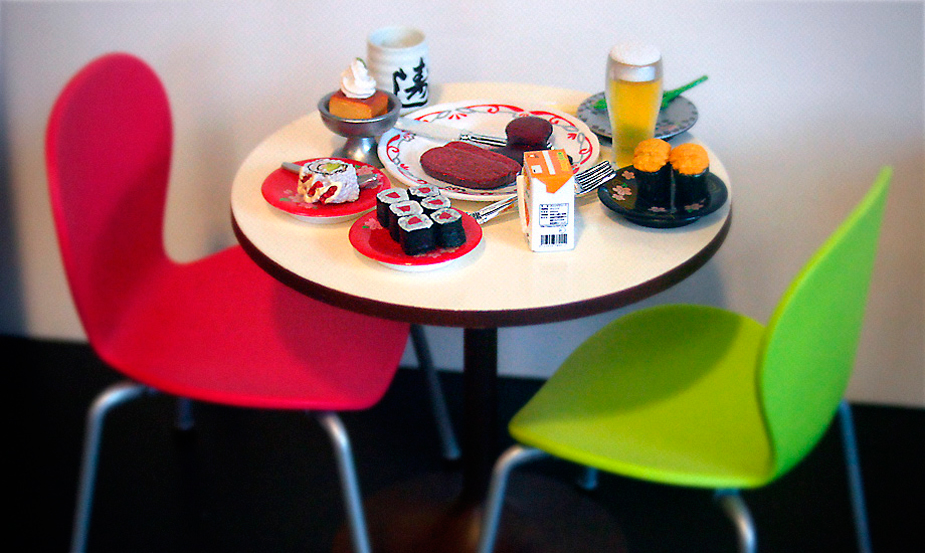
Miniature is in. At least in my small universe. And what’s most in is miniature food. Not small portions of trendy baby vegetables or infant lamb chops, mind you, but the miniature food that causes choking if accidentally swallowed by small children. I’m talking about plastic miniature food produced by the largest nation-state supplier of miniature everything in the world, Japan, where the sushi is about as large as a 40 mg Zoloft tablet and the teriyaki sauce is a tiny plastic smear with the look of a middle toe nail.
What makes mini-food so appetizing is not simply the incredible craftsperson’s attention to perfect detail—though that’s a much appreciated touch. Nor is it the scale-model serving apparatus, including chop sticks, wooden dumpling steamers and mini-woks. Rather I find mini-food among the few things in my life I can totally control without hesitation, reservation or regret. I am the modern Gulliver and these Lilliputian things are in my service—and beck and call.
OK, the analogy stops there and picks up with another, more sobering one: Doll house. What’s the difference between making my plastic Knoll mini-table ready for a mini-meal? Or carefully displaying mini-plats du jour of various tempura fixings and teensy weensy bottles of soy sauce and beer around in the miniature plastic vitrine that I bought to showcase the stuff. Well, mainly, mini-dolls are not part of this scenario. I am not playing house. I’m an adult damn it! And this is an exercise in design appreciation.
The design of these objects, mostly purchased at Toy Tokyo in New York City, is not some goofy caricature, where the ebi (shrimp) is out of proportion to the spicy tuna hand roll, which is larger than the plate. Each component in every $7–9 box of assorted items (usually grouped according to the type of meal, i.e., sashimi or negamaki dinners, etc.) exquisitely conforms to one another in the set and in other sets.
Little, however, deviates from the norm. There is no avant garde dinnerware or radical fusion foods (unless I make them), everything is as traditional as in a typical Japanese restaurant. But what is truly within my control is the ability to mix and match the menu. And one more thing, my mini-environment is perfectly sanitary—there is not a perfectly proportioned scale model mini-cockroach in sight.
(Author’s note: I can no longer find these plastic delicacies in New York, but they are available in Japan and online.)
The post The Daily Heller: Why is Japanese Miniature Food So Appetizing? appeared first on PRINT Magazine.