
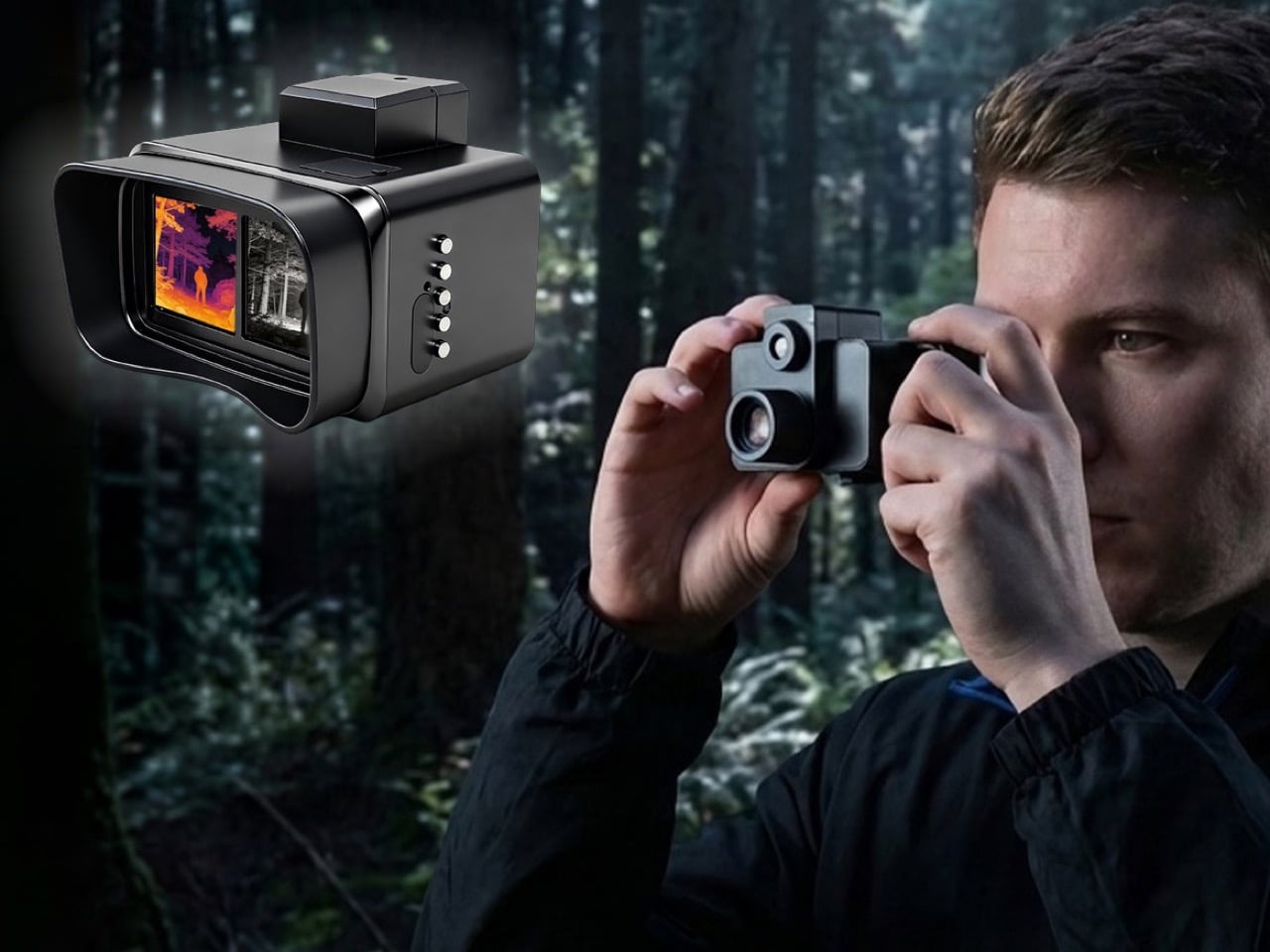
Military forces figured out decades ago that you need two kinds of vision in the dark: one to detect, one to identify. Heat finds the target, detail confirms it. The problem has always been making both feeds available to a single operator without adding weight, bulk, or the friction of switching between devices. High-end tactical units solved this with helmet-mounted dual-tube systems that cost as much as a used car and require specialized training to operate. Consumer and prosumer markets have lived with the compromise, carrying separate thermals and NVGs or settling for low-refresh overlay systems that blur more than they clarify.
SpectraEyes brings the dual-feed architecture down to the enthusiast and professional level. Developed by a Denver-based team that spent 18 months testing sensor fusion algorithms in high-altitude terrain, the system pairs a 60Hz thermal core with a 4K digital night vision sensor in a synchronized side-by-side display. Each screen operates independently, so you can run thermal-only to conserve battery during long scouts, 4K-only for close-range work, or both feeds simultaneously when the situation demands total awareness. IP67 waterproofing, USB-C fast charging, and an operating range from negative 20 to positive 50 degrees Celsius mean this was engineered for field use, available now at $514 during the current campaign window.
Designer: SpectraEyes
Click Here to Buy Now: $514 $830 (38% off) Hurry! Only 18 days left.
The core innovation lives in what SpectraEyes calls the Real-Time Dual-Screen Synchronization System. Rather than attempting to merge thermal and night vision into a single confused image, the optics route each feed to its own dedicated 1280×720 LCD screen inside the binocular housing. The left screen receives data from a 12-micron thermal sensor running at 60Hz with sub-25mk NETD sensitivity, which translates to the ability to detect temperature differences smaller than 0.025 degrees Celsius. That level of thermal resolution separates a warm body from ambient foliage even when both are nearly the same temperature. The independence of the two displays means your brain processes depth, movement, and context from the night vision channel while simultaneously tracking heat signatures on the thermal side, creating a layered awareness that single-feed systems simply cannot replicate.
The right screen displays output from an ultra-low-light CMOS sensor capable of rendering 4K UHD (3840×2160) footage down to 0.0001 lux, roughly ten times darker than what a human eye can process. In starlight conditions, the sensor delivers full-color imaging, which means you see the actual hues of terrain, clothing, and vegetation rather than the washed-out green associated with legacy analog night vision tubes. In total darkness, the built-in adjustable IR illuminator (850nm and 940nm settings) provides monochrome visibility out to 800 meters without the visible red glow that spooks wildlife or compromises stealth. The choice between 850nm and 940nm wavelengths allows you to optimize for either maximum throw or maximum stealth depending on whether you’re observing skittish animals or working in environments where human detection is a concern.
Most consumer thermal optics run at 9Hz or 30Hz, which produces noticeable lag when panning across a scene or tracking moving subjects. SpectraEyes spec’d a 60Hz thermal core specifically to eliminate that stutter. Whether you’re sweeping a tree line or following an animal through dense cover, the thermal feed stays fluid and responsive. The difference between 30Hz and 60Hz might sound academic until you’re trying to track a running target or assess whether movement in your peripheral vision is wind-blown brush or something warm-blooded, and the lag between what’s happening and what you’re seeing becomes the variable that determines whether you capture the moment or miss it entirely.
The 7.0mm focal length provides a 24.9-degree by 18.7-degree field of view on the thermal side, wide enough for situational scanning without losing the resolution needed to pick out distant signatures. Thermal detection range reaches 500 meters, digital night vision stretches to 800 meters. The system supports 1x to 10x continuous digital zoom on the night vision channel, useful for identifying details at range without physically closing distance. Zooming in doesn’t degrade the thermal feed, so you can magnify the night vision side to confirm a target’s identity while keeping the thermal side at native FOV to monitor the broader environment for additional heat sources.
The independent dual-control system means you can toggle each display on or off separately via dedicated buttons on the housing. Running only the thermal channel in scouting mode extends battery life considerably, pulling four to five hours of runtime from the dual replaceable lithium battery setup. Engaging both screens simultaneously in full fusion mode drops that to around two hours, which aligns with what you’d expect from a system pushing two high-refresh displays and processing two sensor feeds in real time. The batteries are external and hot-swappable, so you can carry spares and change them in the field without powering down the unit or losing your position in a critical observation window.
The USB Type-C charging port supports power bank input, so extended missions can be managed with external battery capacity. Storage runs via microSD card, supporting up to 512GB for 4K video recording at 30fps in MP4 or MOV format. Recording captures the night vision feed by default, but you can switch to thermal-only recording or choose to save both feeds as separate files for post-mission review. The ability to document what you observed with native 4K resolution means this doubles as a capture device for wildlife research, security documentation, or any scenario where you need verifiable footage of what happened in low-light or no-light conditions.
The IP67 rating means the housing can handle submersion up to one meter for 30 minutes and shrugs off dust intrusion entirely, appropriate for marine navigation, wet-weather SAR work, or any scenario where gear gets exposed to the elements without warning. The operating temperature range (negative 20 to positive 50 degrees Celsius) covers everything from winter mountain rescue to desert surveillance in summer heat. The form factor is binocular-style rather than monocular, which distributes weight across both hands and allows for more stable long-duration observation compared to single-eye devices that fatigue your grip and throw off your natural field of view balance.
SpectraEyes is currently available through its Kickstarter campaign at $514 as part of the Super Early Bird tier, down from an MSRP of $830. Units ship globally starting June 2026. This is gear built for search and rescue teams who need to spot heat and confirm identity without switching devices mid-operation, for wildlife researchers who track nocturnal behavior across hours of observation, for hunters who work pre-dawn and post-dusk windows where neither thermal alone nor night vision alone tells the full story, and for marine operators navigating in conditions where a buoy, a boat, and a person all look like dark shapes until you layer heat detection over visual context. If you’ve ever carried two optics into the field and spent the night juggling between them, SpectraEyes is the answer to a question the industry has been avoiding for two decades.
Click Here to Buy Now: $514 $830 (38% off) Hurry! Only 18 days left.
The post 60Hz Thermal and 4K Night Vision in One Device. SpectraEyes Basically Gives You Superman’s Vision first appeared on Yanko Design.