
Karolina Wiktor creates a new language born from absence
Karolina Wiktor’s Cartography of Motherhood at the Zachęta – National Gallery of Art in Warsaw brings together drawing, gesture, and sound to trace the artist’s experience of post-stroke aphasia through the lens of motherhood. Following a ruptured aneurysm and strokes in 2009, Wiktor rebuilt her practice around visual and concrete poetry, developing the Czcionka Braku (Font of Absence), a typographic system born of incomplete, illegible letters recorded during acute aphasia.
‘Stroke and aphasia are highly complex conditions, and aphasia is among the most challenging disabilities overall. Rehabilitation must be holistic,’ the artist tells designboom, affecting not only speech but also writing, reading, counting, concentration, attention, and spatial understanding. At the heart of the exhibition lies the intimate bond between Wiktor and her daughter Iga: domestic rituals, gestures, drawings, and rhythms that became, at once, acts of communication and of rehabilitation. The show marks the first time in Wiktor’s practice that motherhood is addressed as a direct subject and as a survival method. The central argument of the exhibition is that agency, authorship, and voice are not lost with language but transformed.
Exhibition Karolina Wiktor. Cartography of Motherhood, Zachęta – National Gallery of Art, 20.02-03.05.2026 | all images by Daniel Rumiancew / Zachęta archive, CC BY-SA
the body as territory at Zachęta National Gallery of Art
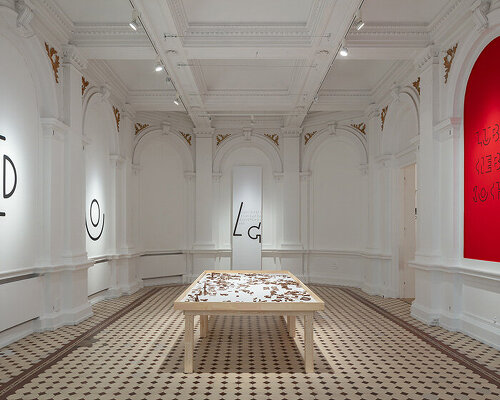
Curated by Katarzyna Kołodziej-Podsiadło with exhibition architecture by Maciej Sierpień of Kibera Studio, the spatial design gives form to the central metaphor of the exhibition. The body is presented as territory to be navigated after a neurological crisis.‘The hands are one of the key areas, as they are directly connected to the brain and cognitive functions. Post-stroke aphasia is not only the inability to speak, but also difficulties with writing, reading, counting, as well as problems with concentration, attention, and spatial understanding,’ the Polish artist shares with us. ‘Drawing and writing are among the methods used in neurological speech therapy,’ This is how her book, Wołgą przez Afazję (Volga Through Aphasia) came into being. Wiktor recorded herself reading it aloud, since reading to her daughter was itself a form of therapy.
The exhibition also includes two games that support recovery beyond speech, addressing the broader range of post-stroke impairments. Sound appears in the film, where the artist walks through Warsaw and, as she puts it, ‘explains how we can support ourselves,’ noting that ‘the best and most proven form of rehabilitation is simply walking.’
in the middle: Karolina Wiktor: Table with Font of Abscence
a map no single person can complete alone
Cartography of Motherhood extends beyond the gallery through the NeuroUżyteczna (NeuroUseful) project, a platform Wiktor has developed over fifteen years to support social participation among people with diverse neurological abilities. Workshops, actions, and meetings are an integral part of Cartography of Motherhood, and Wiktor is clear about what makes this collective format matter. ‘The first and perhaps most important aspect is social rehabilitation,’ which she describes as social design. In practice, this means that someone further along in recovery works alongside someone only months post-stroke. ‘In this way, we help each other, because I know how closeness, emotions, and the possibility of participation are invaluable — for everyone: healthy or ill, artist or audience,’ she explains. Children’s drawings function as directions on a map that no single person can complete alone. Developed in partnership with the Center of Inclusive Art / Theater 21, Cartography of Motherhood runs at Zachęta through May 3rd, 2026.
in the middle: Karolina Wiktor: Table with Font of Abscence
at the heart of the exhibition lies the intimate bond between Wiktor and her daughter Iga | image © designboom
a typographic system born of incomplete letters recorded during acute aphasia
agency, authorship, and voice are not lost with language but transformed
following a ruptured aneurysm and strokes in 2009, Wiktor rebuilt her practice
motherhood is addressed as a direct subject and as a survival method
Karolina Wiktor: Zachęta
the body is presented as territory to be navigated after a neurological crisis
from the left: Lidia Magiera: Hand in Hand, Wiktoria Kuchta: orthosis project, Piotr Pryk: orthosis project supporting the rehabilitation of patient | images of the exhibition courtesy of Zachęta – National Gallery of Art
the spatial design gives form to the central metaphor of the exhibition
from the left: Małgorzata Walaszczyk: Spheres, Cocon 3, Pattern 3, Hoops
workshops, actions, and meetings are an integral part of Cartography of Motherhood
addressing a broader range of post-stroke impairments
project info:
name: Cartography of Motherhood
artist: Karolina Wiktor | @karolina_wiktor
location: Zachęta – National Gallery of Art, | @galeria_zacheta, Warsaw
curator: Katarzyna Kołodziej-Podsiadło
exhibition design: Maciej Sierpień (Kibera Studio)
dates: February 20th – May 3rd, 2026
The post a language beyond words: karolina wiktor traces post-stroke motherhood in warsaw appeared first on designboom | architecture & design magazine.