
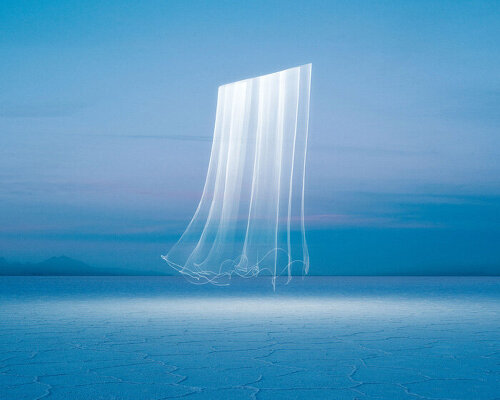
There is a certain kind of clarity that only comes from walking. Moving through the streets of Paris recently, the rhythm of my steps accompanied by a favorite podcast playing in my ears, I found myself captivated by the idea that our reality is inherently unfinished. The world around us is always in a state of becoming, constantly leaning toward what German philosopher Ernst Bloch articulated as the the Not-Yet (Noch-Nicht). It is a concept that perfectly anchors the spirit of our new chapter, and it immediately brought to mind something Rainer Maria Rilke wrote in Letters to a Young Poet: ‘The future enters into us, in order to transform itself in us, long before it happens.’
For so long, we have treated dreaming as a nocturnal retreat, a subconscious escape from a waking world that feels too rigid or overwhelming. But if the world is truly unfinished, our dreams and reveries are far more potent. They become our ‘anticipatory consciousness,’ our way of reaching out and shaping that Not-Yet. They are not a flight from reality, but an active, radical rehearsal for impending material realities.
‘There are daydreams enough, we just have not taken sufficient notice of them. Even with our eyes open, things can be colourful enough or dreamy inside our heads. If the inclination to improve our lot does not sleep even in our sleep –
how should it do so when we are awake?’ – Ernst Bloch, The Principle of Hope
Reuben Wu, Thin Places | more on the photography series here
Bloch argued that everything we create is part of a ‘wish landscape,’ born from what we feel is missing in the present. He distinguished between idle wishing and what he called ‘educated hope.’ This is a hope rooted in the conditions of our current world: it looks for the tendency of what is already building, the latency of what we collectively desire, and crucially, it has the power to mobilize us. As he wrote in The Principle of Hope, ‘The daydream can furnish inspirations which do not require interpreting, but working out, it builds castles in the air as blueprints too, and not always just fictitious ones.’
In this chapter, Dreams in Motion, we explore what happens when those blueprints are brought down to earth. What if our dreams were not just nocturnal illusions, but systems already in motion?
Within our creative ecosystem, I find that nowhere is this transition from dreams and reveries to tangible realities more visible than during Milan Design Week. For a few days each year, the city’s historic palazzos and industrial peripheries become a collective wish landscape. The civic arena transforms into a living laboratory where alternate realities are rehearsed, and where designers prototype emotional, symbolic, and sensorial futures. The ephemeral nature of these installations offers fleeting glimpses of what our future could look like, proving that imagination and dreaming is not an escape from reality, but a vital testing ground for new values, behaviors, and relationships. It is with this exact desire to bridge the abstract and the physical that we are stepping beyond the digital screen this year. To bring our explorations of the Not-Yet to life, designboom is staging ROOM FOR DREAMS, a site-specific takeover at the ME Milan Il Duca hotel. By intervening in a space so intrinsically linked to sleep, we are turning a place of nocturnal rest into an awakened, immersive reverie right in the heart of the city. It is our own blueprint brought down to earth.
Cinema of Dreams by Paf atelier at designboom’s Milan takeover | more on the project here
Crucially, our exploration of the Not-Yet extends far beyond the temporal and geographic limits of Design Week. While our dispatches from Milan will focus intently on these immediate ‘dreams in motion,’ this chapter serves as a much wider vessel. From temporary worlds that prioritize visceral experience over permanence, to spaces and objects as emotional carriers that translate our personal, collective, and political dreams into material form, we are expanding our gaze to examine a diverse topography of dream scenarios across past, present, and future contexts.
‘Everything dreams. The play of form, of being, is the dreaming of substance. Rocks have their dreams, and the earth changes….’ ― Ursula K. Le Guin, The Lathe of Heaven
As Stephen West explained during my walk, unpacking Bloch’s theory, ‘our consciousness and the world are deeply entangled, always co-constituting each other.’ The future is not an event that simply happens to us; it is something we actively dream into existence, object by object, space by space. I invite you to join us in exploring the testing grounds of tomorrow, embrace our unresolved world, and keep your dreams in motion.
Dream by Stephen Antonakos, currently on view at the B. & M. Theocharakis Foundation in Athens | image by designboom
The post the not-yet: dreams, reveries, and hope in an unfinished world appeared first on designboom | architecture & design magazine.