
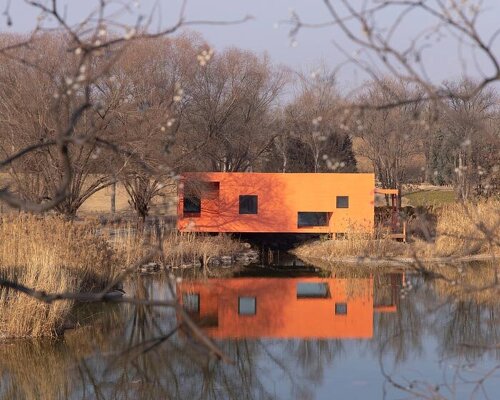
Wiki World builds Red Bridge Cabin on an island in Zhengzhou
Red Bridge Cabin, designed by Wiki World, is an experimental timber structure located within Yuancheng Cultural Park in the Zhengzhou Airport Economy Zone, China. The park, developed around the Yuanling Ancient City site, combines heritage preservation with ecological landscape planning. Positioned on a small island within the site’s existing waterfront, the cabin forms part of a broader series of low-impact structures intended to engage directly with the natural environment.
The project is conceived as both a cabin and a connecting element. A narrow, bridge-like corridor extends from the mainland to the island, forming the primary access route. Enclosed with translucent panels, this passage establishes a gradual spatial transition between the surrounding park and the more contained interior environment. The structure integrates characteristics of a bridge, gallery, and dock, functioning as both circulation and architectural experience.
all images by Arch-Exist
Timber Structure combines bridge, gallery, and dock typologies
The cabin is organized as an elevated timber volume incorporating two courtyards and a large skylight. These elements introduce daylight and create internal spatial variation within a compact footprint. Translucent screens filter external views, while selected openings frame specific perspectives of the surrounding water and vegetation. Through this arrangement, Wiki World design studio establishes a continuous visual relationship between interior and landscape.
The building is constructed using laminated timber, with all components digitally modeled and fabricated as custom elements. The structure is fully prefabricated and assembled on site, allowing for precise coordination of irregular geometries. The cabin is positioned above ground level, minimizing direct impact on the terrain and preserving existing vegetation.
The primary material system is based on engineered timber, combined with small-scale metal connectors that enable repeated assembly and disassembly. Facade elements are made from carbonized wood boards, treated to enhance durability and material performance. The prefabricated approach allows the structure to be installed with minimal disturbance, maintaining the original site conditions.
timber structure positioned on a small island
Red Bridge Cabin is elevated to preserve existing trees and terrain
Wiki World’s Red Bridge Cabin project follows a construction strategy that prioritizes minimal intervention. Existing trees, bamboo, and pathways are retained, and no additional boundary elements or artificial landscaping are introduced. The cabin is conceived as an independent object within the natural setting, relying on elevation and lightweight assembly rather than permanent ground-based construction.
As part of the ‘Wiki Building School’ initiative, the project explores alternative approaches to small-scale living environments. The design focuses on the relationship between spatial use, material systems, and environmental context, using compact form and prefabricated timber construction to investigate new possibilities for dwelling in natural landscapes.
located within a heritage and ecological park
a cabin conceived as both shelter and bridge
translucent panels define the bridge-like passage
structure combines bridge, gallery, and dock typologies
skylight brings daylight into the compact interior
openings frame views of water and vegetation
laminated timber structure with custom-fabricated elements
translucent screens filter the surrounding landscape
carbonized wood cladding enhances durability
daylight floods through skylights and openings into the interior
cabin elevated to preserve existing trees and terrain
architecture placed lightly within the natural environment
gradual transition from park to interior space
project info:
name: Wiki World-Red Bridge Cabin-[Wild Home #138]
architect: Wiki World | @wiki__world
design team: Mu Wei, Feng Zhaoxian, Wu Baorong, He Wen, Xu Xiaodong, Liao Xiaotian, Wang Yuanying, Chen Liang
location: Zhengzhou, China
photographer: Arch-Exist | @archexist
designboom has received this project from our DIY submissions feature, where we welcome our readers to submit their own work for publication. see more project submissions from our readers here.
edited by: christina vergopoulou | designboom
The post wiki world’s red floating timber cabin bridges land and water in chinese park appeared first on designboom | architecture & design magazine.