
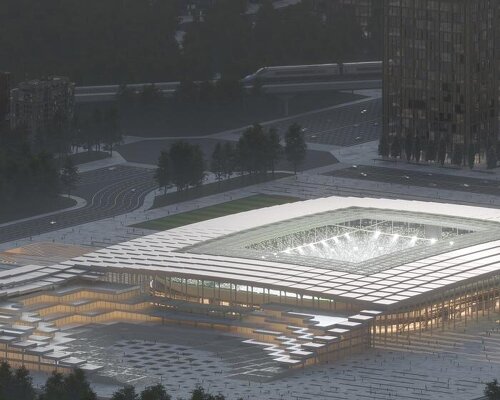
Xi’An International Football Center
The Xi’an International Football Center is conceived as an open civic infrastructure, redefining the conventional role of the stadium within the urban environment. By reducing its perceived scale and introducing a more permeable interface, the project integrates public activity beyond matchday, positioning the stadium as a continuously active element of the city.
The project addresses the limitations of contemporary stadium design, where large-scale venues often function as isolated, event-driven structures with limited engagement in daily urban life. In contrast, the proposal considers the stadium as part of a broader urban system, shaped by the interaction between players, spectators, and the surrounding public realm.
a graduated canopy mediates between the stadium and its surroundings | all images by Yuanbo Jia & Zhijun Lei
The Stadium As An Open Civic Platform
The design introduces the concept of an ‘open civic stadium,’ transforming the building from an inward-focused arena into an accessible public platform. This approach is defined by two primary strategies: reducing the building’s scale and reintroducing public use.
The lower seating tier is partially embedded below ground, decreasing the overall height and visual impact of the structure. Along the perimeter, commercial volumes are arranged beneath a continuous canopy, forming an active urban edge that connects the stadium to its surroundings. Internally, the program is streamlined to essential functions, reducing structural depth and contributing to a lighter architectural expression. The facade is articulated through a system of horizontal and vertical elements that break down the overall mass, bringing the scale closer to that of the surrounding urban context. These interventions support a more gradual transition between the building and the public realm. At ground level, the integration of commercial programs and a semi-enclosed external plaza establishes a continuous relationship between matchday and everyday use. The plaza accommodates daily activities while also supporting small-scale events, ensuring consistent activation beyond scheduled matches.
stadium facade
Extending the atmosphere beyond the stadium
During events, the design enables the stadium experience to extend into the surrounding city. A porous ground-level interface allows sound and visual connections to reach the exterior, while selected areas remain accessible for informal viewing outside the primary seating system. Certain commercial spaces maintain partial visual connections to the interior, allowing indirect engagement with the event. The external plaza functions as a fan zone during matches, supporting collective gathering and extending the event atmosphere into the public domain.
Through these strategies, the Xi’an International Football Center operates beyond its role as a sports venue. It functions as a civic platform that accommodates multiple uses over time, integrating football culture into everyday urban life while reducing the spatial and social separation typically associated with stadium architecture.
vertical and horizontal elements articulate the stadium’s volume
the pitch on match day
textured surfaces define the stadium facade
the pitch on a non-match day
the pitch on a non-match day
a minimal corridor
lounge room
stadium facade
project info:
name: Xi’an International Football Center
architect: Yuanbo Jia & Zhijun Lei
location: Xi’an, China
designboom has received this project from our DIY submissions feature, where we welcome our readers to submit their own work for publication. see more project submissions from our readers here.
edited by: christina vergopoulou | designboom
The post xi’an international football center opens its stadium bowl to the city through a porous form appeared first on designboom | architecture & design magazine.