
‘flying vegetation’: a breezy home blooms in vietnam
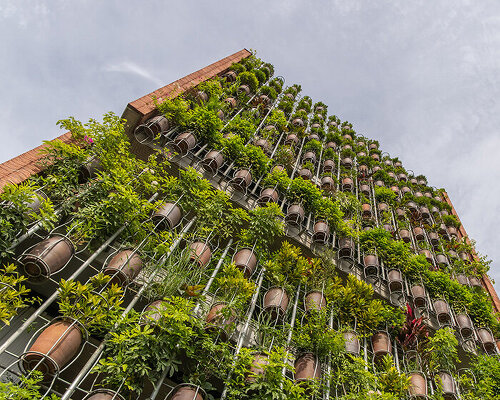
A housing project by H&P Architects, dubbed Flying Vegetation, rises among Vietnam‘s Thai Binh city where a dense urban fabric is opened up by a shared neighborhood garden. The house is recognized at once by its planted facade that mediates the threshold between interior space and the street and uses vegetation as both screen and living surface.
Across the front elevation, rows of terracotta pots are held within a light steel frame that rises the full height of the building. The pots are spaced to allow growth and airflow, forming a permeable screen that softens light, reduces dust, and introduces a shifting layer of green. Seen from the street, the facade reads as a continuous field of plants, while from inside it becomes a calibrated filter that frames views outward.
images © Le Minh Hoang
H&P integrates food production into the structure
The planting system is designed by the team at H&P Architects as an adaptable framework rather than a fixed composition. Each pot sits within a circular metal holder that can be opened for maintenance, allowing residents to replace soil, adjust plant types, and respond to seasonal change. This approach treats the facade as an evolving surface, shaped over time through use.
Material choices reinforce this logic. Clay pots and brick walls share a similar tonal range, grounding the building in familiar construction methods while extending them into a vertical landscape. Soil and vegetation become part of the architectural assembly, aligning with H&P Architects’ broader interest in ‘agritecture’ as a way to integrate food production and living space within the city.
a vertical field of terracotta pots forms a planted facade across the full height of the house
interior spaces flooded by filtered light
Inside H&P Architects’ Flying Vegetation, the presence of the planted screen is immediate. Light enters through layers of leaves and ceramic, casting soft, irregular patterns across floors and walls. Balconies and circulation zones run alongside the facade, creating spaces where planting, movement, and rest overlap.
At ground level, a small courtyard extends the garden inward and introduces water and additional plantings. Brick surfaces are textured and tactile, while timber floors and simple furnishings keep the interiors restrained. The architecture remains quiet, which allows for the growth of plants and the passage of light to define the atmosphere.
the house faces a shared neighborhood garden, extending greenery into the urban fabric
an urban model for cultivation
Combining private living areas with spaces for tenants, the program is organized across multiple floors with shared zones on the upper levels. The house also functions as a small-scale model for urban agriculture. Residents grow and maintain plants directly on the facade, integrating everyday routines with food production and care. In a context where agricultural land continues to shrink, this approach offers a way to reintroduce cultivation into dense urban conditions, connecting inhabitants to familiar practices through the materials of soil, clay, and vegetation.
the planted screen filters sunlight, breezes, and views from the street
a steel frame system allows each pot to be accessed replaced and maintained over time
interior spaces receive softened light through layers of leaves and ceramic pots
plants are spaced to support growth, creating a breathable layer across the elevation
external corridors behind the planted screen connect living spaces with vegetation
project info:
name: Flying Vegetation
architect: H&P Architects | @hp_architects
location: Phu Xuan commune, Thai Binh city, Vietnam
design team: Doan Thanh Ha, Nguyen Hai Hue, Tran Van Duong, Luong Thi Ngoc Lan, Vu Minh Dien, Nguyen Van Thanh, Nguyen Van Thinh
completion: December 2022
photography: © Le Minh Hoang
The post lush facade of potted plants screens this vietnamese residence by H&P architects appeared first on designboom | architecture & design magazine.