
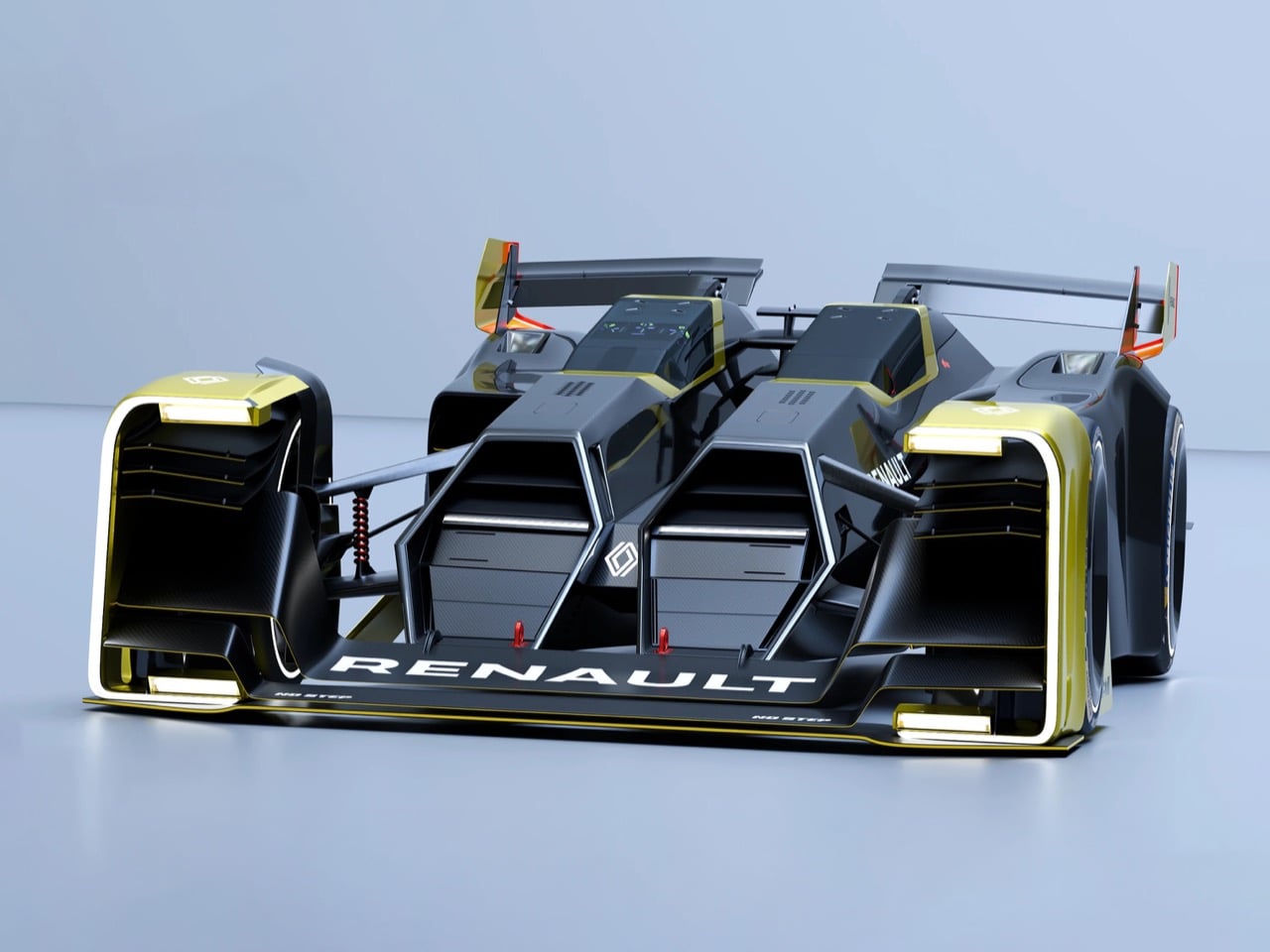
Endurance racing has a violent pit stop problem. Drivers trapped in burning cockpits because harnesses wouldn’t release fast enough. Fuel fires erupting while crews wrestle with high-pressure refueling systems under time pressure. Wheel guns misfiring at exactly the wrong moment. These failures have defined the dark side of Le Mans history since the 1950s, and Taejung Kim’s Renault Double Barrel concept exists to make sure they never happen again. The concept draws its name and its core philosophy from a shotgun’s double barrel mechanism, reimagining the 2040 Le Mans hypercar as something you hot-swap instead of service. The left fuselage contains a complete hydrogen powertrain module. The right fuselage houses the entire driver cockpit as a self-contained pod. When the car screams into the pit lane, the team doesn’t unbuckle a driver or pump fuel into a tank. They eject both entire modules and slot in fresh replacements, sending the car back onto the Circuit de la Sarthe in the time it currently takes just to click a seatbelt harness. The approach transforms pit lane strategy from a dangerous ballet of human coordination into something mechanical, predictable, and inherently safer.
The concept’s inspiration reaches back to the 1955 Nardi Giannini ND750 Bisiluro, an Italian streamliner that split its driver and engine into two separate fuselages connected by a central spine. That car was designed for outright speed on the straights at Monza, accepting terrible handling characteristics in exchange for slicing through the air like a bullet. Kim’s reinterpretation borrows the twin-fuselage architecture but uses it to solve a completely different problem: eliminating the human chaos of endurance racing pit stops. The Nardi needed two separate bodies because mid-century aerodynamics couldn’t integrate a driver and engine into one low-drag form. The Double Barrel uses two bodies because modular replacement demands independent pods, and because splitting mass across two fuselages creates a radically different center of gravity that could fundamentally change how a prototype handles through high-speed sections like the Porsche Curves.
Designer: Taejung Kim
The hydrogen powertrain module on the left carries the entire propulsion system as a single replaceable cartridge. Fuel cell stack, electric motors, power electronics, thermal management, and structural mounting all integrate into one unit that slides into the left fuselage and locks into place through what Kim describes as a shotgun-inspired breach loading mechanism. The driver pod on the right contains the cockpit, safety cell, steering column, pedal box, and all driver interfaces as a second self-contained module. Both pods connect through a central carbon monocoque spine that handles the structural loads and aero surfaces. The concept sketches show mechanical locking points at the front and rear of each fuselage, suggesting the modules slide in from behind and engage positive locks that can be released pneumatically or mechanically under pit lane conditions. The swap mechanism prioritizes speed over tool-free operation, accepting that pit crews will have specialized equipment if it means dropping swap times below ten seconds.
The front fascia is dominated by twin hexagonal air intakes that feed cooling to each fuselage independently. A narrow LED light bar spans the width of the nose, broken into segmented panels that give the car an almost insectoid quality when illuminated. The central spine between the two fuselages rises slightly to create a spine-like ridge that channels airflow over the top of the car, and the bodywork around each pod is heavily sculpted with sharp creases and dramatic undercuts. The rear features a massive integrated wing that spans the full width of both fuselages, with vertical endplates in the same acid yellow as the front dive planes. The diffuser treatment extends deep underneath the rear bodywork, and the taillights are thin horizontal bars integrated into each pod’s trailing edge, outlined in vivid orange-red that pops against the black carbon.
The hot-swap pit stop strategy Kim proposes would require significant changes to current Le Mans regulations, which don’t allow for driver changes mid-stint under normal racing conditions and mandate specific refueling procedures. The FIA and ACO (Automobile Club de l’Ouest) would need to develop entirely new technical regulations governing module interfaces, safety interlocks, and swap procedures. The concept assumes these rules evolve in response to hydrogen adoption and the push toward zero-emission endurance racing. Hydrogen refueling presents unique challenges, current systems require careful pressure management and grounding to prevent static discharge ignition, and a modular cartridge swap eliminates those risks entirely by treating the entire fuel cell stack as a consumable that gets swapped rather than refilled. The driver pod swap solves the harness release problem that has caused fatalities when drivers couldn’t exit burning cars fast enough, and it also allows teams to rotate drivers without the psychological pressure of quick unbuckling under race conditions.
The twin-fuselage layout creates interesting aerodynamic opportunities and problems. Splitting the car’s mass into two distinct bodies allows each fuselage to generate its own downforce independently, potentially creating a system where the left and right sides can be tuned asymmetrically for different corner characteristics. The gap between the fuselages becomes a massive air channel that could feed cooling, create a venturi effect for underbody downforce, or house active aero elements. The downside is drag. Two separate bodies create more frontal area and more turbulent wake than a single unified form, and at Le Mans, where cars spend significant time at full throttle down the Mulsanne Straight, drag is everything. Kim’s concept accepts this compromise, betting that the pit stop time advantage and the safety benefits outweigh the aerodynamic penalty.
The project was developed as a personal exploration in 2026 with mentorship from Dre Ahn of Dvision Studio, rendered in Blender using Cycles for the photoreal lighting, and presented through a comprehensive design development breakdown that shows Kim’s process from initial research through final execution. The concept doesn’t pretend to be production-ready. It’s a provocation, a design exercise that takes a genuine problem in endurance racing and solves it through radical rethinking of what a race car can be. Whether the FIA ever allows modular pod swaps is almost beside the point. The Double Barrel concept demonstrates that the pit stop, which has remained fundamentally unchanged since the 1950s despite massive advances in safety technology, could be completely reimagined if someone is willing to throw out the assumption that a race car has to be a single unified object.
The post Renault Le Mans Hypercar Concept Swaps Entire Drivers Like F1 Changes Tires first appeared on Yanko Design.