
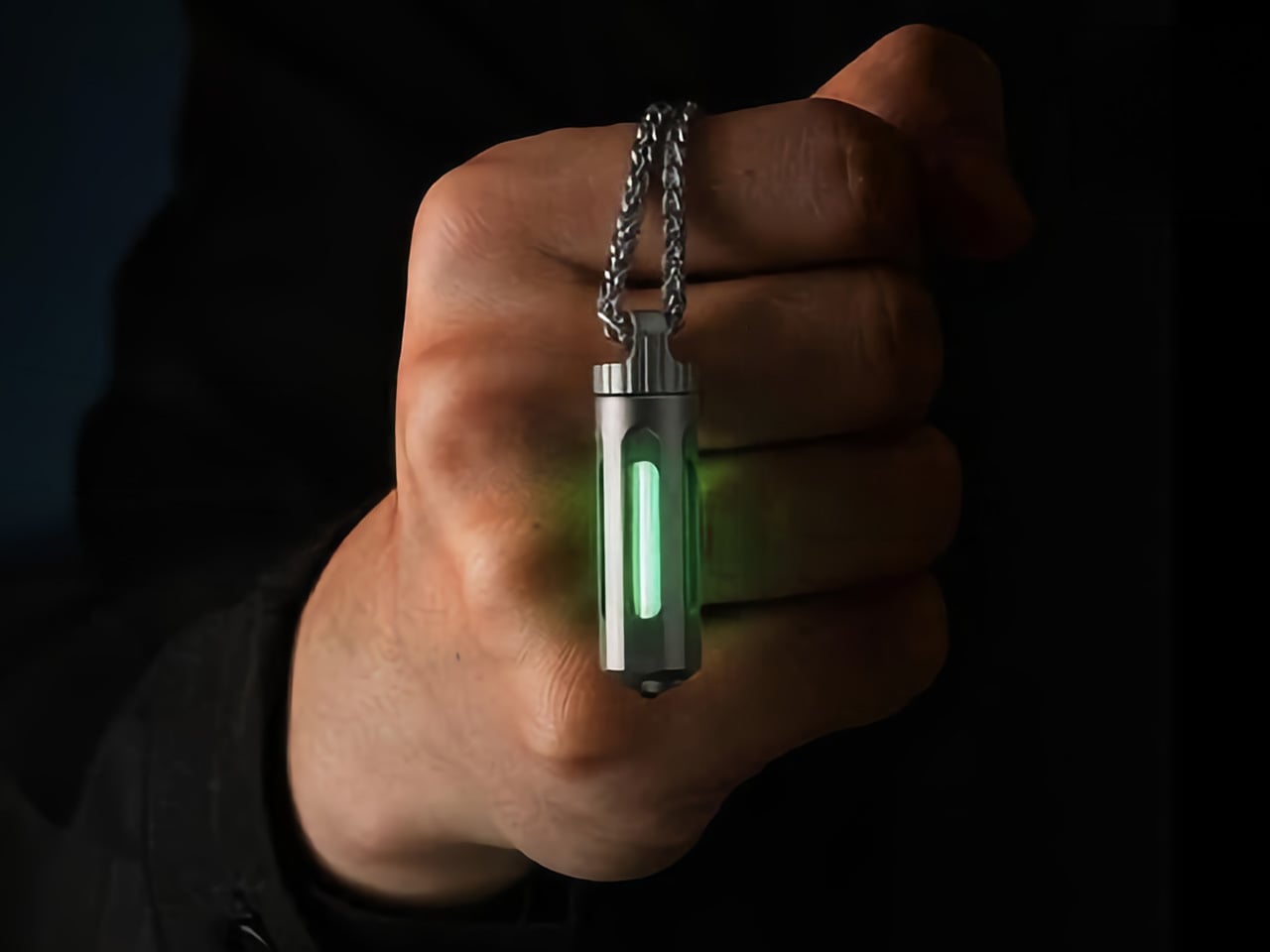
Tritium is a hydrogen isotope with a half-life of 12.3 years. As it decays, beta particles strike a phosphor coating and produce light. The process requires no electricity, no chemical reaction, and no external energy. It simply happens, continuously, for decades. This is why tritium appears in emergency exit signs, military watches, and aviation instruments. The glow is faint compared to an LED, but the reliability is absolute. Nothing else in the consumer lighting world can claim 25 years of operation with zero maintenance.
NoxTi by Xedge packages that physics in a 45mm titanium cylinder designed for keychain carry. The tritium vial sits inside a precision quartz tube with 92% light transmission, surrounded by a CNC-machined Gr5 titanium body that weighs just 10.7 grams. The construction is fully serviceable. Two silicone O-rings hold the vial in place, and when brightness fades after two decades, you push the old tube out and slide a new one in. The design includes a ceramic-tipped glass breaker at one end, a keychain hole at the other, and a floating core that’s visible from all sides. Xedge ships it in six colors (Ice Blue, Apple Green, Red, Sunset Orange, Violet, Ocean Blue) and two finishes (sandblasted titanium or black coating). Pricing starts at $25 for a luminescent vial version and $45 for tritium.
Designer: Xedge
Click Here to Buy Now: $30 $42 (28% off). Hurry, only 73/350 left! Raised over $253,000.
The titanium shell measures 45mm long by 12mm wide, putting it in the same size class as a AA battery but considerably lighter. At 10.7 grams, the weight registers as barely-there on a keychain, roughly equivalent to two US pennies. The Gr5 titanium alloy (also known as Ti-6Al-4V) is the workhorse material of the aerospace industry, chosen for its exceptional strength-to-weight ratio and total resistance to corrosion. This alloy doesn’t rust, doesn’t tarnish, and doesn’t degrade in salt water, sweat, or extreme temperatures. Xedge tested the assembly from -20°C to 50°C, and the glow remained steady throughout. The body is CNC-machined, not stamped or cast, which means tighter tolerances and cleaner geometry.
Quartz glass transmits 92% of visible light, far outperforming acrylic or polycarbonate alternatives that yellow and scratch over time. The tube encasing the tritium vial is hermetically sealed, protecting the vial from moisture, dust, and impact. Beta particles from tritium decay are so weak they cannot penetrate paper, let alone quartz. The radiation stays contained. If the tube somehow shattered, tritium is a gas that dissipates instantly with no lingering hazard. The engineering priority here is longevity. The quartz will still be optically clear in 2050.
Two precision silicone O-rings grip the quartz tube at either end, holding it perfectly centered inside the hollow titanium body. The tube doesn’t shift, doesn’t rattle, and appears suspended in midair when you look through the cutouts in the shell. The effect is clean and technical, like looking into a piece of scientific equipment. More importantly, this mounting method makes the vial user-serviceable. When the tritium dims after 20 or 25 years, you press the tube out from one end and slide a fresh one in from the other. No adhesive. No permanent seals. The titanium body becomes a platform you keep forever, swapping cores as needed.
The six color options let you tailor the glow to preference or function. Apple Green is the brightest to the human eye and the most common choice for visibility. Ice Blue reads as cooler and more modern. Red preserves night vision, a carryover from military and aviation use. Sunset Orange, Violet, and Ocean Blue lean aesthetic. Xedge also offers two finishes. The sandblasted titanium option reveals the raw gray-silver lustre of the alloy and develops a patina of micro-scratches over time, creating a lived-in look. The black-coated finish uses a hard scratch-resistant diamond-like coating (DLC) to cloak the body in matte black, letting the glowing core do all the visual work.
The ceramic-tipped glass breaker at the tail end functions as an emergency tool. It’s designed for car windows and similar tempered glass applications. Xedge cautions that it’s for emergencies only, not casual testing, which is the responsible way to position a feature like this on a keychain-sized tool.
NoxTi ships in two versions. The luminescent vial version uses a glow-in-the-dark tube that absorbs ambient light and re-emits it at night, priced at $25. The tritium model glows continuously for 25 years with no external light needed, starting at $45. Both versions ship worldwide with free shipping included. Add-ons include extra vials (three-packs of luminescent tubes for $20, tritium vials for $60), black coating upgrades, quick-release key rings, and stainless steel necklaces. Delivery is scheduled for August 2026.
Click Here to Buy Now: $30 $42 (28% off). Hurry, only 73/350 left! Raised over $253,000.
The post This 45mm Titanium Keychain Glows for 25 Years Without Batteries Using Pure Material Physics first appeared on Yanko Design.