
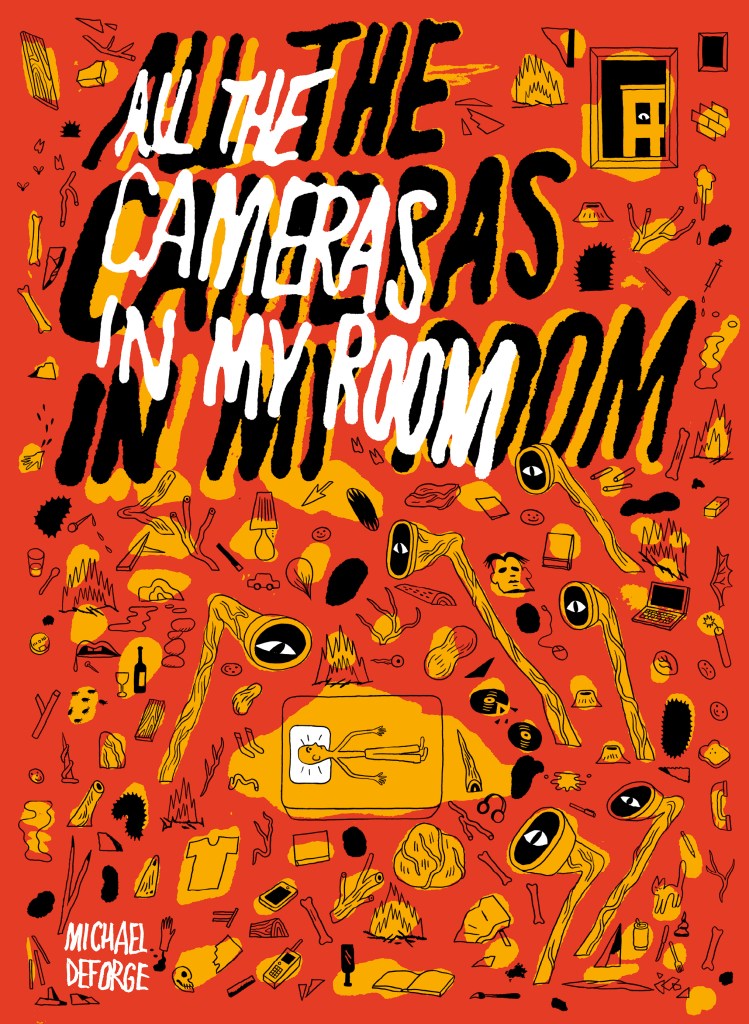
Michael DeForge makes comics that capture the messiness, heartache and absurdity of the world. His next book, All the Cameras in My Room (Drawn & Quarterly, April 21), is an eclectic mix of stories, each drawn in a different style, told in a different way, laser-sharply aimed at a different facet of today’s collective sociopolitical anxiety.
For openers, a figure skater makes a deal with a devil—each spin she completes means one less rotation for Planet Earth. A mole goes so deep undercover that he ends up serving life in prison. Filled with sly references, these stories tackle the surveillance state, toxic fandom, the way pop culture nostalgia can turn cultish, and more—without moralizing in the process.
DeForge may remind readers of others in the history of comics but he is a uniquely self-confident artist. We recently spoke about his influences and narrative intentions. Our conversation inspired me to read the book a second time (but not before bedtime).
Each story is more surprising than the next. It feels a bit like “Twilight Zone” meets “Black Mirror” meets “Pee Wee’s Playhouse” meets “Severance” meets Kurt Vonnegut. Tell me, do you consider this satire, or some kind of inner purge of demons, or both, or none of the above?
Satire is a big part of my work, and I lean on humor a lot. I certainly bring a lot of my personal life to the comics as well. Even with the wilder or goofier premises, I try to ground everything going on with human emotions and human stakes. Many of my favorite pieces of narrative art are flexible about tone and genre—Gilbert Hernandez’s body of work or a movie like Johnnie To’s Running On Karma are the examples I often use.
The bleeding phones touch nerves because if you follow such things, there are forever toxins in almost everything we consume. What does bleeding technology mean to you?
You’re actually very close in getting at what the inspiration for the comic was, which was initially an extended joke about microplastics. But the story kind of expanded out from that.
People sometimes make the mistake of thinking of technological development as something inevitable, and as something neutral. Like, the received wisdom is that something gets “invented,” and once that Pandora’s Box is opened, the best we can do is try to regulate the way it’s used for “ill” and encourage other people using it for “good.” But the way technology develops is actually the result of a lot of specific material forces and ideological drivers, and all of that is reflected in the actual guts of the technology around us.
“For Training Purposes” is the most realistic of your supposed fantasies. I’ve had the same thoughts.
That comic gestated for a while. I have a friend who volunteers for a crisis line and I once asked them about that emotional toll, especially during a stretch where their own life was full of chaos and instability. And the conversation was a bit like, “How are you able to actually be there for someone when you’re going through it yourself?” And their reply was that it’s a lot like acting: “Imagine someone who would be helpful in this moment, and then pretend you’re that person.” I come back to suicidality a lot in my writing because of some of my own history, and so I thought to approach the topic as a dialogue. And I really liked the idea of organizing that dialogue around a sort of roleplay.
And so my first version of it was a comic that was half-corporate “mental health awareness” speak. The joke was going to be someone calling a suicide hotline and being met with a glorified customer service line, but then this genuinely vulnerable conversation gradually seeps out through the cracks of this pre-written corporate script. But that felt like only half an idea. Some time passed, and I eventually watched this movie called Handsome by Joe Gage/Tim Kincaid, who directed a lot of gay pornography and some B movies. Handsome is a porno structured around dirty phone calls, and there’s a lot of interesting stuff in it about projection, about the way fantasies bleed into reality and, of course, roleplay. That made me realize I wanted the comic to be about the person receiving the call, not the one making it. And the rest of the comic came together very quickly after that, and I wanted to make the Joe Gage influence very visible.
The strip with the animal whose son dies and transforms into a flock is totally relatable. Does this have a simple origin, or is it a more complex investigation of your feelings about loss? The line “My other son had been up all night keeping watch. For what? Unsure.” is such a human response to such a tremendous loss. Did this strip take a long or short time to conceive and execute?
I’m not totally sure where that comic came from, but I wrote it fast. When I finished it, I thought it was one of my “mean” comics, in that it was a bit cruel and a bit cold. But once I read it aloud on a book tour I felt differently about it. I had some more tenderness towards this narrator for whom normal expectations around parental love and care and appropriateness were simply beyond her capabilities. Writing about grief is difficult because it’s so universal but also so specific. I’ve found it’s in our individual expressions of grief where we surprise ourselves the most.
There is a quality in the look of these comics that reminds me of the Hairy Who.
Who have you been absorbing and translating in your art?
I love the Hairy Who. Big comics figures for me have been Gilbert Hernandez, Lynda Barry, Saul Steinberg, Kazuo Umezu and Mark Beyer. Keita Amemiya’s films and design work shows up a lot in this collection, and Masao Adachi was on my mind a lot for “The Organizer.” Derek Jarman and Stuart Hall have both played big parts in informing how I think about art.
“Non-profit” is brilliant yet disturbing. Did you sketch it out, or was this an evolution of your thinking?
I didn’t plot much of that one out. I was in the mood to draw cats and vehicles that week, and just used that as a jumping off point.
Why do you work in so many different styles? The wit and humor are yours throughout, but you seem to have a penchant for multiple visual languages.
I get bored very easily, so I’d have a hard time settling on one way of writing or one way of drawing. I also think different stories require different visual solutions. It’s a fun puzzle to figure out at the beginning of each comic, determining what the internal visual logic of it is going to be. I probably got that from doing gig posters in high school, where part of what’s interesting is figuring out how to represent the sound and aesthetic of different bands while still drawing something that feels natural to you. It’s what I like doing about film posters or Blu-ray covers now. I realize I have a pretty clear voice that comes through no matter what anyway.
I am anxious to hear what you have to say about “The Organizer.”
The way groups self-sabotage is always of interest to me, and so I wanted to write a comic about “infiltration” that’s actually more about how groups do themselves in. I was nervous about putting this one out. I do a lot of political work and have experience with direct action, so I was afraid people would assume I’m trying to say something accusatory about the real spaces I organize in. I found out a few people thought I was taking shots at them based on some panels I posted online, and I really wasn’t whatsoever. If anything, I’m trying to implicate myself and some of my own tendencies, and be self-critical about them. I intentionally tried to make the reality of the comic very heightened, not something that someone would confuse with a “grounded” portrayal of what’s going on the ground right now.
The post The Daily Heller: Making Comics is a Lot Like Acting appeared first on PRINT Magazine.