
uncanny valley opens in new york city
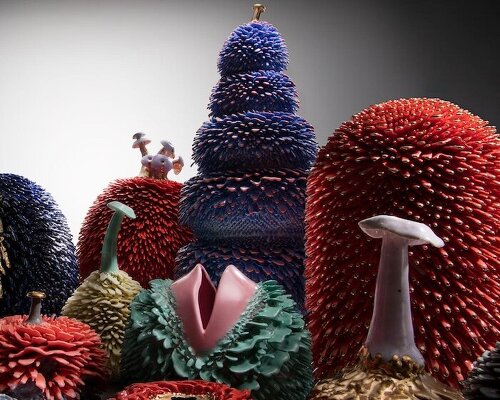
The Haas Brothers’ Uncanny Valley at the Museum of Arts and Design in New York brings together eighty-five works that present objects as active presences within a dreamlike, speculative reality.
Installed across sculpture, furniture, ceramics, painting, and digital work, the exhibition moves without hierarchy. A beaded plant, a low table, and a fur-covered creature occupy the same space, each following its own internal logic. The show reads as a continuous environment where distinctions between art and design give way to a shared condition of movement and interaction.
Across scales, from handheld vessels to towering figures, the works establish a setting where objects hold their own positions while remaining in constant relation. This flattened field recalls Object-Oriented Ontology, a philosophical framework that treats all objects as equally present, each carrying its own internal reality.
Uncanny Valley, Haas Brothers, exhibition view. image © designboom
when function gives way to behavior
Several of the Haas Brothers’ works begin from familiar typologies and shift them through small adjustments. A table takes on a gesture that suggests movement. A seat gains weight and posture through its surface and stance. These changes alter how the object is encountered, moving attention away from use and toward presence.
The design duo describe this shift as a move toward empathy, where an object gains intensity once it exceeds its expected role. The effect is immediate: objects hold attention through attitude and proportion rather than purpose alone.
Uncanny Valley, Haas Brothers, exhibition view. image © designboom
systems that generate form
Process drives the exhibition forward. The Accretion works build surfaces through repeated applications that echo patterns found in coral, fungus, and mineral growth. Paintings follow a similar logic, with layers added through controlled sequences that accumulate into dense, tactile fields. Beaded plants extend this approach through mathematical structures, where stitch patterns and proportional systems guide the final form. Algorithmic landscapes draw from early digital graphics, producing environments that develop through code.
Across these works, form emerges through rule-based procedures that continue to operate as the objects take shape. Growth, repetition, and variation remain visible, giving each piece a sense of duration. The exhibition builds a world where making is ongoing, where systems continue to act within the finished work.
Uncanny Valley, Haas Brothers, exhibition view. image © designboom
the uncanny as a spatial condition
The title points to a perceptual threshold. Many objects sit between recognition and uncertainty, drawing on familiar references while maintaining distance. Fur, bronze, glass, and ceramic surfaces suggest bodies, plants, or tools, yet resist stable identification. Proportions shift slightly. Symmetry breaks along one axis. Details accumulate beyond expectation.
This tension produces a sustained attentiveness. The viewer registers something known, then pauses at the point where that recognition begins to slip. The works hold this position without resolving it, allowing perception to move across their surfaces and forms in a continuous loop.
Uncanny Valley, Haas Brothers, exhibition view. image © designboom
objects in relation
Seen together, the works establish a network of correspondences that extends across the gallery. Repetition appears across different materials and scales. A clustered ceramic surface finds an echo in a painted field. A beaded structure aligns with a digital pattern. These connections move through the exhibition, linking pieces through rhythm and variation.
The installation supports this reading. Spacing allows each object to maintain its presence while still participating in a larger system. Movement through the galleries becomes a process of tracing these relationships, where attention shifts through shared structures and gestures. The exhibition operates as a field in motion, where no single object fixes the experience.
Uncanny Valley, Haas Brothers, exhibition view. image © designboom
Uncanny Valley, Haas Brothers, exhibition view. image © designboom
Uncanny Valley, Haas Brothers, exhibition view. image © designboom
Uncanny Valley, Haas Brothers, exhibition view. image © designboom
Uncanny Valley, Haas Brothers, exhibition view. image © designboom
project info:
name: Uncanny Valley
artist: Haas Brothers | @thehaasbrothers
museum: Museum of Arts and Design (MAD) | @madmuseum
location: 2 Columbus Circle, New York, New York
dates: April 11th — August 16th, 2026
photography: © designboom
This article is part of designboom’s Dreams in Motion chapter, exploring what happens when we treat our dreams and reveries as an active, radical rehearsal for impending material realities. Explore more related stories here.
The post a dreamlike cast of objects shapes the haas brothers’ joyful reality appeared first on designboom | architecture & design magazine.