
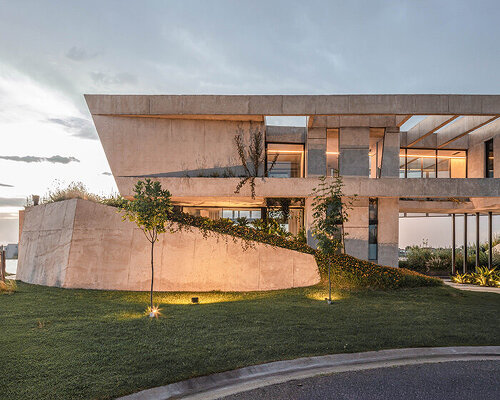
an inhabitable landscape along the lagoon
Grizzo Studio designs Casa Lomadas facing a lagoon outside Buenos Aires, Argentina. The house sits as a long, folded concrete bar, perched across two constructed mounds that reorganize the site into an artificial terrain. From the first view, the work reads as a negotiation between mass and ground, with the building and landscape operating as one continuous system.
The two mounds establish the logic of the plan. One begins at the street edge and extends outward, widening as it moves toward the water, carrying the main approach. The other starts as a vehicular entry and garage before slipping into the garden and reappearing as a planted ramp that leads back up to the house. These are more than supports. They carry movement, hold program, and shape how the building is experienced from arrival to the far edge of the lagoon.
images © Federico Kulekdjian
casa lomadas: the arrival sequence
At the point where the mounds meet the concrete bar of Grizzo Studio‘s Casa Lomadas, a double-height exterior void opens up the entry. A shallow reflecting pool sits within this space, pulling the eye across the site while catching fragments of sky and structure. The approach is guided sideways before turning inward, so entry happens through movement rather than a single front door moment.
Walking along the left mound, the path thickens into interior space. The kitchen and dining areas sit within this built ground, embedded into the slope, and the ceiling lifts as the sequence reaches the living room. From there, the plan stretches toward a gallery that projects over the lagoon. It feels like the end of a long, measured progression, where the horizon becomes the final wall.
the house is set on a double plot facing over one hundred meters of lagoon shoreline
geometry as a working tool
Casa Lomadas is defined by a faceted language of angled concrete planes. Walls tilt and shift, creating a sense of tension that directs attention outward. Views are framed in specific directions, and the landscape is brought into constant peripheral vision. This geometry carries through every space, so the building reads as a continuous operation rather than a collection of rooms.
A suspended staircase cuts through this system, built from folded raw steel sheet. It appears light against the heavier concrete surfaces and lands onto a large interior planter, tying the movement between levels back to the ground. Materials remain direct throughout. Exposed concrete, raw steel, and stone are left visible, giving the house a consistent physical character that holds together as one piece.
a folded concrete bar stretches across two constructed mounds that shape the site
upper level and extended ground
On the upper floor, the more open spaces continue the outward orientation. A living area and study extend onto a planted terrace positioned above the gallery, set up as a vantage point toward the lagoon and sunset. A bridge crosses back over the entry void, connecting to the bedrooms and maintaining a sense of continuity across the plan.
From here, the second mound becomes active again, forming a descending green ramp that leads back toward the garden. Movement across the house always returns to the ground, even when passing through upper levels. The project keeps linking interior circulation with the terrain, so each path feels part of a larger system.
the mounds guide circulation and hold program as an extension of the landscape
edge conditions and enclosure
At the far end of the concrete bar, the main bedroom opens in both directions through large glazed surfaces. The en-suite bathroom extends outward, with the bathtub placed at the edge of the cantilever. The position gives a direct relationship to the lagoon, where the horizon becomes part of the interior view.
The rear facade introduces a perforated metal screen, suspended away from the main structure. It filters light and softens the mass of the concrete bar, allowing air and views to pass through. From the outside, it adds a layer of depth. From within, it creates a shifting field of light that changes through the day.
a double height entry void with a reflecting pool organizes arrival
interior spaces are embedded within the sloped ground and open toward the lagoon
a perforated metal screen filters light along the rear facade
upper level spaces extend to a planted terrace overlooking the water
project info:
name: Casa Lomadas
architect: Grizzo Studio | @grizzostudio
location: Buenos Aires, Argentina
photography: © Federico Kulekdjian | @fedekufoto
The post grizzo studio’s ‘casa lomadas’ is shaped by folded concrete volumes in argentina appeared first on designboom | architecture & design magazine.