
Ecological design defines Pentaspace’s nature-integrated school
Heartfulness International School in Hyderabad, India, designed by Pentaspace Design Studio, integrates architecture and landscape to form a campus organized around ecological principles. Conceived for pre-primary education, the project explores how spatial design can support learning environments that are closely connected to natural systems.
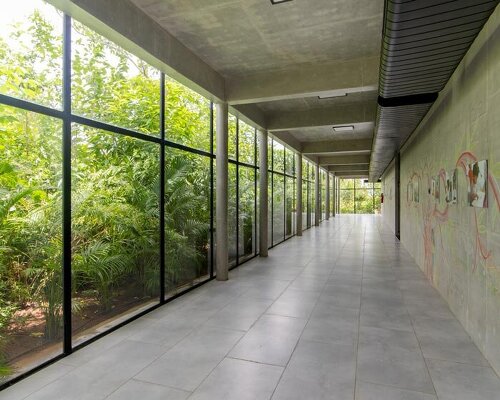
The design is structured around the integration of a developing forest within the campus. Vegetation is incorporated as an active component of the architecture, shaping both spatial experience and environmental performance. Vertical planting systems are installed along cable frameworks, forming a layered green facade that evolves over time. This vegetated envelope contributes to shading, cooling, and air filtration while establishing a visual and physical connection between students and the surrounding landscape.
Material selection emphasizes durability and clarity of construction. Exposed concrete and glass are used as primary elements, with concrete walls providing thermal mass and low maintenance. The restrained material palette avoids applied finishes, allowing the building’s surfaces to remain adaptable over time. Interior walls function as a neutral background for student activity, with drawings and murals gradually becoming part of the spatial expression.
all images by the Media team at Heartfulness
Open-Courtyard School invites children to learn within nature
Pentaspace Design Studio centers spatial organization on an open courtyard that connects classrooms on either side. This central void operates as a shared outdoor space, supporting a range of activities including play, movement, and informal learning. Circulation is defined by wide corridors that extend these functions, acting as transitional zones between enclosed classrooms and open-air environments.
Environmental strategies are integrated at multiple scales. The campus operates on solar energy, achieving a net-zero energy balance. Passive design measures, including cross-ventilation, deep overhangs, and the thermal properties of concrete, reduce reliance on mechanical cooling. Ground-level planting and vertical gardens contribute to microclimatic regulation and support biodiversity within the site.
The project establishes a continuous relationship between built form and landscape. Through the use of vegetation, passive environmental systems, and adaptable material surfaces, the school functions as a spatial framework that supports both educational activities and ecological processes.
a school campus integrates architecture with a developing forest landscape
vegetation forms an active layer within the architectural system
open-air zones support play, movement, and informal activities
a central courtyard connects classrooms across the plan
deep overhangs provide shade and climate control
the courtyard functions as a shared outdoor learning space
built form and ecology are integrated through spatial design
glass and concrete define the building’s primary material palette
exposed concrete provides thermal mass and durability
interior surfaces remain neutral to accommodate student activity
project info:
name: Heartfulness International School
architect: Pentaspace Design Studio | @pentaspacedesignstudio
principal designers: Gaurav Sanghavi, Pragya Sanghavi, Harsh Pote
design team: Tejaswini Patil
location: Hyderabad, India
photographer: Media team at Heartfulness
designboom has received this project from our DIY submissions feature, where we welcome our readers to submit their own work for publication. see more project submissions from our readers here.
edited by: christina vergopoulou | designboom
The post open courtyards and evolving green facades turn hyderabad school campus into living forest appeared first on designboom | architecture & design magazine.