
‘POLISH MODERNISM’ EXHIBITION AT TORRE VELASCA
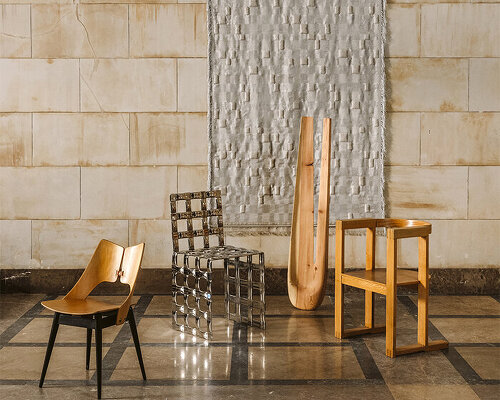
Following its success with Romantic Brutalism in 2025, Visteira Foundation returns to Milan Design Week with the exhibition titled ‘Polish Modernism. A struggle for Beauty.’ Hosted on the 16th floor of Milan’s iconic Torre Velasca from April 20–26, the exhibition explores the courageous nature of Polish design. Curated by Federica Sala and Anna Maga, the show juxtaposes historical masterworks with contemporary designs to reveal how Poland’s turbulent history gave rise to modernism.
historical masterworks of polish modernism | all images courtesy of Visteria Foundation
The exhibition’s title is drawn from a 1948 text by Irena Krzywicka, framing modernism not as a mere aesthetic choice, but as an act of cultural resistance. In the Polish context, the movement was a multifaceted project for a nation forging its identity. Instead of succumbing to the traditional form-function dualism, Polish designers embraced modernist ideas, pushing creative and technical boundaries to benefit the common man and improve the quality of everyday life.
Through the interweaving of different generations and design approaches, the exhibition invites visitors to appreciate and reflect on how Polish modernism evolves, adapts and remains deeply relevant.
Visteria Foundation brings a selection of Polish craft and design pieces to Milan Design Week 2026
POLISH DESIGN AS A COMPETENCE FOR THE FUTURE
The Visteria Foundation, led by the founder Kataryna Jordan, positions Polish design as a ‘competence for the future’. This approach is anchored by the legacy of the Institute of Industrial Design (IWP). Founded in 1950 by Wanda Telakowska, the IWP is one of Europe’s oldest design institutions and operates on the conviction that beauty is a civic right, not a luxury.
The curatorial narrative of ‘Polish Modernism. A struggle for Beauty’ contrasts the functionalist rigor with postmodern reinterpretations, revealing a cyclical return to modernism as a response to socio-cultural shifts. For the foundation’s president and curators, the core question remains: in a world of overproduction and climate crisis, what does it mean to be modern? What are the needs of a modern society?
‘Polish Modernism. A struggle for Beauty’ contrasts the functionalist rigor with postmodern reinterpretations
Muszelka chair 1956s by Teresa Kruszewska exemplifying the ingenuity of Polish modernism
REINTERPRETING ARCHIVES FOR MILAN DESIGN WEEK 2026
The exhibition rejects a dry chronological recount of Polish modernism in favor of a conceptual dialogue. Featuring scenography by Zofia Wyganowska Studio, the showcase engages with the brutalist heritage of the Torre Velasca. This narrative is enriched by works of renowned Polish artists such as Władysław Strzemiński, Edward Krasiński, and Katarzyna Kobro, and unique loans from the National Museum in Warsaw, including furniture pieces from Jan Kurzątkowski and Bohdan Lachert, and the Muszella chair by Teresa Kruszewska.
A dedicated room features the IWP (IID)_Design Repository_2.0 project, where contemporary designers reinterpreted archival icons like the meblościanka (wall unit) and the amerykanka (convertible armchair). These are not mere reconstructions, but experimental prototypes illustrating the logic of modernist thinking applied to modern production standards.
Plucka Chair by Maria Chomentowska: the ‘New look’ modernism of 1950s
The bridge between eras is furthered by commissioned works from designers, including Tomek Rygalik, Maria Jeglińska-Adamczewska, Paweł Olszczyński, Igor Polasiak (Craftica Gallery), and Maja Ganszyniec, who created objects especially for the exhibition. Selected works by artists whose designs reflect the influence of modernist ideas include Mati Sipiora, Marek Bimer, Aleksandra Hyz, Monika Patuszyńska, and Małgorzata Markiewicz. Their works mirror a modern understanding of the ‘struggle for beauty’ as a struggle for quality of life in an era of uncertainties.
After Milan Design Week, the exhibition moves to the Visteria Foundation’s headquarters at the Gawroński Villa in Warsaw in September 2026.
Phantom Chair, crafted in steel weaving technique by Mati Sipiora
curators Federica Sala and Anna Maga and architect Zofia Wyganowska
Kataryna Jordan founder of Visteria Foundation
project info:
name: Polish Modernism. A struggle for Beauty
foundation: Visteria Foundation | @visteria.foundation
curation: Federica Sala | @lafedesss and Anna Maga | @ann.amaga
design: Zofia Wyganowska Studio | @zofiawyganowskastudio
location: Torre Velasca – Piazza Velasca 3/5, Milan Italy
dates: April 20-26, 2026
The post visteria foundation fills torre velasca with polish modernism at milan design week 2026 appeared first on designboom | architecture & design magazine.