
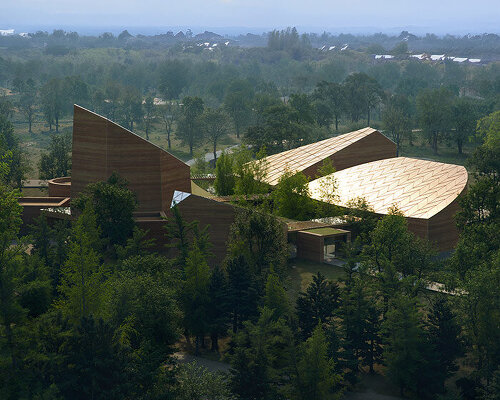
a campus set into the landscape
The new Cherokee Heritage Center in Oklahoma by Safdie Architects organizes a series of low, faceted volumes across a wooded site, forming a campus that sits close to the ground and follows the terrain. From a distance, the rammed earth buildings read as a cluster of warm, earth-toned forms, their sloped roofs catching light at different angles while tree canopies soften their edges.
Each volume holds a distinct program, yet the composition feels continuous. Paths trace between the buildings, moving through planted clearings and across shallow water. The layout encourages a gradual approach, with the architecture revealing itself in fragments rather than as a single front-facing object.
visualizations © Mir, courtesy Safdie Architects
architecture built from the earth
The exterior of Safdie Architects’ Cherokee Heritage Center is defined by layered, horizontal bands of rammed earth, giving the walls a subtle grain that shifts in color from sandy beige to deeper ochre. With this material choice, the architects ground the project visually and physically, and tie it to the surrounding soil while providing a consistent surface across the varied geometries.
Roof forms introduce a different language. Some volumes taper into sharp, angular peaks, while others curve gently, creating a contrast between faceted and rounded profiles. In one of the central structures, a faceted skylight assembly crowns the space, its triangulated geometry filtering daylight into the interior below.
Safdie Architects organizes a series of rammed earth volumes across a wooded Oklahoma landscape
inside the upcoming cherokee heritage center
Along the interiors, light becomes the main spatial driver. In the taller galleries, daylight enters from above through patterned skylights, casting defined patches of brightness that move slowly across the textured walls. The thickness of the rammed earth is evident at openings, where deep reveals frame views outward and reinforce a sense of enclosure.
Circulation spaces remain open and legible. Glass walls along the ground level connect interior rooms to the surrounding landscape, allowing views of trees, water, and planted areas to remain present throughout the visit. Structural elements are kept minimal in these zones, with slender columns supporting extended rooflines that create shaded thresholds.
faceted and curved roof forms create a varied silhouette that responds to light and topography
connections across the site
Bridges and covered walkways link the buildings, maintaining continuity while allowing the landscape to pass through. One pedestrian bridge crosses a shallow stream, bringing visitors close to water and vegetation before re-entering the built fabric. These transitions between inside and outside occur frequently, keeping the experience in dialogue with the site.
Outdoor areas are treated as extensions of the architecture. Terraces step gently from interior floors, and seating is integrated into the topography. The project avoids a rigid boundary, instead allowing edges to blur where glass, shade structures, and planting overlap.
Public spaces, including a café and gathering areas, are found at the intersections of paths. Here, larger spans and open glazing create a more transparent condition, with views extending across lawns and into the trees beyond. The curved roof over the café introduces a softer profile, contrasting with the sharper volumes nearby.
the campus is arranged as a network of paths that guide visitors through buildings and planted clearings
a central skylit volume filters daylight through a triangulated roof structure into gallery spaces
rammed earth walls carry horizontal striations that reflect the tones of the surrounding soil
glass edges connect interiors to trees water and seasonal changes across the site
bridges and walkways link buildings while allowing the landscape to pass through
project info:
name: Cherokee Heritage Center
architect: Safdie Architects | @safdiearchitects
location: Tahlequah, Oklahoma, USA
visualizations: © Mir | @mir.no
partners: Moshe Safdie, Jaron Lubin
design team: Belinda Valenti, Sam May, Tunch Gungor, Tess Lubin, Kristen Jackson, Yousun Nam
architect of record: Anishinabe Design Inc.
landscape: PWP Landscape Architecture
civil engineering: Wallace Design Collective
mechanical, electrical engineering: Buro Happold
mechanical engineer of record: HSA
The post safdie architects plans cherokee heritage center as a cluster of rammed earth blocks appeared first on designboom | architecture & design magazine.