
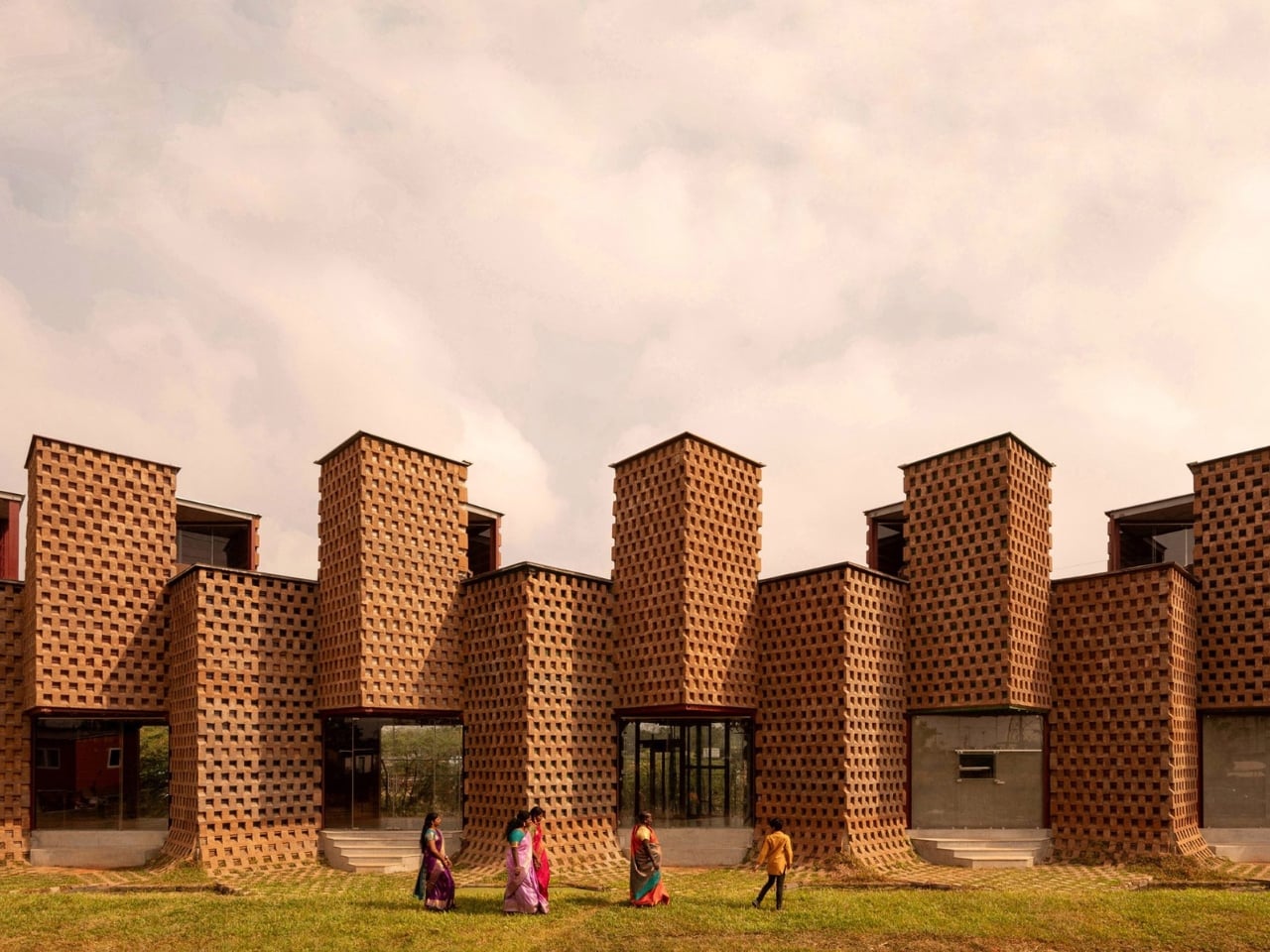
When you hear “shipping container restaurant,” you probably picture a food truck-adjacent setup with exposed steel walls and Edison bulb string lights. Petti, a restaurant in Tuticorin, Tamil Nadu, is nothing like that. Designed by Indian studio Wallmakers, it is one of those rare projects that makes you stop and ask why we haven’t been doing this all along.
Tuticorin is a port city, and like most port cities, it has a very specific kind of visual language. Industrial, gritty, layered with the residue of trade. Discarded shipping containers are a common sight there, stacked along waterfronts and left to rust once their working lives are over. For most people, they’re background noise. For Wallmakers’ founder Vinu Daniel and his co-architect Oshin Mariam Varughese, they were a starting point.
Designer: Wallmakers
The team took twelve of those containers, cut them in half lengthways, and welded them onto a steel frame. That alone sounds like a fairly standard repurposing story. But here’s where it gets genuinely interesting. Instead of leaving the steel exposed or cladding it in something conventional, they coated the entire exterior in poured earth. Not just a surface treatment for looks, either. The earth layer was designed in an alternating recessed pattern specifically to reduce heat gain and cut the building’s reliance on air conditioning by 38 percent. In tropical Tamil Nadu, where heat is a year-round reality rather than a seasonal inconvenience, that’s a serious design decision with real consequences.
The result is a building that looks like it grew out of the ground. From the outside, Petti reads as a textured, warm-toned structure with a zigzagging profile, the kind of silhouette that makes you stop and puzzle over whether it’s old or new, industrial or handcrafted. The answer is that it’s both, and that tension is exactly the point.
Inside, the layout follows the logic of the containers themselves. Each container half creates a defined niche, so the dining experience becomes surprisingly intimate for a space that seats 200 people. You’re tucked in, not floating in a vast open plan. During the day, natural light filters in through skylights above each seating area. At night, chandeliers made from old wax and pipes take over, filling the space with a glow that’s warm without being precious. The floors are laid with discarded deck wood and oxide. It’s a level of material consistency that tells you the team thought carefully about every surface, not just the ones visible from the street.
Petti doesn’t perform sustainability, and that’s a distinction worth making. A lot of design projects with eco credentials feel like they need you to notice the eco credentials first and the design second. Petti reverses that. The photograph you’re drawn to first is a beautiful one: warm light, earthy texture, layered geometry. The backstory, the fact that you’re looking at marine waste and mud, makes it more compelling, not less beautiful.
There’s a real argument here about how we build in tropical climates. Shipping containers are notoriously poor insulators on their own, which is why so many container architecture projects end up being thermally uncomfortable. Wallmakers addresses this head-on with the poured earth facade, and the 38 percent reduction in cooling load isn’t a marketing figure pulled from thin air. It reflects the kind of climate-specific thinking that a lot of globally distributed architectural trends skip entirely because they were never designed with heat in mind.
Petti also pushes back on a certain aesthetic snobbery in sustainable design, the assumption that salvaged materials and low-carbon building methods produce something that looks compromised or impermanent. This restaurant looks better than most places that cost considerably more to build, and it leaves a much lighter footprint while doing it.
The name itself is worth sitting with. Petti means “box” in Tamil, and the simplicity of that is quietly perfect. A box, rethought, coated in earth, stacked into something you’d travel to see. That’s not a small thing.
The post The Restaurant Made of Mud and Marine Waste Is Drop-Dead Gorgeous first appeared on Yanko Design.