
castor place opens in piraeus as a transformable cultural venue
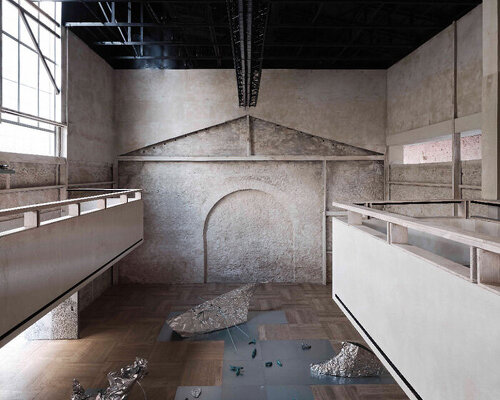
Andreas Kostopoulos of Manhattan Projects New York City (MPNYC) reactivates a 19th-century warehouse into Castor Place, a multi-use cultural venue in Piraeus, designed to host an evolving spectrum of events. Conceived under Manhattan Projects New York City, the project reframes the historic masonry shell as a flexible, open-ended environment for lectures, exhibitions, performances, and gatherings, balancing preservation with a forward-looking spatial strategy.
The original 1850s fabric of the building is rearticulated through a process of subtraction. Andreas Kostopoulos, former associate director at Diller Scofidio + Renfro, removes layers accumulated over time, restores sealed openings and reintroduces natural light as a primary architectural device. This act of surgical archaeology allows the structure to regain permeability and legibility, transforming it into a porous, welcoming environment.
Castor Place, Piraeus, Athens, Greece © Yiorgos Kaplanidis
MPNYC uses indeterminacy as a design tool
Rather than imposing a fixed identity, the project embraces indeterminacy. Modular staging systems, adaptable lighting, and an open floor plan enable the venue to continuously reconfigure according to use. The approach recalls the theoretical ambitions of Cedric Price’s unbuilt Fun Palace, where architecture operates as an enabling framework. At Castor Place, space becomes a responsive instrument shaped by its occupants.
The venue takes its name from Kastoros Street, referencing Castor of the Dioscuri twins, embedding a subtle narrative of duality into the project’s identity. This idea resonates spatially, expressed through parallel conditions: old and new, heavy and light, fixed structure and fluid use. Kostopoulos and his team at MPNYC avoid erasure, instead allowing historical traces to coexist with contemporary interventions.
designed to host an evolving spectrum of events
a three-part spatial sequence
The venue unfolds as a sequence of interconnected environments. The Hall anchors the project with its industrial scale and capacity for large gatherings, while the Atrium introduces a softer, garden-like atmosphere under skylights. Above, the Loft operates as an elevated, flexible platform overlooking the main space. Together, these elements form a continuous spatial narrative, enabling events to move fluidly across distinct yet interrelated settings.
Whitewashed surfaces act as a neutral field that highlights the raw qualities of the existing structure, from masonry textures to structural rhythms. Rather than masking imperfections, the intervention frames them, allowing material authenticity to guide the spatial experience.
Balconies and multiple elevations introduce visual connections and expand the programmability of the venue, supporting simultaneous uses and layered perspectives. The architecture resists singular definition, operating as a continuously shifting stage set. At Castor Place, Kostopoulos proposes a model of adaptive reuse that privileges openness, ambiguity, and long-term adaptability over fixed form.
the original 1850s fabric of the building is rearticulated through a process of subtraction
the act of surgical archaeology allows the structure to regain permeability and legibility
a porous, welcoming environment
Andreas Kostopoulos inside Castor Place
project info:
name: Castor Place | @castor_place
architects: MPNYC | @manhattanprojects
location: Piraeus, Greece
lead designer: Andreas Kostopoulos | @andreaskostopoulos
photographer: Yorgos Kaplanidis | @kaplanidis
The post MPNYC transforms 19th-century warehouse into flexible cultural venue in piraeus appeared first on designboom | architecture & design magazine.