
This guide explores the core pillars of digital marketing, how they work together, and how businesses can build scalable systems for long-term success. Find real examples.
Digital marketing is no longer optional. It is the foundation of brand visibility, customer acquisition, and scalable growth. Whether you are launching a startup, expanding an established business, or entering new markets, digital marketing determines how customers discover, evaluate, and choose your brand. Unlike traditional marketing, digital strategies are measurable, adaptable, and performance-driven. Every click, impression, and conversion provides insight. The brands that win are not simply visible but also strategically aligned, creatively compelling, and continuously optimized.
Why Digital Marketing Matters
Digital channels provide precise targeting, real-time tracking, and measurable ROI.
Awareness through social and paid ads
Consideration via content and SEO
Conversion through optimized landing pages
Retention through email and remarketing
The Core Pillars of Digital Marketing
Effective digital marketing is built on three foundational pillars: Paid, Social, and Content.
1. Paid Marketing
Paid marketing accelerates visibility and drives immediate traffic.
• PPC Advertising
Platforms such as Google Ads, Yahoo, and Bing allow brands to target high-intent search queries. PPC works best when aligned with a strong keyword strategy and persuasive ad copy.
Key components:
Keyword research
Conversion tracking
Bid strategy
Retargeting
• ORM
Online reputation management strengthens trust. It impacts conversion rates by:
Monitoring reviews
Responding to feedback
Maintaining credibility
2. Social Media Marketing
Social media builds relationships, brand awareness, and community engagement.
• Social Media Management
This includes:
Profile optimization
Content calendar planning
Community engagement
Influencer collaborations
Facebook and Instagram focus on visual storytelling, LinkedIn supports professional positioning, TikTok and YouTube drive video engagement.
• Social Media Design
Creative assets are critical:
Feed posts
Stories and reels
Ad creatives
Banners
Strong visuals directly impact engagement and click-through rates.
• Social Ads
Paid social campaigns involve:
Audience targeting
Ad copywriting
Campaign setup
Performance monitoring
When combined with retargeting, social ads increase conversion probability.
3. Content Marketing
Content marketing builds long-term authority and organic visibility.
• SEO Services
This makes sure your brand appears when customers search. Includes:
On-page optimization
Technical SEO
Link-building strategies
App store optimization
SEO is compounding, which means the longer you invest, the stronger the results.
• Content Development
High-value content positions brands as experts. Formats include:
Blog articles
eBooks
Website copy
Lead magnets
Sales pages
Content fuels SEO, social media, and email marketing simultaneously. With effective content marketing tools, this can lead to measurable results in a short time.
4. Email Marketing
Email marketing drives retention through the following:
Campaign automation
Lead nurturing sequences
Segmented targeting
Digital Marketing Channels to Consider
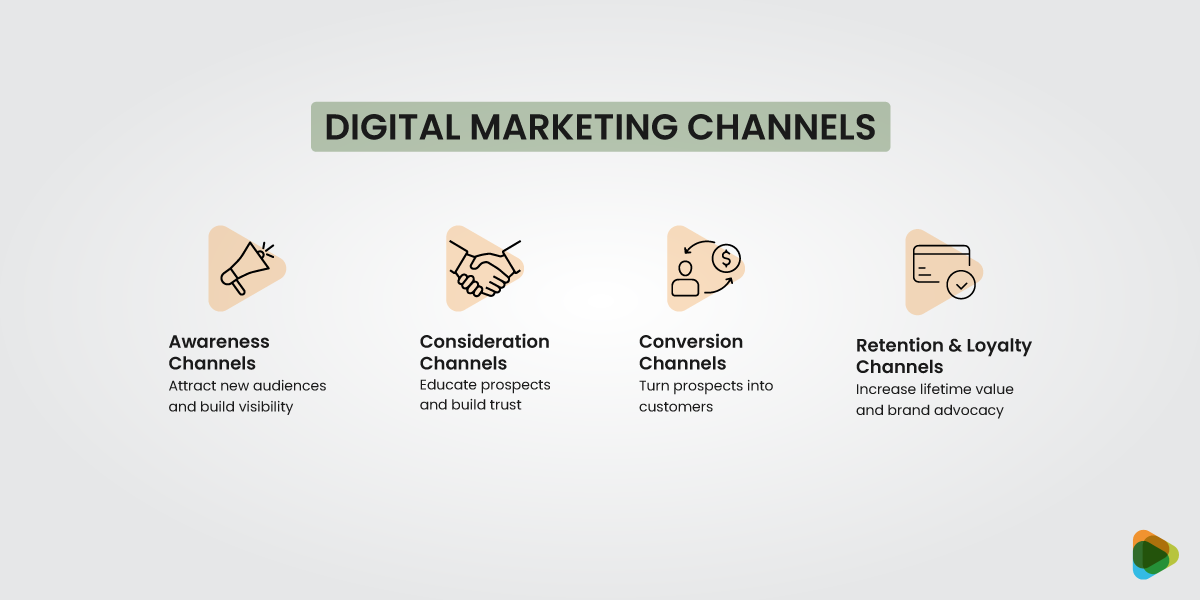
Awareness Channels → Attract new audiences and build visibility
Consideration Channels → Educate prospects and build trust
Conversion Channels → Turn prospects into paying customers
Retention & Loyalty Channels → Increase lifetime value and brand advocacy
A high-performing digital marketing strategy is built around customer intent. Each channel serves a different role depending on where your audience is in the journey.
1. Awareness Channels
At this stage, the objective is visibility and brand recall. You’re capturing attention and creating the first impression.
Social Media Marketing
Platforms like Facebook, Instagram, LinkedIn, and TikTok allow brands to:
Reach broad or niche audiences
Build brand personality
Share educational and entertaining content
Run targeted paid awareness campaigns
They work well for brand storytelling in social media, audience growth, and market education.
Display Advertising
Display ads appear across websites and apps through networks like Google Display Network. They include:
Banner ads
Native ads
Rich media ads
Increase brand recognition, support awareness campaigns, and reinforce messaging across the web.
Video Marketing
Video is one of the most impactful awareness tools, especially on platforms like YouTube and TikTok. Common formats:
Brand story videos
Explainer videos
Educational content
Short-form viral clips
Video drives stronger engagement, retention, and emotional connection compared to static formats.
2. Consideration Channels
At this stage, potential customers are actively researching solutions. Your focus shifts to credibility, differentiation, and value.
Search Engine Optimization (SEO)
SEO helps your website rank organically in search results on Google and Bing. Core components include:
Keyword research
On-page optimization
Technical improvements
Backlink building
Capture high-intent traffic and establish authority while reducing reliance on paid ads.
Content Marketing
Content marketing supports SEO and nurtures trust simultaneously. Formats include:
Blog posts
Pillar pages
Case studies
Whitepapers
Webinars
Answer buyer questions, address objections, and position your brand as the go-to expert.
Email Nurturing
Email sequences guide prospects through the decision-making process. Tools like Mailchimp and HubSpot help automate:
Welcome sequences
Educational series
Lead magnet follow-ups
Behavior-triggered emails
Email nurturing builds trust over time and moves leads closer to conversion.
3. Conversion Channels
Here, strategy becomes revenue-focused. Traffic is high-intent and ready to act.
PPC Campaigns
Pay-per-click (PPC) advertising targets ready-to-buy users through platforms like Google Ads and Meta Ads. Advantages include:
Immediate visibility
Precise audience targeting
Budget control
Measurable ROI
PPC works well for product launches, competitive keywords, and time-sensitive promotions.
Retargeting Ads
Retargeting reconnects with users who previously interacted with your brand, such as visiting your website or abandoning a cart.
Landing Pages
Landing pages are dedicated, conversion-focused pages built for one specific action. Key elements include:
Clear value proposition
Single, strong CTA
Social proof
Minimal distractions
Unlike homepages, landing pages are optimized entirely for conversion performance.
4. Retention and Loyalty Channels
Acquiring customers is expensive. Retaining them is where profitability grows.
Email Marketing
Beyond nurturing, email drives repeat purchases and loyalty. Examples include:
Post-purchase sequences
Upsell and cross-sell emails
Re-engagement campaigns
Exclusive offers
Email remains one of the highest-ROI digital channels.
Community Building
Communities help build emotional loyalty and long-term engagement. Examples are:
Private groups on Facebook
Professional groups on LinkedIn
Brand-owned membership platforms
Benefits include stronger retention, word-of-mouth marketing, and valuable customer feedback loops.
Remarketing Campaigns
This draws focus on existing customers instead of prospects. Examples such as:
Loyalty promotions
Product updates
Seasonal campaigns
VIP offers
This approach keeps your brand top-of-mind and increases overall lifetime value.
Key Factors that Drive the Success of a Digital Marketing Strategy
The following factors are critical to achieving long-term success.
1. Clear and Measurable Goals
Every strategy or digital marketing approach needs defined objectives to provide direction. Common goals include:
Lead generation
Revenue growth
Brand awareness and authority
Audience expansion
Without clear goals, campaigns risk being unfocused and inefficient.
2. Data-Driven Decision Making
Effective strategies rely on analytics rather than guesswork. Key metrics to track include:
Cost per acquisition (CPA)
Return on ad spend (ROAS)
Conversion rate
Engagement rate
Customer lifetime value (CLV)
Consistently reviewing performance allows for iterative improvements and higher ROI.
3. Audience-Centered Approach
Strategies must align with the needs, behaviors, and preferences of the target audience. This includes:
Understanding buyer personas
Mapping the customer journey
Personalizing content and messaging
Audience insights drive relevance and increase engagement.
4. Omnichannel Consistency
A cohesive presence across channels ensures that messaging and branding are unified. Benefits include:
Stronger brand recall
Better cross-channel performance
Seamless customer experience
Coordination between social media, email, SEO, PPC, and content marketing is key.
5. Valuable and Relevant Content
Content is the backbone of digital strategy. High-quality content:
Educates and informs audiences
Builds trust and authority
Supports SEO and organic discovery
Nurtures leads through the funnel
The right content delivered at the right stage significantly boosts conversions.
6. Agility and Continuous Optimization
Digital marketing is dynamic. Strategies must be adaptable:
Testing ad creatives, messaging, and channels
Adjusting budgets based on performance
Leveraging real-time insights for rapid improvement
Agility ensures the strategy evolves with audience behavior and market trends.
7. Automation Tools
Automation and analytics tools streamline execution and measurement:
Marketing automation platforms (e.g., email nurturing, workflows)
Analytics dashboards for real-time insights
CRM systems for managing customer relationships
Technology enables scale, efficiency, and data-driven precision.
8. Effective Customer Experience
Success is based on how you create a seamless journey from discovery to loyalty:
Optimized landing pages
Intuitive website navigation
Fast loading speed and mobile optimization
Consistent post-purchase support
A positive experience drives repeat business and brand advocacy.
Creative and Messaging in Digital Marketing
Successful digital marketing relies on a balance of consistent branding, platform-optimized creativity, and data-driven experimentation.
1. Visual Identity Across Channels
A strong and consistent visual identity increases brand recognition and trust.
This includes:
Consistency in Branding – Logos, color schemes, typography, and imagery should maintain a unified look across social media, ads, email, and landing pages.
Creative Adaptation per Platform – While branding should remain consistent, each platform has unique audience expectations and formats. For example:
Short, punchy visuals for Instagram and TikTok
Informative, professional visuals for LinkedIn
Engaging thumbnail images and motion graphics for YouTube
Creative adaptation helps make sure that your content resonates and stays on-brand.
2. Copywriting for Conversions
Words drive action as much as visuals. Effective copywriting focuses on clarity, persuasion, and emotional resonance:
Headlines – Capture attention immediately and are often the deciding factor for engagement.
CTA Optimization – Calls-to-action must be clear, compelling, and relevant to the user’s stage in the journey. Examples: ‘Download Now’, ‘Claim Your Free Trial’, or ‘Learn More’.
Emotional Triggers – Connecting with your audience emotionally increases recall and motivates action. Incorporate storytelling, social proof, and relatable scenarios.
Great copy doesn’t just inform, it guides users seamlessly toward conversion.
3. Creative Testing
Even the most polished campaigns require validation. Testing allows you to make sure that you make data-driven decisions.
Ad Variations – Test multiple headlines, visuals, formats, and CTAs to see what resonates with your audience.
Performance Benchmarking – Track metrics like CTR, conversion rate, engagement, and bounce rate to identify high-performing creatives.
Iterative Optimization – Use insights from testing to continuously refine creative elements, making sure campaigns remain effective over time.
A culture of testing allows brands to maximize ROI and avoid wasting budget on underperforming creative.
Step-by-Step Process for Creating Digital Marketing Campaigns
The process begins with discovery and strategy, where goals, audience insights, and competitive positioning are clearly defined. From there, the right marketing channels are selected to ensure maximum reach and relevance. Once the direction is set, creative assets such as ads, landing pages, and content are developed to align with the strategy.
Campaigns are then launched with proper tracking and performance systems in place. After launch, continuous optimization improves results through data analysis and refinement. Finally, once performance is proven, campaigns are strategically scaled to expand reach, increase conversions, and drive sustainable business growth.
Step 1: Discovery and Strategy
Goals defined
Audience researched
Competitor analysis completed
Strategic roadmap created
Every effective digital marketing campaign begins with clarity and research. This phase defines direction and ensures marketing efforts align with business objectives.
And it includes:
Defining business goals (leads, sales, brand awareness, engagement)
Identifying target audience segments and buyer personas
Conducting market and competitor analysis
Clarifying brand positioning and messaging
Establishing measurable KPIs and benchmarks
Step 2: Channel Selection
Platforms selected
Funnel structured
Paid and organic channels aligned
Targeting approach finalized
Choosing the right marketing channels allows you to make sure that the message reaches the right audience at the right time. The step covers:
Evaluating paid advertising platforms
Identifying organic content opportunities (SEO, social media, content marketing)
Planning email marketing and automation funnels
Structuring retargeting and remarketing strategies
Integrating channels into a cohesive marketing ecosystem
Step 3: Creative Development
Ads designed
Landing pages built
Copy written
Conversion elements implemented
Strategy is implemented with on-brand visuals and written assets that drive engagement and conversions. It focuses on:
Designing high-performing ad creatives
Developing optimized landing pages
Putting together persuasive copy and clear calls-to-action
Maintaining consistent branding across all assets
Preparing variations for testing and optimization
Step 4: Campaign Launch
Campaigns activated
Tracking integrated
Budgets allocated
Audiences segmented
Once assets and systems are ready, campaigns are launched with structured tracking and monitoring.
Activating campaigns across selected platforms
Installing tracking pixels and analytics tools
Setting budgets and bidding strategies
Segmenting audiences for targeted delivery
Monitoring early performance indicators
Step 5: Optimization and Reporting
Metrics analyzed
Tests conducted
Targeting refined
Reports generated
Digital marketing requires continuous refinement to improve efficiency and results.
Monitoring performance metrics (CTR, CPA, ROAS, engagement rates)
Conducting A/B testing on creatives and messaging
Adjusting audience targeting and placements
Optimizing landing pages for better conversions
Producing clear performance reports with insights
Step 6: Scaling
Budgets increased
Audience expanded
Automation implemented
Growth accelerated
After achieving consistent performance, campaigns can be expanded strategically to accelerate growth. This can lead to:
Increasing budgets for high-performing campaigns
Expanding into new audience segments
Introducing automation and advanced funnel strategies
Launching additional channels
Replicating and enhancing successful creative strategies
Digital Marketing Services: What they Cost
Costs vary widely based on the services you choose, campaign complexity, creative production needs, and contest-led platforms or agencies.
Contest-Based Creative (ZillionDesigns)
Businesses launch a design contest for campaign visuals, landing page layouts, ad sets, or branded marketing assets.
Multiple designers submit concepts, you choose the best one.
Pricing is transparent and fixed based on the package you choose.
Costs typically range from $300 to $1000 depending on the number of concepts, revisions, and deliverables included.
Best for businesses that want a variety of ideas, competitive designs, and cost control.
Agency Services
Some contests and collaborations can be scaled into broader strategic work, including multi-channel campaign design, pitch decks, content templates, or enterprise branding systems that support digital marketing efforts.
Pricing for this level goes beyond $2000 as requirements grow.
You can combine ZillionDesigns outputs with strategy or campaign management support from your internal team or external contractors.
Typical Price Ranges by Service Model
Service Model
Typical Cost Range
What It Covers
DIY Tools & Platforms
$0 – $500/month
Basic tools for email, social scheduling, or analytics; limited support
Freelance Specialists
$300 – $5,000+/month
Tactical execution for specific services (SEO, PPC, social ads); flexible options
Contest-Based Creative Platforms
$300 – $5,000+ per project
Multiple creative concepts for ads, social visuals, landing pages; fixed pricing
Dedicated Consultants
$1,000 – $15,000+/month
Strategy, planning, and execution across channels
Full-Service Agencies
$2,000 – $50,000+/month
Integrated strategy, multi-channel campaigns, analytics, optimization, reporting
Factors that Influence Digital Marketing Costs
Several factors determine final pricing, including:
Scope of Services
Will you run paid ads, organic content, email marketing, SEO, or all of the above?
More channels and tactics require larger budgets and greater expertise.
Campaign Complexity
Simple single-channel campaigns cost less
Multi-channel, full-funnel strategies with automation and complex tracking cost more.
Creative Production
Custom visuals, professional video production, branded templates, and copywriting increase costs.
Pre-made or templated work reduces pricing.
Market Competition
Highly competitive industries (e-commerce, finance, insurance) require higher ad budgets and deeper optimization, increasing overall spend.
Target Geography
National or international campaigns typically cost more than regional or local efforts due to broader audiences and higher competition.
Volume of Work
Larger ad spends and frequent content production (e.g., daily social posts) increase management time and can raise monthly retainers.
Performance and Tracking
Advanced analytics, conversion tracking, and custom dashboards add to setup and service costs.
Pricing by Specific Digital Services
Here are digital marketing services to consider with their pricing.
Paid Advertising (Search & Social)
Setup: $500 – $2,500+
Monthly Management: 10–20% of ad spend or $1,000 – $10,000+
Creative production and landing page design are often additional.
SEO Services
Monthly SEO packages: $800 – $10,000+
One-time audits: $500 – $3,000+
Includes on-page optimization, technical fixes, content development, and link-building strategies.
Content Marketing
Blog writing: $150 – $800 per article
Ebooks/Whitepapers: $800 – $5,000+
Lead magnets and premium content packages vary based on length and research needs.
Social Media Management
Base package: $500 – $3,000+/month
Includes content calendars, posting, engagement and community management
Paid social campaigns are priced separately.
Email Marketing
Setup: $300 – $2,000
Monthly management: $300 – $3,000
Includes automation workflows, list segmentation, and performance reporting.
Service
Typical Range
Notes
SEO
$800 – $10,000+/month
Long-term strategy
Paid Ads Management
10–20% of ad spend
Performance-based
Social Media Management
$500 – $3,000+/month
Posting + engagement
Content Marketing
$150 – $800 per article
Based on depth
Email Marketing
$300 – $3,000+/month
Automation included
How to Evaluate Digital Marketing Results
When comparing pricing, it’s important to look beyond cost. True value comes from return on investment, such as:
Increased brand awareness
Leads and customer acquisition
Revenue growth from campaigns
Cost per acquisition (CPA) improvements
Retention and lifetime customer value
Investing in expert execution, thorough reporting, and continuous optimization typically drives stronger results.
Digital Marketing Essentials
Let’s take a look at the core digital marketing essentials every business needs to establish before increasing ad budgets.
1. Clear Strategy and Defined Objectives
Every effective digital marketing effort begins with clarity.
Clearly defined business goals (leads, sales, awareness, retention)
Well-defined target audience and buyer personas
Competitive positioning analysis
Unique value proposition
Defined KPIs (CPL, CPA, ROAS, conversion rate)
Structured marketing roadmap
Without strategic alignment, marketing becomes random activity instead of measurable growth.
2. Strong Brand Identity and Messaging
Consistency builds recognition and trust.
Clear brand positioning statement
Defined tone of voice and communication style
Cohesive visual identity (colors, typography, imagery)
Consistent messaging across website, ads, and social platforms
Clear and compelling calls-to-action (CTAs)
3. Conversion-Ready Website
Your website is your digital foundation and primary conversion engine. So focus on the following factors:
Clear value proposition above the fold
Fast loading speed
Mobile responsiveness
Simple navigation and logical structure
Conversion-focused landing pages
Optimized forms with minimal friction
Trust indicators (reviews, testimonials, security badges)
Traffic without conversion optimization results in wasted marketing spend.
4. Search Engine Optimization (SEO)
Organic visibility reduces dependency on paid traffic.
Keyword research aligned with search intent
On-page optimization (titles, meta descriptions, headers)
Technical SEO setup
Internal linking structure
Consistent high-quality content creation
Backlink development strategy
5. Paid Advertising Infrastructure
Paid ads accelerate growth when structured correctly.
Clear campaign objectives
Defined audience targeting
Proper pixel and conversion tracking setup
Structured campaign and ad group segmentation
High-quality ad creatives
Retargeting campaigns
Poor structure leads to wasted budget and unreliable performance data.
6. Content Marketing System
Content builds authority and nurtures audiences.
Editorial calendar
Funnel-aligned content (awareness, consideration, decision)
SEO-optimized blog articles
Social media content strategy
Repurposing strategy across platforms
7. Email Marketing and Automation
Email remains one of the highest ROI digital channels.
Lead capture systems
Welcome sequences
Segmentation based on behavior
Automated follow-up campaigns
Performance tracking (open rate, CTR, conversions)
Automation converts traffic into long-term customer relationships.
8. Analytics and Tracking Systems
Data drives informed decision-making.
Analytics installation and configuration
Conversion tracking
Standardized UTM parameters
Performance dashboards
Regular reporting structure
A/B testing framework
9. Conversion Optimization Process
Improving conversion rates increases ROI without increasing traffic.
A/B testing creatives and landing pages
Funnel drop-off analysis
User behavior tracking
Clear CTA placement
Page speed optimization
Trust-building design elements
Small conversion improvements compound into significant revenue growth.
10. Scalable Growth Plan
Marketing should change and scale as performance improves.
Identifying profitable campaigns
Budget scaling strategy
Audience expansion plan
Automation refinement
Testing new channels methodically
Long-term content and advertising alignment
Case Studies
NorthPeak Dental (Local SEO Growth)
Problem: Strong patient reviews but ranked beyond page one for key local search terms, limiting appointment bookings.
Process: Conducted local keyword research, optimized the Google Business Profile, improved on-page SEO, created geo-targeted service pages, and built high-authority local citations.
Outcome: Local keyword rankings improved from page 3 to top 5 positions. Organic traffic increased by 62%. Monthly appointment calls increased by 48% within 4 months.
MetroHive Properties (Paid Ads Performance)
Problem: Generated traffic through paid ads but struggled with high cost-per-lead and low-quality inquiries.
Process: Restructured Google and Meta campaigns, implemented accurate conversion tracking, built dedicated landing pages per property type, and tested multiple ad variations.
Outcome: Cost-per-lead decreased by 37%. Qualified lead volume increased by 54%. Viewing bookings increased by 29% within one quarter.
LunaGlow Beauty (Social Media Strategy)
Problem: Growing follower base but low engagement and minimal website conversions from social platforms.
Process: Developed a structured content calendar, introduced short-form video content, leveraged influencer collaborations, optimized profile funnels, and implemented retargeting ads.
Outcome: Engagement rate increased by 73%. Social CTR improved by 41%. Website sales from social traffic increased by 36% over 3 months.
SummitTrail Outfitters (E-commerce Optimization)
Problem: Experienced heavy traffic but low checkout completion and high cart abandonment rates.
Process: Conducted a full UX audit, simplified checkout from 5 steps to 3, added trust signals and product reviews, optimized product pages, and implemented abandoned cart automation.
Outcome: Conversion rate increased from 1.8% to 3.1%. Cart abandonment dropped by 26%. Monthly revenue increased by 44% within 90 days.
WealthBridge Consulting (Email Automation Funnel)
Problem: Generated webinar leads but failed to convert registrants into booked strategy calls.
Process: Built segmented nurture sequences, implemented automated follow-ups, personalized messaging based on engagement behavior, and integrated CRM lead scoring.
Outcome: Email open rates increased from 18% to 32%. Click-through rates improved by 38%. Strategy call bookings increased by 47% in 8 weeks.
Digital marketing makes it easier for brands to connect with the right audience at the right time through data-driven strategies. With tools like social media, SEO, and analytics, businesses can build strong customer relationships, increase visibility, and drive sustainable growth.
(FAQs)
1. What is included in digital marketing services?
These services include search engine optimization (SEO), paid advertising (PPC), social media marketing, content marketing, email marketing, conversion rate optimization, and analytics tracking. Businesses may use individual services or combine multiple channels for a full-funnel strategy.
2. How long does digital marketing take to show results?
Paid advertising can generate traffic and leads within days or weeks, SEO and content marketing can take 3–6 months to show meaningful growth. Long-term, scalable results require consistent optimization and refinement.
3. How much should a business budget for digital marketing?
Smaller businesses can begin with small monthly investments while competitive industries require higher budgets for ads, content production, and optimization. A common guideline is allocating 5–15% of revenue toward marketing, depending on the growth stage.
4. Which digital marketing channels are most effective?
SEO supports sustainable organic growth, paid ads provide faster results, social media builds brand engagement, email marketing strengthens retention, and content marketing builds authority. The strongest strategies integrate multiple channels.
5. How do you measure digital marketing success?
It is tracked with key performance indicators such as conversion rate, cost per acquisition (CPA), return on ad spend (ROAS), customer lifetime value (LTV), traffic growth, and engagement metrics. The specific KPIs used should work directly with your campaign goals that could be focused on awareness, leads, or revenue.
The post A Comprehensive Guide to Digital Marketing: PPC, Social Media, and Paid Ads appeared first on ZD Blog.