
TAOA’s cavernous and luminous museum in hangzhou
The Hangzhou Empathy Museum by TAOA Studio stands along a riverfront corridor in Hangzhou, where a former construction site has been reworked into a compact community arts institution. The project begins with an unfinished condition, an underground parking garage already complete and a planned structure above, and turns that fragment into a civic space with a distinct architectural presence.
TAOA approaches the museum from the inside outward, with its original massing described as a cube truncated by a cylinder. Exhibition halls carved from the basement drive the organization of the floors above, and each program presses outward to adjust the structure and facade.
images © TAOA Studio
a facade as a ‘peeled shell’
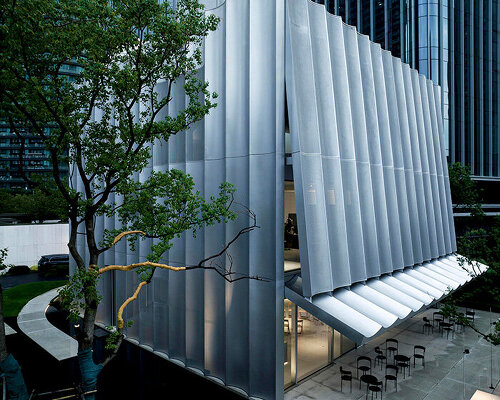
Facing a river on one side and a major road on the other, the envelope of TAOA’s Hangzhou Empathy Museum reads as a peeled shell. The city-facing elevation opens and curves away, creating a surface that stands slightly apart from the inner volume while allowing air and light to pass between. The building gains depth through this layered construction, with exterior skin and interior rooms held in measured tension.
The architects wrap the entire exterior in a facade of curved stainless steel panels. Their inherent stiffness allows wide spans without secondary purlins, giving the surface a continuous rhythm. Under changing daylight the metal carries a soft sheen. Reflections shift with passing clouds and traffic, lending the volume a sculptural tenderness that tempers its compact form.
TAOA transforms an unfinished parking structure into the Hangzhou Empathy Museum
the perforated skin blurs views and diffuses light
Along the Hangzhou Empathy Museum’s north facade, TAOA employs perforations to temper the brightness of the sky. From inside, the city appears as a blurred field of movement and color, similar to an abstract drawing. The effect supports the galleries, where artworks receive steady, diffuse illumination and outside distractions recede into a gentle background presence.
The second floor lifts at a calculated angle to brace the canopy below. This move introduces a profile that recalls the protective depth of traditional eaves. The overhang creates shade at the ground plane and establishes a sheltered zone where visitors gather before entering, a subtle gesture that strengthens the building’s relationship with the street.
a peeled facade forms a layered shell between the museum and the city
The entrance sits within a semi circular concavity that draws visitors inward. The geometry suggests a pull toward the doorway, easing the transition from sidewalk to interior. Above, a narrow crevice admits daylight, which falls through a three story void. This tall space, described by the architects as a spatial canyon, sets the scale for the visit and frames the first encounter with the museum.
At ground level, the plan opens toward the north and extends into a cantilevered platform. The edge between interior and exterior softens as paving and floor align. At one corner, a vertical void links all floors, transforming an awkward angle from the earlier structure into a luminous core. Light drops from above and washes the walls, giving the junction a quiet, contemplative character.
curved stainless steel panels create a continuous skin with subtle reflections
A staircase runs along the sidewall and becomes visible in fragments through the perforated metal. From the street, silhouettes of movement animate the facade, offering glimpses of activity within. The path upward feels direct and legible, and encourages visitors to easily move between levels.
Connections to the underground galleries are designed with the same level of care. Portions of the structural slabs were removed to draw daylight and planted views down into the basement. Exhibition rooms below ground gain a surprising sense of openness, and the sequence between above and below reads as one continuous environment.
perforated metal filters daylight and softens views toward the surrounding streets
a recessed entrance draws visitors into a three story canyon filled with light
vertical voids and a side stair reveal movement and connect all levels
exhibition spaces carved from the basement shape the building from the inside outward
project info:
name: Hangzhou Empathy Museum
architect: TAOA Studio | @taoarchitecture
location: Hangzhou, China
completion: 2025
photography: © TAOA Studio
design team: Tao Lei, Chen Zhen, Cui Xiang, Tao Ye, Meng Xiangrui, Wang Shuchen, He Xiaotian
lead architect: Tao Lei
construction: Hangzhou Jingyi Decoration Engineering Co., Ltd.
lighting consultant: TS Lighting
landscape design: Hangzhou Musan Landscape Design
structure design: Zhejiang Institute of Architectural Design and Research
The post a perforated, fluted facade peels away from TAOA-designed hangzhou empathy museum appeared first on designboom | architecture & design magazine.