
A Sensitive Renovation Of An Exemplary 1950s Melbourne Home
Architecture
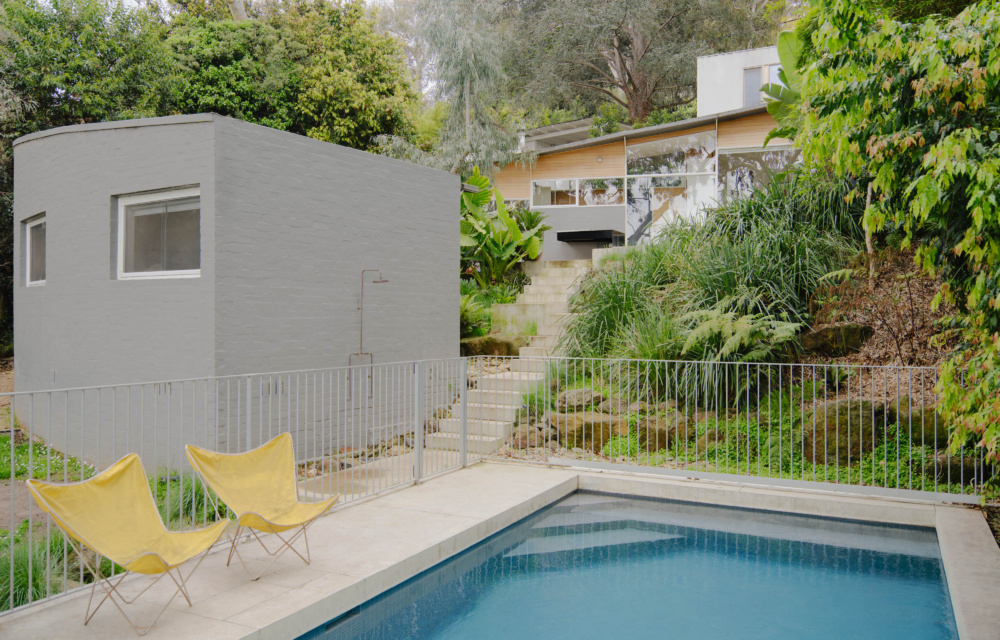
Coil House (also known as the Snelleman House) designed by Peter McIntyre in 1954 is one of the most celebrated modernist Melbourne houses of the early post-war period.
Heritage protected since 2011, the Ivanhoe East home was recently renovated by architect Karen Abernethy to reinstate lost character and extend the floor plan.
The house gets its name from its ‘coil’ floor plan, which curves down its sloping Ivanhoe East site, originally to suit two eucalyptus trees.
‘The [main] eucalyptus trees have long been removed, but the house still curves around a new landscaped native garden and looks onto the broader river landscape beyond,’ says Karen.
The new family room addition.
The house navigates multiple split levels.
Dining table by Thomas Lentini.
Where the meals area meets the new family room.
The kitchen and meals area was reconfigured and modernised — bringing all spaces onto the same level.
The original home’s thermal envelope was upgraded with new wall, floor, and ceiling insulation wherever possible.
The entry way sits at the middle of the lounge and kitchen.
The external view of the new family room addition, to the right.
Coil House now has the space and functionality required for a family of five, without compromising Peter’s original vision.
When architect Karen Abernethy first met the owners of Peter McIntyre’s Coil House (1954), it was around a cramped four-seater dining table, which somehow fit the family of five.
Improving the functionality of the house was clearly required, but renovations couldn’t compromise the legacy of the heritage-protected home.
The house gets its name from its ‘coil’ floor plan, which curves down its sloping Ivanhoe East site, originally to accomodate two eucalyptus trees. ‘The [main] eucalyptus trees have long been removed, but the house still curves around a new landscaped native garden and looks onto the broader river landscape beyond,’ says Karen.
Coil House was one of McIntyre’s first solo projects after starting his architectural practice in 1950. His most notable projects include the Melbourne Olympic Pool (1956), Parliament Station (1974), and Dinner Plain Alpine Village.
Some modifications were made to Coil House in the 1970s. In addition, McIntyre’s original external brick paint colour was changed to white, and the feature joinery colours altered. The kitchen joinery, however, was still in its original form from the 1950s.
Karen’s job was maintaining the remaining 1950s features while expanding the home to suit the family, who purchased the property from the original Snelleman owners. Her clients desired a slightly larger and more modern living area, kitchen, and bathroom, as well as a new study and main bedroom.
To avoid interrupting the existing form of the original reverse J-shaped house, Karen added two minimal pavilions to the rear of the existing coil.
These pavilions — one single-storey housing a new family room, and one double-storey containing the study and main bedroom above — are connected to the original home with glazed linking structures that provide a visual separation between old and new. ‘The glazed areas not only provide a visual break but also frame views of the existing house that previously were not possible,’ says Karen.
The external materials of the original coil have been reinstated, and the brickwork painted in a darker colour — similar to the tone of McIntyre’s original scheme. Internal elements such as the brick paving at the entry and the original fireplace were also restored.
Materials in the additions deliberately contrast with the original house. As Karen explains, ‘Where the original house was predominantly dark coloured masonry externally, we designed a custom light weight metal zig-zag cladding for the new additions.’ The original floors are timber and walls are plaster, while the additions feature travertine floors, and brick walls.
The kitchen and meals area was reconfigured and modernised — bringing both spaces onto the same level — and seamlessly meeting the family room addition. The bedrooms, entryway, and lounge room otherwise remain as is, except for new joinery, polished floors, and upgraded windows.
The original home’s thermal envelope was also upgraded with new wall, floor, and ceiling insulation.
Gone is that tiny dining table. Coil House now has the space and functionality required for a family of five, without compromising Peter’s original vision.
Karen consulted with Peter throughout the process, and he approved the design approach.