
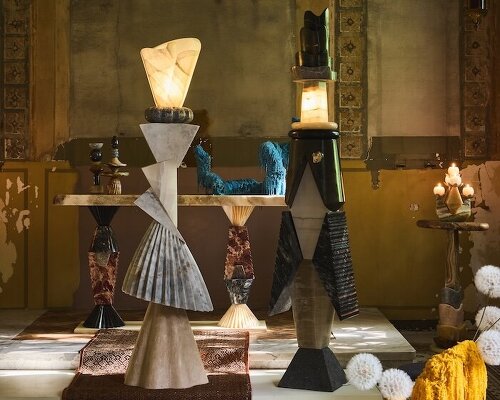
objects embody desire and agency amid historic alcova context
One part of Milan Design Week 2026‘s edition of Alcova returns to the former Baggio Military Hospital on the western edge of Milan. The largely defunct complex is overtaken by the alternative forms and experimental gestures that define the event, yet its previous life remains legible. Visitors move through the ‘lavanderia’ (laundry), the ‘cucina’ (kitchen), or the ‘chiesa’ (church), navigating spaces that still bear the marks of their original use. Cracking frescoes and dust-coated tiles point back to earlier intentions, suggesting how each room once operated as part of a larger system of daily life. The site’s overlap between past and present frames the way objects are encountered. At their most functional, they respond to immediate needs. At their most aspirational, they propose a different way – even fantasy – of living.
The exhibition program works within this tension, presenting projects that treat objects as carriers of both utility and imagination. Across the site, installations draw out these layered meanings. Some approach the object as something almost spiritual, others as something instinctive or domestic, but all engage with the idea that design is not only about form, but about the desires it embodies. In this context, the ‘dream’ is not abstract. It is embedded in material, shaped by use, and continuously redefined by the environments it inhabits. We speak to the minds behind installations that merge past lives and future visions.
Baggio Military Hospital sets the scene | image courtesy of Alcova
Leo Lague & VERSA host a spiritual environment at the Chiesa
Within the complex’s former church, a cloud of smoke fills the hall as if a mass had just occurred and the incense had not yet been snuffed out. Raphael Miranda, creative director for VERSA, the scenography studio behind the installation, says the environment is crafted as ‘an extension of consciousness and spirituality.’ The layers of fog, sound, and scent that linger through the space create a profound feeling for the visitor: ‘They feel like they are in heaven,’ remarks Miranda, ‘like they are meditating.’ Among the smoke, pieces from the Brazilian architecture firm Leo Lague populate the space, hiding in the foggy corners of this former place of worship.
Leo Lague furniture and VERSA scenography | image by Hugo Takemoto courtesy of VERSA and Leo Lague
Xaver Kuster & Paul Canfora restore lackluster fountains
‘Looking to old water fountains in cities like Paris or London, and how the culture of the fountain used to be there,’ inspired Xaver Kuster and Paul Canfora to return to the design potential of this mundane public object. They lament how the fountains now found in cities are blank, functional objects, often described in a lackluster tone. In this current landscape of boredom-inducing drinking receptacles, the duo experiment with form and material to revive the forgotten art of beautiful public fountains.
rethinking a water fountain | image by Xaver Kuster, courtesy of Xaver Kuster and Paul Canfora
Slalom, V.A.I. and Studiolatte merge revive retro acoustics
Passing through a bright yellow geometric facade, visitors find a collaboration between Slalom Acoustic Systems, V.A.I. (Vintage Audio Institute Italia), and Studiolatte. The room is textured by an acoustic buffer made of recycled materials. In its citrusy tones and groovy tunes, the space creates a connection between the smooth-running sounds of synthesizers past and the eye-popping contemporary aesthetic envisioned by the Italian design studio. During Milan Design Week, the instruments will be played by Pontus Berghe, who runs V.A.I., alongside a different musician each day of the event. Created on these preserved machines, the sound is irreplicable by AI or any digital tools. In the harmonies and melodies that emerge, there is a certain preciousness—this music can only exist when made with these original instruments.
Studiolatte featuring Slalom Acoustics x V.A.I. | image by Piercarlo Quecchia, DSL Studio
The Wedding by Sten Studio: romance amid inanimate things
When looking for ‘The Wedding’, the installation by Mexico City–based Sten Studio, it’s easy to find by following the sound of a harp playing. ‘When we saw the room at first—the abandoned chapel—I said, ‘Let’s create a wedding. Let’s create emotions,’’ recounts creative director Jose Miguel Schnaider. Schnaider points to the beautiful bride, Aurella, and the groom, Vireon (both lamps). Stools stand in for bridesmaids and groomsmen. The two-person benches create a space for intimacy and union. The console acts as an altar, and a series of dripping candelabras provides ambiance for the matrimony on display. ‘We are literally witnessing a wedding ceremony,’ he concludes, as the harpist plays a rendition of Enya’s ‘Only Time.’
the wedding by Jose Miguel Schnaider of Sten Studio | image by Ramona Balaban, courtesy of Sten Studio
Caveat builds a micro-factory in the garden of Tempio
In the garden of Baggio’s Tempio space, the design studio Caveat is making spoons. Starting with a small piece of metal—’this is the same quality of steel that’s used in kitchen cutlery,’ explains designer Macarius Eng—they demonstrate the process. As he feeds the piece between two different bending mechanisms, he notes, ‘Once we press it, we can use it straight away.’ In this micro-factory, the small self-actuated press helps demystify large-scale production, answering the question: what makes a spoon… a spoon?
image by Caveat
Studio Do resurrect discarded marble Within tempio Ruins
The works of Studio Do carry the memories of tables and domestic structures as they are assemblages of discarded marble structures. On sourcing these remnants, cofounder Dana Seachuga points to a number of sources: ‘Some pieces we got secondhand from people renovating their homes. They dismantle, say, a fireplace and want to get rid of the marble. We assist with the dismantling and give it a new home.’ Despite the ornate carvings that signal their past function, the pieces ‘are all made from this very basic, simple principle: we extract an element from one stone, then we disassemble and reassemble,’ creating works that straddle time.
Studio Do’s project ‘Within The Ruins’ | image by studio DO.
Pani Jurek Studio cast rainbow tiles over Casa delle Suore
Michał Borecki, one of the designers behind Pani Jurek, describes the making of this rainbow of tiles that covers the floor: ‘The first thing is color, and then ceramic,’ he says, pointing to his colleague Magda Jurek’s background in painting as the impetus for the colorful compositions. Based in Poland, he brings up the historical precedent that brought these works to life. ‘The concept of the ceramics themselves is based on ceramics from the 50s and 60s in Eastern European countries. Ceramics in public spaces were very popular: they were used in libraries, restaurants, train stations, and so on. But in the 90s, they disappeared and were mostly destroyed because people didn’t like them. They were seen as connected to the communist era.’ Now, decades later, these concentric circles and neon waves both echo to the past while re-writing what ceramic decoration can be.
the colorful ceramics of Pani Jurek | image by Tomo Yarmush, courtesy of Pani Jurek Studio
HEAD – Geneva in Tempio designs an anthropocentric rodent feast
‘We work on the relationship between animals, spaces, and humans,’ says Youri Kravtchenko, instructor at HEAD – Geneva, as he explains the collection of projects his students have created that challenge the notion of the Anthropocene, creating design spaces for non-human actors to inhabit.. There’s a vertical pond for frogs, a series of instruments for doves, and, most notably, A Feast for Rats, ‘that are actually good and digestible for rats specifically, but also for birds and squirrels.’ He adds that they captured footage of squirrels munching on a corner of the table the night before the opening. A testament to their success in the animal kingdom.
‘A Feast for Rats’ and other typologies that challenge the anthropocene | image by Annalise Kamegawa, courtesy of the writer
Natalia Triantafylli & Andrew Pierce Scott: potpourri furniture
At first, the works of Natalia Triantafylli & Andrew Pierce Scott feel like stepping into the memory of a grandparent’s home—the floral décor, the padded seating. But look again: the proportions are slightly too large, the plush cushions are actually ceramic, and the welded seams are prominently visible at each corner. The duo, in a project sponsored by the British Council, were inspired by ‘going to these old houses in London or seeing antique furniture and observing the making and the craft in it—but not trying to keep it in that vacuum,’ says Pierce Scott. ‘It’s contemporary—we’re making it now.’ Triantafylli notes that returning to handcraft is essential to their work. In the past, people often made things by hand, and by leveraging ceramics that still bear thumbprints and irregular edges, the duo faithfully bring the memory of those storied objects into the contemporary moment.
furniture that’s a memory of furniture | image by Tim Salisbury, c of Natalia Triantafylli & Andrew Pierce Scott
project info:
name:
brand:
name:
brand:
name:
brand:
name:
brand:
name:
brand:
name:
brand:
name:
brand:
name:
brand:
name:
brand:
location: Alcova at Baggio Military Hospital, Milan, Italy
The post a stone wedding, meditating chairs and dinner for rodents: objects try on new lives at baggio military hospital appeared first on designboom | architecture & design magazine.