
A Striking Pre-Fab Home In The World’s Widest Canyon
Architecture
The pre-fabricated home takes a backseat to the majestic sights of Capertee Valley beyond.
The two-bedroom floor plan covers an efficient 98 square metres.
Each CLT panel is assembled in FABPREFAB’s factory to be shipped to site and craned into place. The offsite building process minimises damage to the landscape.
The house is constructed using cross-laminated timber (CLT) — made from several layers of solid wood panels bonded with a structural adhesive.
Designed for a busy couple, the house is a calming base to enhance their precious quality time together.
The colour palette reflects the home’s setting.
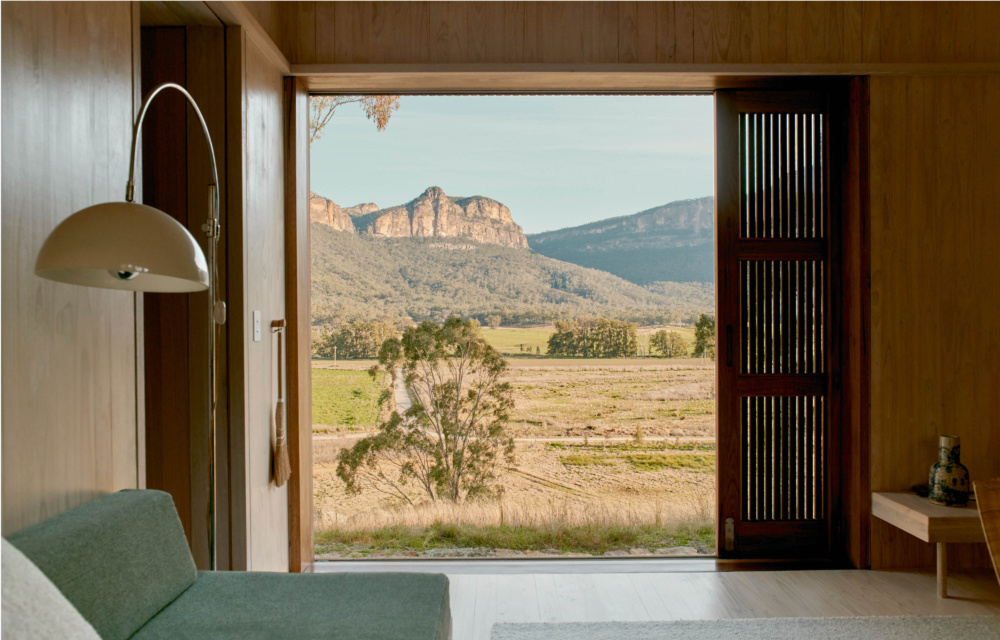
Large windows ensure the views remain centre stage.
The uniform look of CLT takes a backseat to its environment.
The home is set in NSW’s breathtaking Capertee Valley.
The prefabricated dwelling is an extension of an original tiny house designed by TRIAS architecture and design studio.
The home is designed to be relocated, if and when it’s needed, leaving the site in its original condition.
Practice ground doubles as short-term accommodation when the owners are overseas.
Creating a home in the widest canyon in the world (yes, even wider than the Grand Canyon) is an exercise in perspective.
The canyon in question, Capertee Valley, is a surprisingly under-the-radar landscape of sandstone cliffs and limestone formations situated north of the Blue Mountains in New South Wales.
This is a special part of the world, where the owners of this new home have been camping for many years. Now a busy couple who travel frequently for work and spend extended periods apart, they desired a calming base to enhance their precious quality time together.
Seeking the least disruptive build possible, the couple discovered Minima: a prefabricated series of small dwellings designed by architecture studio TRIAS for FABPREFAB.
‘This collaboration is an important part of our studio where we are exploring unique building types and working on homes that have much lower impacts in terms of carbon, waste, and site damage,’ says Casey Bryant, director of TRIAS.
‘The repetition in these projects allows us to test and evolve the design thinking, integrate learnings and use the new technologies and systems that become available, ultimately making the standard Minima better.’
The resulting home, known as Practice Ground, is a two-bedroom, two-bathroom custom extension of TRIAS’ original Minima design. The home starts as a standard 24.5-square-metre pod, expanded in modules to accommodate specific client and site needs.
FABPREFAB’s offsite building process minimises damage to the landscape and, in this case, navigates issues accessing the relatively remote site in Glen Davis, as well as the high cost of local construction.
All Minimas are constructed using cross-laminated timber (CLT) — made from several layers of sustainable wood panels mounted on steel screw piles — negating the need for concrete footings. Each panel is completely assembled in FABPREFAB’s factory.
‘It’s a very sustainable material, made from rapidly growing pine and manufactured locally. The trees sequester biogenic carbon, so the embodied carbon of these projects is reduced,’ says Casey.
In the case of Practice Ground, the CLT panels were delivered to site on four separate trucks, then craned into place over two days.
‘The one slightly comical challenge came when the local council decided to remove an old bridge on the way to site,’ says Casey. ‘This delayed delivery, as we had to wait until a new bridge with capacity to bear the trucks and crane was available.
‘Positively though, our clients were able to engage with council in the process, and they have salvaged the original timbers from the removed bridge for a future project.’
This home features blackbutt exterior timber cladding as a custom addition, providing increased bushfire protection and a canvas that will age beautifully.
‘It has been left to grey naturally and has harmonised with the eucalypts that surround the home,’ says Casey.
Internally, the uniform look of CLT takes a backseat to its environment. There’s almost no decoration, with nearly every room benefiting from large openings that frame uninterrupted views of huge rock formations beyond.
Butterflies come and go through the windows and kangaroos pass by under the ever-changing light of the canyon cliffs.
If the owners one day decide to relocate, they can take the home with them, leaving little evidence it ever existed.
Casey explains, ‘The lifting infrastructure is all in place and it can be moved to a different site if desired. The screw pile foundations and rock walls can also be removed and reused, so the site can be returned to its original state.’
The 98-square-metre home doubles as short-term accommodation when the owners travel, allowing others the chance to experience the beauty of the remarkable Capertee Valley.
An edited version of this story originally appeared in The Design Files Magazine Issue 03. Subscribe to the biannual print magazine here.