How Sleep state nurtures human design and creativity
While most technology is built for waking life – meaning the hours we are alert and awake – a third of our lives happens in darkness, in a sleep state we are barely conscious of. Adam Haar Horowitz, a cognitive scientist and CEO of DUST, treats those hours not as downtime, but as a space to design and influence thought, as his work focuses on the hypnagogic state – or the threshold between wakefulness and sleep – where the brain produces ideas that are associative, fluid, and untethered from logic. He and his team at MIT’s Fluid Interfaces Lab have developed tools to detect that state and guide it, transforming sleep into a medium for creativity, research, and artistic exploration. The starting point is Dormio, the device Adam Haar Horowitz led the creation of at MIT’s Fluid Interfaces Lab with a team of neuroscientists, engineers, and designers.
It’s basically a glove fitted with biosensors – a flex sensor in the fingers and a pulse oximeter for a full description – that monitors the body’s transition from waking into sleep. It targets hypnagogia, the state between waking and sleep, sometimes called sleep onset, where the brain produces a quality of thought that is associative and loosely connected, and ‘not constrained by the logic structures of full wakefulness.’ In the past, Salvador Dalí used to hold a key over a metal plate as he dozed, so that when he fell asleep and his hand relaxed, the key would drop and the sound would wake him, while Thomas Edison did something similar with steel balls. They were both trying to catch the hypnagogic state, but Dormio reaches for it with biosensors instead of keys and metal objects.
Boreal Dreams, made in collaboration with Jakob Kudsk Steensen and sound by Matt McCorkle | Tribeca Immersive Installation Images 2025, photo by Mikhail Mishin
adam haar horowitz’s devices can steer our ‘dreams’
When Dormio detects that the person wearing it is entering sleep onset, a connected app plays a pre-recorded audio cue, a word or phrase related to a chosen subject, delivered into the room through a speaker. The person, still in hypnagogia, incorporates the cue into their thoughts and reports their experience aloud when the app prompts them to wake. This process, which the scientist and his collaborators call Targeted Dream Incubation, found that post-sleep creative performance increases after targeted dream incubation, meaning users became more ‘creative’ in their thinking. Through the glove, they were able to steer the content of what their sleeping brain generates.
Another project where Adam Haar Horowitz tests dreams is The Dream Hotel. Working with artist Carsten Höller, he designed a series of museum installations, each one a room in which a person goes to sleep under conditions engineered to produce a specific kind of dream. Dream Hotel Room #1, shown at Fondation Beyeler, Art Basel, and LUMA Arles in 2024, uses a bed that rocks participants to sleep on a motorized platform, a rotating replica of the Amanita muscaria mushroom spinning overhead, and audio stimuli chosen for their association with flight. In the study and data collected after, the report says that 67 percent of participants reported dreams involving flying.
the piece explores how climate change impacts our sleep and dreams | photo by Mikhail Mishin
Ways that brain can communicate other than ‘thinking’
Hotel Room #2, titled Communal Dreams, moved the project to the MIT Museum, where three participants at a time enter a sculptural environment filled with pulses of light, sound, and motion and fall asleep together. The piece turns shared sleep into a form of theater, where the audience becomes the installation and not just participants. The same logic runs through Boreal Dreams, a collaboration with artist Jakob Kudsk Steensen that premiered at Tribeca Film Festival in 2025, and here, the film brings participants into an immersive environment built from footage and sounds of the boreal forest, a biome under pressure from climate change. Then, after the film ends, participants take an overnight audio soundtrack home designed to continue the forest imagery into sleep.
This approach allows Adam Haar Horowitz to turn the film’s second half into a moving picture and conclude it in the viewer’s bedroom, in their dreams and without a screen. There’s also Cyber Key to Dreams, which collects dreams from groups of people and feeds them into a system that reflects them back, connecting a person’s past dreams to dreams from other minds, building a kind of distributed dream record. The project, created with artist Agnieszka Kurant and a team from MIT, was shown at the V&A Museum in London. Wordoid, also made with the artist, goes one step further with a hyperscanner to record brain activity from several people at once and renders those recordings as a holographic film, where brains communicate without language but through moving lights.
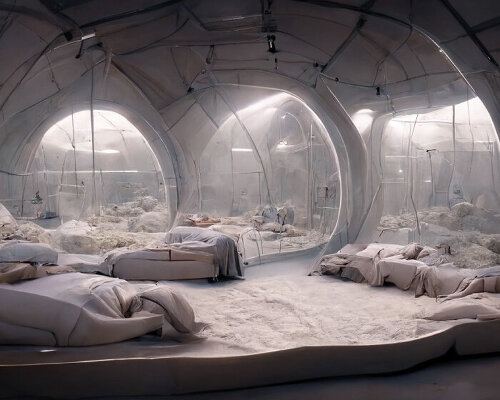
Dream Hotel (2023), made in collaboration with Pattie Maes and Carsten Höller | AI sketch and image by Alejandro Medina
And then there is DUST, the app that Adam Haar Horowitz is building now. He’s designing it for everyone, and it teaches people to remember more of their dreams, to reduce nightmares, to have lucid dreams, and to address insomnia. The tools underlying it – targeted audio cues, sleep onset detection, dream journaling with guided prompts – are the same tools that produced research papers and museum installations. The app is the part where the technology leaves the lab and enters the morning routine.
What connects all of these projects is a position that Adam Haar Horowitz holds across his research, his art collaborations, his legal briefs, and his teaching at MIT: that dreams are not noise. They’re not random byproducts of the brain cleaning itself up at night. He imagines them as a system that generates thought, processes experience, and produces material that the waking mind can use. His works are an argument, made in piezoresistive fabric and motorized beds and overnight soundscapes and an app, that we have left a space of our lives unexamined. The devices and means he builds is a set of tools for uncovering it and for finding out what happens there when we do.
Dream Hotel is a series of museum installations | AI sketch and image by Alejandro Medina
still from Adam Is Dreaming, a film by Wendi Yan | still by Wendi Yan
view of Cocoon, in collaboration with Judith Amores and Oscar Rosello
Masca is a flexible sleep mask for REM sleep detection, made in collaboration with Oscar, Tomás, Ethan and Irmandy from MIT | image courtesy of Adam Haar Horowitz
view of Hotel Room #2: Communal Dreams
Hotel Room #2: Communal Dreams transforms the MIT Museum into a living dream laboratory
Dream Hotel Room #1: Dreaming of Flying with Flying Fly Agarics (2024) in collaboration with artist Carsten Höller
Dormio | image by Oscar Rosello
Cocoon is a vision of a sci-fi future where dreams are controllable via human machine symbiosis
Agnieszka Kurant, Wordoid, 2026
project info:
scientist: Adam Haar Horowitz
This article is part of designboom’s Dreams in Motion chapter, exploring what happens when we treat our dreams and reveries as an active, radical rehearsal for impending material realities. Explore more related stories here.
The post adam haar horowitz crafts devices that turn sleep state into space for design and creativity appeared first on designboom | architecture & design magazine.