
factory 5.0: a pavilion shaped by biological intelligence
Studio Aditya Mandlik (SAM)’s Factory 5.0 is a timber structure that positions biological intelligence as a genuine collaborator, co-authored by 10,000 king worms metabolizing Styrofoam in real time. ‘When we design built environments, we’re reshaping the planet’s outermost skin, one that has always supported complex, multi-species life,’ the architect tells designboom. ‘My instinct is to design in dialogue with that broader ecological knowledge system.’
Founder of the studio, Aditya Mandlik, frames the work as a call to rethink architectural authorship in the context of the Fifth Industrial Revolution, a moment defined by the convergence of human and non-human intelligence. ‘Making is no longer a linear, directive process; it becomes a co-evolution shaped by multiple intelligences operating simultaneously across material, biological, and spatial scales,’ the architect notes.
At the core of the project is plastic, the defining material of the First Industrial Era, reframed through decomposition ‘Plastic became a lens to understand how drastically our intentions and consequences can diverge,’ Mandlik tells us. ‘Working with worms revealed that nature already holds pathways for metabolising what we consider irreversible problems.’ Speaking to designboom, Mandlik positions Factory 5.0 as a framework for rethinking material futures, using decomposition to expand architectural imagination.
all images courtesy of Studio Aditya Mandlik
how worms reshape the geometry of the structure in real time
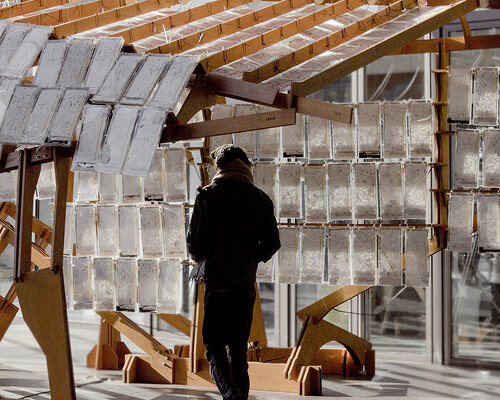
Factory 5.0 is a composite system of 546 digitally fabricated timber components interlaced with 200 Styrofoam plates housed in transparent acrylic chambers. These interiors become operational terrains where worms, approached as collaborators of the project, actively reshape the geometry of the pavilion. ‘Their behavior resembled that of micro-sensors, always recalibrating in response to temperature, light, and moisture,’ Mandlik explains. ‘These feedback loops began to dictate the pavilion’s evolving porosity.’ This procedure results in a continually transforming architectural section, revealed in various ways as visitors move around and through it.
Unexpected behavioral patterns soon become part of the design language. Worms clustered for warmth below 20°C, migrate toward darkness, and even metamorphose when isolated, behaviors that influence spatial rhythm and material decay rates. ‘Designing with decomposition demanded accepting that anything we create should ultimately be able to return to natural systems,’ the Mumbai-based architect tells designboom. This approach shapes decisions from assembly logic to the portability of the pavilion. Factory 5.0 was already in its second life at DDW, having been flat-packed, transported, and reconfigured from its Mumbai debut.
This adaptability extends into its afterlife. ‘Disassembly is not the end of a project, but the beginning of its next metabolic phase,’ Mandlik notes. After the exhibition, timber components are repurposed, while worm-transformed Styrofoam plates, sensitive to light, sound, and human presence, are preserved as memory objects and later used as molds for casting metal lights. The project becomes a living model for regenerative architecture in a world where biological and technological intelligence co-author space. Dive into the full Q&A below.
a timber structure that positions biological intelligence as a genuine collaborator
Interview with Aditya Mandlik
designboom (DB): Factory 5.0 introduces worms as active co-creators. What first prompted you to explore biological intelligence as a design partner?
Aditya Mandlik (AM): For me, collaborating with non-human intelligence has always felt like a natural extension of architectural thinking. When we design built environments, we’re effectively reshaping the planet’s outermost skin, a layer that has long supported complex, multi-species life. So my instinct is to design in dialogue with that broader ecological knowledge system. With Factory 5.0, this became particularly critical. Since the installation was conceived as a prototype for architecture in the Fifth Industrial Revolution, we chose to work with natural decomposers to break down single-use plastic, the defining material of the First Industrial Era. That act of decomposition became both method and message, positioning architecture as a metabolic, co-authored process rather than a purely human-driven one.
co-authored by 10,000 king worms
DB: As you mentioned, the project sits within the theme of the Fifth Industrial Revolution. How do you define ‘non-human intelligence’ in an architectural workflow, and what does it contribute to the act of making?
AM: Architecture becomes truly contextual, geographically, socially, culturally, and ecologically, only when every actor present on a site is allowed to perform. I’ve always believed that the planet operates through a dense web of behaviors, where each entity, human or non-human, contributes its own role to a constantly unfolding system. These behaviors are not passive; they are forms of intelligence that shape, negotiate, and adapt the environments we share. So when I speak of ‘non-human intelligence’ in architecture, I’m not thinking of it as an add-on to the design workflow. Instead, I see it as an existing field of entangled, cooperative interactions that we must learn to work with rather than override. In that sense, making is no longer a linear, directive process; it becomes a coevolutionary act, shaped by multiple intelligences operating simultaneously across material, biological, and spatial scales.
the worms metabolize Styrofoam in real time
DB: Why did you choose plastic as the primary site of decomposition, and what did the worms reveal to you about its future?
AM: Plastic is, in many ways, the great material triumph of the First Industrial Revolution. It reshaped human behaviour, accelerated production, and became inseparable from modern life. What interested me was this contradiction: a material originally engineered with ecological intent has, within a single generation, shifted into the category of ‘waste.’ Plastic became a lens through which to examine how drastically our intentions and their consequences can diverge over time. Working with worms made this contradiction even more compelling. Their ability, together with the bacteria in their microbiome, allows to break down complex molecular structures like single-use plastics, revealed something deeply optimistic. It suggested that nature already holds pathways for metabolising what we perceive as irreversible problems. This collaboration points toward a future where small-scale worm farms could become decentralized systems for decomposing not only single-use plastic but other organic waste as well. It reframes the issue from one of disposal to one of co-evolution, where natural intelligence and human design actively negotiate the lifecycle of materials.
rethinking architectural authorship in the context of the Fifth Industrial Revolution
DB: How did you approach designing a structure whose form and meaning emerge through processes of decomposition?
AM: The pavilion was conceived as an active dialogue between space and matter, its form articulated as a vector, a directional force urging us to rethink the foundations of how we build. If we are to imagine alternative futures, we must first intervene in the material realities we currently inhabit. In this sense, the afterlife of single-use plastic became a crucial point of departure, not merely as a problem to be managed, but as an ecological agent capable of reframing architectural imagination. Designing with decomposition demanded an acceptance that anything we create should ultimately be capable of returning to natural systems. This principle shaped every aspect of the project—from embracing material deterioration to defining the pavilion’s assembly logic. Factory 5.0 was therefore conceived as a fully disassemblable structure, enabling its components to be repurposed or reintegrated long after it’s exhibition in Mumbai. The pavilion itself was already in its second life at Dutch Design Week 2025, having been transported, reconfigured, and re-adapted specifically for the climate and conditions of Eindhoven. In this way, the pavilion’s form, meaning, and visitor experience were never intended to be fixed. Instead, they were designed to evolve through cycles of breakdown, transformation, and return, mirroring the metabolic processes that animated the project from within. Factory 5.0 ultimately positions decomposition not as an endpoint, but as a generative force shaping both architectural expression and ecological imagination.
at the core of the project is plastic
DB: What were some of the most unexpected behaviors or feedback loops you observed during the worms’ metabolic process?
AM: One of the most unexpected insights came from observing how socially and environmentally responsive the worms were. Across experiments with multiple species, we studied how they reacted to variations in temperature, light, moisture, and even sound. Their behavior resembled that of micro-sensors, constantly adjusting and recalibrating in response to subtle environmental shifts. When temperatures dropped below 20°C, the worms instinctively clustered together to exchange body heat. In contrast, a worm left alone for two to three days often initiated metamorphosis, cocooning and transforming into a darkling beetle within a week. Their strong preference for darkness was equally revealing; exposure to light compelled them to migrate toward shaded areas, often resulting in higher aperture densities in those regions of the styrofoam panels. These feedback loops became foundational to understanding how the pavilion would behave, transform, and ultimately decompose over time. They also directly informed our preparations for installing the pavilion in the city centre. To help the worms acclimate to the Eindhoven’s weather, each acrylic container was equipped with insulation film, containers holding moisture-absorbing gels, and external UV-A/UV-B thermal lamps. Adjusting these parameters allowed us not only to support their metabolic processes but also to intentionally mediate aperture densities in specific zones of the panels, shaping the pavilion’s evolving porosity as an active design tool.
plastic is reframed through decomposition
DB: Factory 5.0 can be flat-packed, reconfigured, and repurposed, extending its material life after exhibitions. How does this design-for-disassembly strategy align with your vision of metabolic architecture?
AM: Design for Disassembly, for me, emerges directly from the intelligence embedded within the informal urban fabric of Mumbai, a landscape that is continually dismantled, reconfigured, and reinhabited across generations. It is not only an ecologically sensitive strategy but also a culturally attuned one, acknowledging the fluid, intergenerational patterns of occupation shared by both human and non-human actors. Within the broader framework of metabolic architecture, Design for Disassembly becomes a means of embracing uncertainty. It enables structures to adapt, mutate, and respond to conditions that neither designers nor other participants can fully anticipate. In this sense, Factory 5.0’s ability to be flat-packed, reassembled, or repurposed is therefore not just a logistical choice. It extends the material life of the pavilion while situating it within a continuous cycle of transformation, reuse, and reintegration. In that sense, disassembly is not the end of a project, but the beginning of its next metabolic phase.
Factory 5.0 is a composite system of 546 digitally fabricated timber components
DB: Looking ahead, what potential do you see for architects to collaborate with other biological systems, and how might this shift the profession toward a truly post-anthropocentric future?
AM: I believe architecture has remained deeply human-centric for most of its history, shaped first by our evolutionary instincts and later by the pressures of rapid urbanization. In constructing the modern city, we have often produced hyper-sanitized environments that separate us from the ecological systems we are inherently part of. What we tend to overlook is that humans themselves are complex biological beings; recognizing ourselves as nature is the first step toward reframing how we design. Looking ahead, I see enormous potential for architecture to collaborate not only with biological systems but with the dense fabric of behaviors, patterns, and intelligence already present on every site. These living interfaces, microbial, botanical, geological, atmospheric etc., continuously negotiate and transform the environments we inhabit. Engaging with them allows architecture to shift from being an imposed, static form to becoming an entangled and co-evolving process. Also, for this shift to meaningfully unfold, architects cannot operate in isolation. Policymakers, engineers, industries, and communities must also acknowledge these biological systems as co-residents and co-authors of the built environment. Only then can we move toward a truly post-anthropocentric future, one in which architecture is created not just for humans, but with and alongside the intelligence of the broader living world.
the structure incorporates 200 Styrofoam plates housed in transparent acrylic chambers
worms actively reshape the geometry of the pavilion
a continually transforming architectural section
unexpected behavioral patterns soon become part of the design language
worms clustered for warmth below 20°C migrate toward darkness
Aditya Mandlik observing the worm behavior
project info:
name: Factory 5.0
architect: Studio Aditya Mandlik (SAM) | @studioadityamandlik
biological agents: 10,000 king worms
The post aditya mandlik on how decomposition becomes design method in worm-driven architecture appeared first on designboom | architecture & design magazine.