
Mini PCs used to be defined by how invisible they could be, small black rectangles tucked behind monitors or under shelves. That made sense when they were just low-power desktops, but feels out of step now that these machines are running models, listening, watching, and routing data. If AI is going to sit on your desk, it might as well look like it belongs there instead of hiding like a piece of infrastructure.
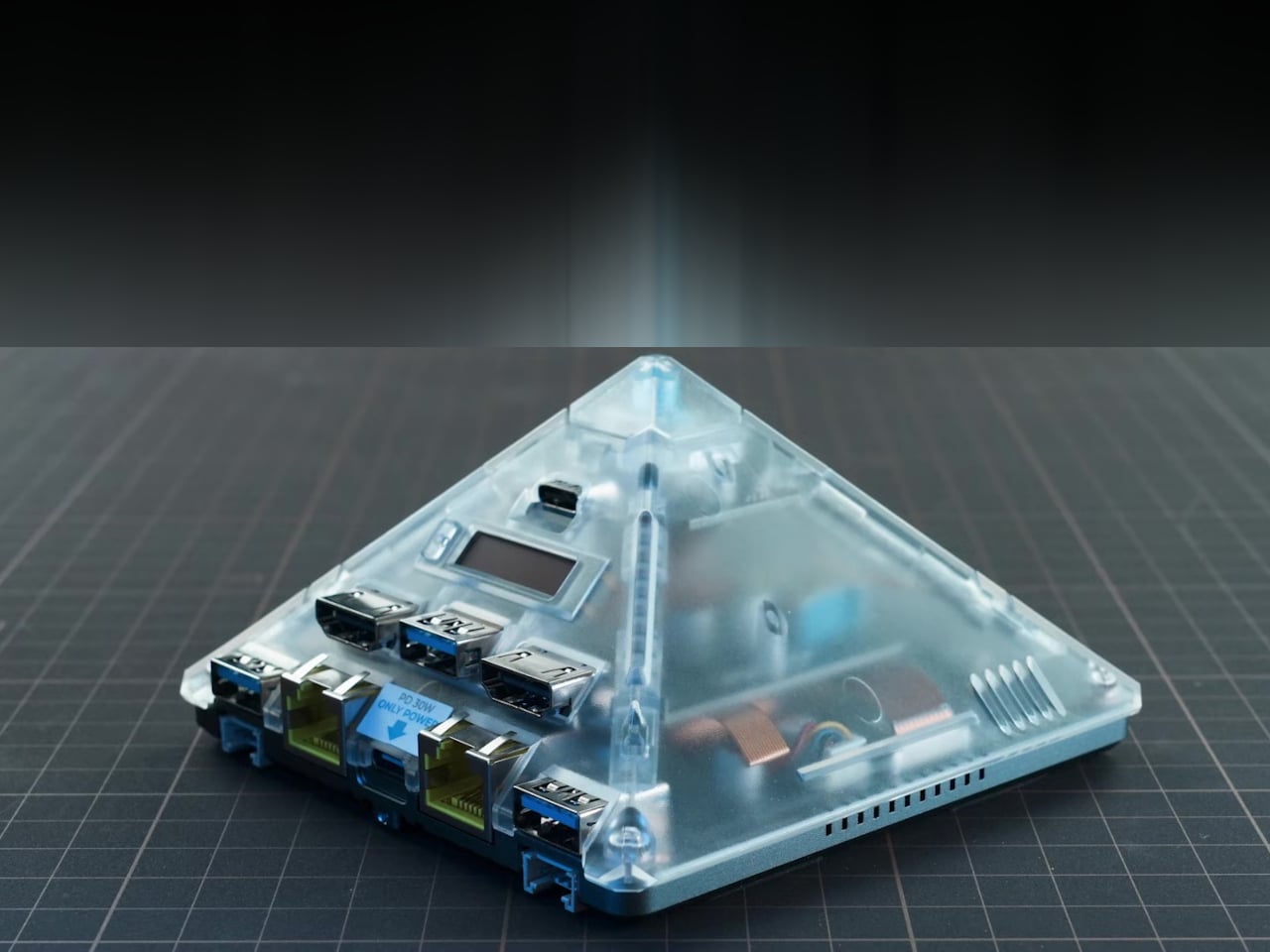
M5Stack’s AI Pyramid Computing Box leans into that idea, turning an edge-AI platform into a small pyramid that looks more like a sci-fi artifact than a router. There are two versions, a transparent 4 GB model that shows off its internals and RGB light bars, and a Pro 8 GB version in a solid gray shell that keeps the same silhouette but reads more like a piece of industrial hardware. Both share the pyramid form and the underlying platform.
Designer: M5Stack
The pyramid shape goes beyond visual gimmick and gives the device a clear front edge where all the serious ports live, dual HDMI, dual Gigabit Ethernet, four USB-A, and USB-C power, while the sloping faces leave room for vertical RGB strips and a small OLED status window. The top becomes a natural exhaust point for the turbo fan, turning the whole volume into a kind of thermal chimney that glows when the system is alive.
Inside the pyramid is Axera’s AX8850 SoC, an octa-core Cortex-A55 at 1.7 GHz paired with a 24 TOPS NPU and hardware 8K H.264/H.265 encode and decode. The 4 GB model splits its LPDDR4x as 2 GB for the system and 2 GB for accelerators, while the Pro doubles that to 4 GB plus 4 GB, giving more headroom for local vision pipelines, speech models, or compact language models running under Linux.
On a desk, the AI Pyramid sits between a monitor and a small camera array, its dual HDMI outputs or input-plus-output feeding displays while the dual Ethernet ports bridge a home network and an isolated camera VLAN. The four-mic array and built-in speaker let it act as a local assistant or meeting transcriber, while the OLED strip quietly shows IP addresses or system load, and the RGB bars pulse to indicate activity.
Giving an AI mini PC a recognizable silhouette changes how you relate to it. A flat box disappears, which is fine for a dumb hub, but a device that is running models, listening, and orchestrating other hardware benefits from a form you can read at a glance. The AI Pyramid leans into that, making the thermal core, the ports, and even the status lights part of a small, legible object that feels like it was designed to share your desk rather than hide behind it.
The post AI Mini PCs Don’t Need to Hide: This One’s a Sci-Fi Pyramid first appeared on Yanko Design.