
alsar-atelier forms temporary installation from plastic pallets
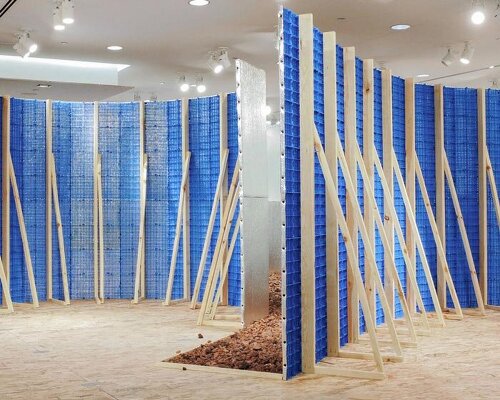
‘The Embellished, the Transient, and the Ordinary’ is a full-scale architectural installation by Alsar-Atelier that transforms ordinary plastic pallets into an ornamental vertical wall. Presented at the Chicago Architecture Biennale, it investigates post-pandemic design through the lens of temporary exhibition architecture. The project transforms standard construction materials into a reversible enclosed space, addressing the environmental and economic impact of short-lived installations. Built from off-the-shelf components and dry joints, the structure can be fully disassembled and reused, demonstrating how exhibition design can reduce waste while maintaining spatial and atmospheric quality.
The installation emerges from the broader context of the coronavirus pandemic, when cities rapidly adapted to new social and environmental conditions. Designers responded by activating vacant spaces with temporary, flexible interventions that relied on readily available materials and fast assembly methods. This shift raised questions about permanence, reuse, and responsibility in architecture. The project positions itself within that discussion, asking whether the methodologies developed during the pandemic can inform more sustainable approaches to temporary design.
all images courtesy of Alsar-Atelier
chicago exhibition booth comments on post-covid design
Instead of relying on custom fabrication, the installation by architecture and design research studio Alsar-Atelier constructs a single enclosed environment using plastic pallets, dimensional lumber, insulation, and gravel. After disassembly, each element can return to its original purpose. The design avoids permanent alteration of materials, framing reuse as a central architectural principle rather than an afterthought. A single vertical partition organizes the interior. Through a deliberate composition of solid and void, and through the contrast between organic curves and orthogonal geometries, the partition creates an intimate interior atmosphere that appears monolithic from within. At the same time, the outer enclosure clearly expresses its tectonic logic, revealing how each component connects and supports the structure.
the project transforms standard construction materials into a reversible enclosed space
fully reversible install criticizes exhibition architecture
The project relies entirely on dry assembly methods, eliminating adhesives and irreversible fixings. This strategy ensures efficient construction and complete disassembly while preserving the integrity of every part. By locating permanence in the lifecycle of materials rather than in the object itself, the installation proposes an alternative model for exhibition architecture.
Ultimately, the work operates as a critical spatial experiment. It demonstrates how ordinary materials, assembled without waste and without permanence, can generate a controlled and immersive environment. In doing so, it reframes temporary architecture as a site for environmental accountability and material precision rather than disposable spectacle.
a single vertical partition organizes the interior
built from off-the-shelf components and dry joints, the structure can be fully disassembled and reused
the partition creates an intimate interior atmosphere that appears monolithic from within
after disassembly, each element can return to its original purpose
exhibition architecture conceived for reuse rather than disposal
project info:
name: The Embellished, The Transient, and The Ordinary
architect: Alsar-Atelier | @alsar_atelier
location: Chicago, USA
designboom has received this project from our DIY submissions feature, where we welcome our readers to submit their own work for publication. see more project submissions from our readers here.
edited by: claire brodka | designboom
The post alsar-atelier repurposes raw construction materials as reversible enclosed exhibition booth appeared first on designboom | architecture & design magazine.